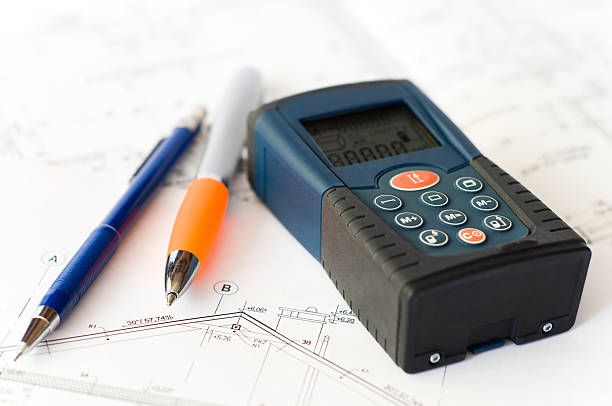
Laser distance meter typically achieve millimeter-level accuracy indoors, but errors immediately appear when used on a blazing construction site. The root of the issue lies deep within the physical and optical mechanisms operating inside the device.
1. Thermal Refraction in the Air Layer Near the Ground
When measuring on concrete or asphalt surfaces under direct sunlight, the thin layer of air right above the ground is heated, creating continuous temperature differentials. The laser beam is forced to travel through these media with inhomogeneous refractive indices, leading to the bending of the optical transmission path.
The path of light is no longer an absolute straight line, causing the feedback angle returning to the sensor to experience coordinate phase shifts. Consequently, the value displayed on the screen accumulates virtual errors that the naked eye cannot detect.
2. Charge Saturation at the Optical Sensor
The optical sensor (photodiode) on the meter must process extremely weak reflection signals from the target. When operating outdoors, infrared radiation from sunlight floods the receiving lens, completely overpowering the amplitude of the returning laser pulse.
Photon saturation occurs when the optical filter cannot completely separate the laser wavelength from high-intensity stray light. The microprocessor misidentifies the background noise as pulse signals, resulting in random number jumps or distance error reports.
3. Reduction of Diffuse Reflection Based on Angle of Incidence
Most construction materials reflect light diffusely according to the law of light distribution. When technicians hold the meter outdoors and tilt the sighting angle away from the perpendicular plane (90 degrees) relative to the object, the returning photon energy decreases exponentially.
At distances over 30 meters under bright sunlight, the feedback energy is insufficient to trigger the threshold of the circuit board, forcing the device to estimate the signal using interpolation algorithms and inducing systematic errors.
4. Temperature-Induced Variations in the Laser Diode Power Supply Current
The power control boards of laser diodes are highly sensitive to the housing temperature when exposed to sunlight for prolonged periods. Elevated ambient temperatures alter the junction resistance and the actual luminescence wavelength of the diode.
This wavelength shift distorts the refraction angle through the collimating lens system inside the device body. The emitted laser beam spreads out at its center (beam divergence), reducing the energy density over the target spot area.
5. Optical Vibration and Lack of Reference Support Points
Long outdoor distances require absolute steadiness of the handheld device. Unlike indoor environments with walls or ceilings serving as reference benchmarks, open outdoor spaces eliminate the operator's visual support points.
Small amplitude vibrations in the wrist are magnified multiple times through the optical focus, causing the laser spot on the target to sweep back and forth over an area instead of fixing on a single center point. The device continuously measures fluctuating distances in a split second and returns a skewed average value.
Outdoor errors in laser distance meters stem from a combination of optical, thermodynamic, and physical operational factors. Clearly identifying these mechanisms enables technicians to adjust their measurement techniques and enhance the reliability of the device on construction sites.