An adjustable DC power supply is best selected by first matching its controllable output voltage and current to the device or test being performed. Protection functions and compatibility with the existing measurement or test system are equally important for reliable day-to-day work.
For laboratory, educational, industrial R&D, and electronics testing tasks, the practical goal is stable, controllable power that can be set accurately and incorporated into the workflow with minimal manual error.
Summary: Match voltage and current capability to the application. Check over-voltage, over-current, and over-temperature protection. Confirm required communication interfaces before selecting a unit.
What should an adjustable DC power supply output match?
The supply’s output voltage range and current limit should match the specific power requirements of the application. This lets the user set an appropriate operating point rather than relying on an output that is too limited or unnecessarily broad for the task.
Fine voltage and current adjustment is particularly relevant when testing sensitive electronic components or conducting detailed research. The source material also identifies output stability and low ripple as useful characteristics when a test needs steady, clean DC power.
| Selection point | Why it matters in testing |
|---|---|
| Output voltage range | It needs to cover the voltage required by the application. |
| Current limit | It needs to support the application’s current demand while allowing controlled settings. |
| Voltage and current adjustment | It helps users target precise operating points during testing. |
| Output stability and ripple | These characteristics matter when supplying sensitive electronics. |
Why are protection functions important in a DC power supply?
Protection functions help limit the effect of unexpected electrical conditions on connected equipment. The relevant safeguards named in the source are over-voltage, over-current, and over-temperature protection.
In a setting with frequent tests, power-related faults can interrupt work and potentially affect sensitive instruments. A supply with appropriate protections can therefore support safer operation and reduce avoidable downtime during extended test cycles.
Which protection functions should be checked before selection?
Check whether the unit provides protection against voltage, current, and temperature conditions that could exceed the intended operating limits. The protections should be considered alongside the needs of the connected device and the planned test procedure.
- Over-voltage protection: relevant when an excessive output voltage could affect the load.
- Over-current protection: relevant when current must be limited for the connected equipment.
- Over-temperature protection: relevant for managing abnormal thermal conditions in the power supply.
Note: Protection requirements depend on the equipment being powered and the conditions of the test. Confirm the available functions and their operation for the specific power supply under consideration.
When do communication interfaces matter for an adjustable DC power supply?
Communication interfaces matter when the supply must work with measurement instruments, automated test benches, or a system that records and manages test data. They can reduce manual intervention by allowing settings and readings to be logged, adjusted remotely, or synchronized with other devices.
The source identifies RS-232, RS-485, USB, and LAN as common interface types that may support integration in different testing configurations. Required interfaces should be confirmed against the existing equipment before a purchasing decision is made.
How can interface compatibility improve a testing workflow?
Interface compatibility can make an adjustable DC power supply easier to incorporate into an established laboratory or production test process. Where supported by the supply and the surrounding system, it enables coordinated control and data handling instead of repeated manual adjustment.
This can be useful in automated testing environments as well as in applications that require settings and readings to be recorded. Compatibility is not determined by the interface name alone; the supply and the instruments or test bench must be able to operate together.
What other practical factors affect DC power supply selection?
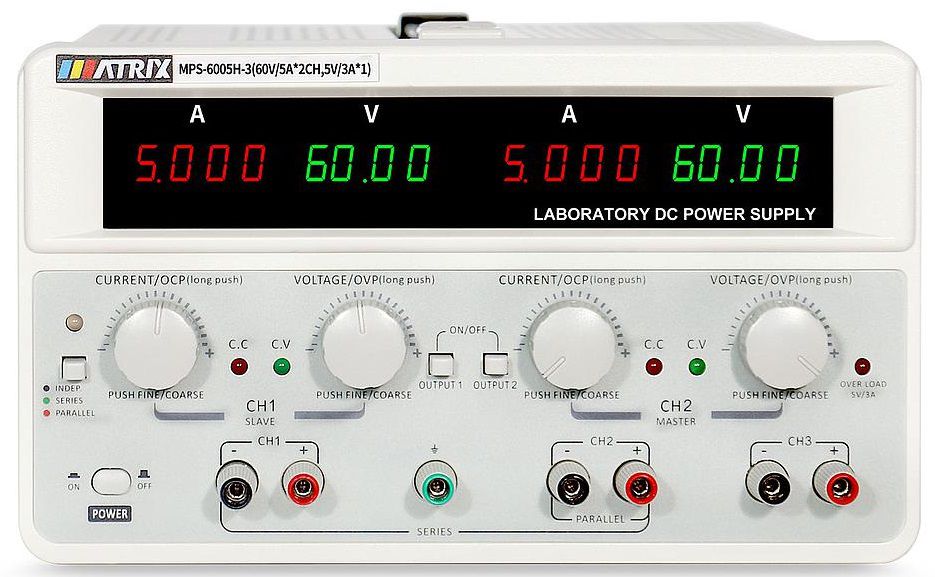
User operation and the physical working environment also affect the suitability of a unit. The source notes that a user-friendly interface can support rapid resetting and parameter adjustment, while compact form and quiet operation can be useful in professional workspaces.
These points do not replace checking electrical requirements and protections. They help determine whether the power supply will be practical to use consistently within a laboratory, educational, or industrial testing routine.
What is a practical checklist for choosing an adjustable DC power supply?
Laboratory DC Power Supply selection starts with the test requirement, then verifies safety and system integration. This order keeps the decision focused on the application rather than on features that may not be needed.
- Identify the required output voltage and current for the intended device or test.
- Assess whether precise voltage and current control, stable output, and low ripple are relevant to the work.
- Check the needed over-voltage, over-current, and over-temperature protections.
- Confirm whether RS-232, RS-485, USB, LAN, or another existing system interface is required.
- Consider operating convenience, including parameter adjustment, workspace constraints, and noise expectations.