
Wire coating thickness gauge is measured non-destructively by first zeroing a suitable gauge on bare wire, then taking readings on coated wire of the same substrate type and diameter. This approach helps monitor coating variation without stripping or damaging the part.
The probe selection must match the wire material, diameter, coating type, and access conditions. Consistent positioning is especially important because wire is a small-diameter substrate.
Why should coating thickness be measured on wire?
Coating thickness should be measured because protective and corrosion-control coatings commonly have an allowable thickness range. Coatings that are too thin or too thick can contribute to premature failure, while variation can also affect quality control and coating costs.
Small-wire coating processes have several variables that can change the final thickness. In powder coating, for example, preheat temperature and time, dipping time, and post-heat temperature and time all influence the result.
Which wire coatings may require thickness inspection?
Thickness inspection can apply to many coatings used to protect wire from wear, damage, or corrosion. Examples in the supplied material include chrome, porcelain, galvanizing, aluminum, epoxy, polyester, polyethylene, polyvinyl chloride (PVC), and paint.
- Galvanizing is used on chain-link fencing, where zinc coating thickness and consistency affect corrosion protection.
- Epoxy is used on steel reinforcing bars, wire mesh, and dowel bars; the cited common specification range is 7 to 12 mils (175 to 300 microns).
- Polyester or nylon coatings are used on items such as dishwasher baskets, shopping carts, and bicycle racks.
- PVC coatings are used on applications including bicycle racks, dishwasher baskets, refrigerator racks, freezer baskets, and fencing wire.
How do you measure a coated ferrous wire?
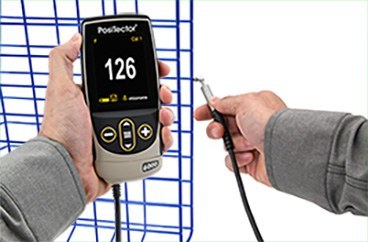
For ferrous wire, the PosiTector 6000 F Microprobe series is described as a non-destructive option for measuring most coatings on ferrous wires as small as 80 mils in diameter (14 gauge). The stated maximum coating thickness is 45 mils (1150 microns).
For a measurement sequence, the instrument is zeroed on a bare wire as a calibration adjustment. Measurements can then be taken on coated parts with a similar substrate and diameter, so the bare reference wire should match the inspection condition as closely as practical.
How can repeatability be improved on small-diameter wire?
Repeatability can be improved by controlling probe alignment and part positioning. A quick-release adaptor with a V-groove is intended to align the ferrous microprobe on small diameters and convert it into a constant-pressure probe.
A probe fixture stand can further support repeatable placement of each wire sample. Where access is limited, 45- and 90-degree microprobes are available for awkward or hard-to-reach locations.
What should be used for non-ferrous wire?
PosiTector 6000 N Microprobes are identified for measurement on slightly larger-diameter non-ferrous, non-steel wires. The choice between a ferrous and non-ferrous microprobe should therefore follow the wire substrate as well as its diameter.
Applicable PosiTector 6000 models can permanently store calibration adjustments, potentially one for each wire substrate and diameter. This can simplify repeat inspections where multiple wire types are checked regularly.
When is PosiPen a practical alternative?
PosiPen is a mechanical gauge presented as a cost-effective alternative with similar measurement capability but lower accuracy and resolution. Its stated advantage is direct measurement on hot applications without damaging the probe.
This makes the trade-off clear: select a mechanical gauge when its operating characteristic suits the application, while recognizing that its accuracy and resolution are lower than the referenced microprobe solution.
How can thickness readings support process control?
Advanced PosiTector 6000 models, identified by a “3” in the model name, can continuously update the number of readings, average, standard deviation, minimum, and maximum during measurement. These values help an operator observe variation while inspecting a production run.
The HiLo feature permits high and low limits and provides audible and visual alerts when a reading exceeds those limits. The supplied data also states that up to 100,000 readings can be stored in as many as 1,000 batches for later analysis.
Which standards may be relevant to coated-wire inspection?
Relevant requirements depend on the wire product and coating system. The supplied standards list includes ASTM A392 for zinc-coated steel chain-link fence fabric, ASTM A641/A641M for zinc-coated carbon steel wire, ASTM A775/A775M for epoxy-coated reinforcing bars, ASTM A884/A884M for epoxy-coated steel wire, and ASTM F668 for PVC and other organic polymer-coated chain-link fence fabric.
Some standards rely on coating weight for thickness measurement. A coating thickness gauge can be used for spot inspection where monitoring coating variation is required, but the applicable specification should determine the acceptance method and limits.




