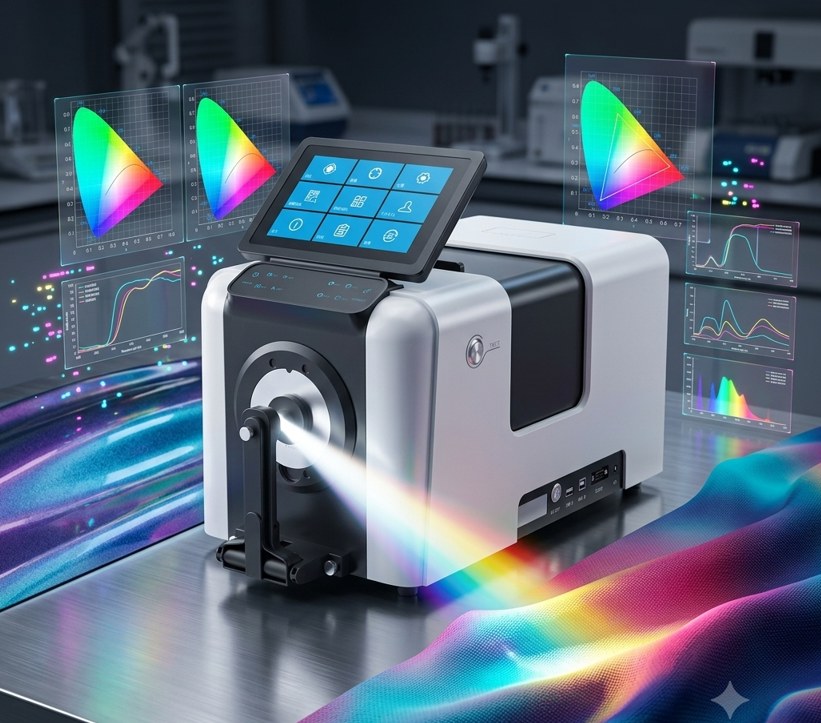
Color is a critical part of how products are evaluated, from a vehicle’s painted panels to the shade of a textile, beverage, package, or cosmetic. Yet visual assessment alone can vary with lighting conditions, observer experience, fatigue, and surrounding colors. Colorimeter support a more consistent process by converting color appearance into measurable data that teams can compare, communicate, and track.
For industrial automation and quality-control environments, this measurement-based approach can help establish clearer acceptance criteria between incoming materials, production batches, reference samples, and finished goods. The appropriate workflow depends on the product surface, material, and color effect being evaluated.
How colorimeters express color differences
Color measurement commonly uses the CIE L*a*b* color space. In this system, L* describes lightness on a scale from black to white, while a* represents the red–green direction and b* represents the yellow–blue direction. These coordinates provide a practical way to record the color of a sample as numerical values.
A colorimeter can also compare two measured colors and calculate a total color difference, often expressed as ΔE. This gives quality teams a shared numerical basis for evaluating how closely a sample matches a target. The acceptable ΔE range is not universal: it should reflect the application, material, visual requirements, and the organization’s inspection process.
Colorimeter applications across industries
Automotive finishes and interior materials
Automotive assemblies bring together metal body panels, bumpers, mirror housings, and interior components that may use different materials and surface textures. Measuring color helps teams evaluate whether these parts present a coordinated appearance after assembly.
Metallic, pearlescent, and other angle-dependent coatings add complexity because their appearance can change with viewing angle. Multi-angle measurement is used for such finishes to assess color alongside visual characteristics such as sparkle and graininess. Interior applications can also involve leather, fabrics, and PVC panels, where texture affects reflected light and must be considered during evaluation.
Textiles and apparel
Textile production can experience variation between natural fibers, dyed yarns, processed fabrics, and finished garments. Recording L*a*b* values provides a digital color reference that can be shared between design, production, and quality teams rather than relying only on physical swatches.
Color measurement can also support fabric durability assessments. By comparing ΔE values before and after exposure scenarios such as washing, sunlight, fluorescent lighting, or sweat-stain testing, teams can document color change during their evaluation process.
Plastics and consumer electronics
Consumer products often combine plastic, glass, and anodized aluminum in one design. A phone, for example, may include a metal frame, glass back, and injection-molded plastic elements. Measuring each component helps manufacturers evaluate visual color consistency across different materials.
In plastics processing, color checks can begin with pellets or powders and continue through molded parts. The source data identifies PET, PE, PP, and ABS as examples of plastic materials where color fluctuations may be monitored. This creates an opportunity to identify variation before it affects larger production quantities.
Food and beverage quality checks
In food and beverage applications, color can influence judgments about freshness, ripeness, baking level, and overall sensory quality. Meat processors may use the a* value to evaluate redness in beef and pork. For liquids with light transmission, including juices, wines, and beer, transmission color measurement can be used to monitor color stability and clarity.
Hygiene requirements are especially important in this sector. Depending on the measurement setup, vertical or non-contact approaches can help measure a sample without direct contact with the food surface.
Coatings, paints, and architectural finishes
Paint color meter require repeatable matching of a sample to a requested color. L*a*b* data can provide a measurable starting point for color-matching processes and for communication between the customer-facing, formulation, and production stages.
For exterior coatings, periodic measurements can document color change after exposure to conditions such as UV radiation and acid rain. Tracking ΔE over time gives research and quality teams a way to observe trends when assessing weathering behavior.
Cosmetics, printing, and packaging
Powder and paste cosmetics, including eyeshadow, pressed powder, lipstick, and liquid foundation, may require careful measurement because contact can disturb the sample or contaminate the instrument lens. Non-contact spectrophotometric measurement is used where maintaining distance from the sample is important. Color measurement may also support skin-tone matching for foundation selection.
In printing and packaging, colorimeters and printing spectrophotometers help teams compare spot colors and CMYK output on packaging films, paper labels, and gravure inks. Automated multi-point scanning can support the review of color variation across a printed area and across production batches.
Building a practical color-control process
A useful color-control program starts by defining the reference sample, measurement conditions, material type, and acceptance criteria. Teams can then measure consistently at relevant points, such as incoming inspection, in-process checks, and final inspection. Comparing results to the same target helps transform subjective visual discussions into documented production data.
Across automotive, textiles, plastics, food, coatings, cosmetics, and printing, color matching machine provide a structured way to manage visual consistency. By selecting a measurement approach suited to the product and surface, organizations can use color data to support clearer quality decisions throughout the workflow.