The short answer is: it is not certain. Many multimeters can still provide normal readings at this current level. However, the accuracy of the result depends on the measurement range, resolution, background noise, and your circuit's operation. If you simply need to know the standby current in microamperes (µA), a DMM is usually sufficient. But if you need to monitor a current that changes continuously over time, the situation is different.
Can a multimeter measure currents in the range of a few microamperes (µA)?
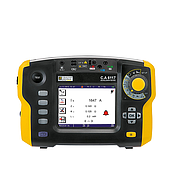
Consider a circuit board that consumes approximately 8 µA in standby mode. This level is well within the measurement capabilities of many devices; some high-end digital multimeters (DMMs) feature µA or mA ranges with sufficient resolution to clearly display such a value. You simply connect the meter in series with the circuit, power it up, and take the reading.
However, the real challenge lies elsewhere: actual current consumption is rarely static. A board might draw 8 µA while idle, spike to 20 µA during data processing, and then drop back to just a few microamperes. Some devices may sleep for several seconds, wake up instantly to perform a task, and then return to sleep. In such cases, a single reading on the DMM display fails to capture the full picture of the circuit's power consumption.
When can DMM still meet the requirements?
If your goal is simply a quick check such as seeing whether a board draws 5, 10, or 50 µA—a standard DMM works fine. When selecting a device, however, you should pay attention to a few key factors:
+ The lowest current measurement range supported
+ Resolution within the µA range
+ The measurement's noise floor
+ The burden voltage introduced when the meter is connected to the circuit
+ The stability of the readings while the circuit is operating
It is worth elaborating on "burden voltage," as this factor is often overlooked. Connecting a meter in series with a circuit means the meter itself introduces resistance, which causes a voltage drop. This drop can sometimes be significant enough to alter the operating conditions of the circuit being tested. This explains why two different meters might yield different results when measuring the same circuit, even though both are technically "accurate" according to their own specifications.
Why is measuring currents in the range of a few microamperes on a circuit board more difficult than imagined?
The displayed figure represents only a single moment, not the whole story. A reading of 6 µA does not mean the current remains constant at that level; the MCU, sensors, and communication modules each have their own operating cycles, causing the current to fluctuate—pulsing from a few microamperes up to several tens of microamperes.
For battery-powered IoT devices, this distinction is far more significant than it might appear. A measurement taken over just a few seconds might show a reassuringly low standby current. However, continuous recording over several hours reveals sporadic wake-up events and brief current spikes that a momentary measurement would miss.
When should you switch to a specialized low-current meter?
The dividing line depends on the question you are asking. If the question is simply "what is the current in µA?", a standard DMM is sufficient. However, when the question shifts to "how does this board consume current throughout its entire operation?", a different type of tool is required.
Here are a few common scenarios:
- Measuring the sleep current of an IoT chip, requiring clear differentiation between Sleep, Deep Sleep, and the MCU wake-up phase
- Checking for leakage current, where consumption levels are in the µA, nA, or even lower ranges
- Evaluating actual battery life, which requires continuous data logging rather than a single, one-off measurement
- Component testing, involving the monitoring of minute current fluctuations as voltage or operating conditions change
- R&D applications requiring high resolution, low noise floors, and PC connectivity for data logging
For these types of requirements, instruments such as picoammeters, electrometers, or SMUs (Source Measure Units) far outperform standard DMMs. Some models can even power the circuit while simultaneously measuring current and voltage and logging data for later analysis.
Does seeing a µA reading mean you have to buy a separate meter?
Not necessarily. The deciding factor isn't the unit of measurement itself, but rather the measurement range and characteristics you require. Simply seeing "µA" and rushing out to buy a picoammeter would be a bit hasty.
So, if you need to measure currents in the range of a few microamperes (µA), where should you start?
Before purchasing equipment, answer three questions: what is the expected minimum current, what is the maximum current that might occur, and is the current stable or does it fluctuate over time?
For example, a circuit expected to draw 5 to 10 µA in sleep mode but occasionally spiking to 100 µA upon waking requires different equipment than a circuit that maintains a steady 5 µA throughout.
Read more:
Measuring the circuit board's current consumption in standby mode
Is the current too low for a standard meter to measure?
Only after answering those three questions can you determine whether a DMM suffices or if you need to upgrade to a picoammeter, electrometer, or SMU. If you need to do more than just read a µA value such as monitoring consumption patterns, measuring leakage current, or recording current fluctuations over time EMIN offers a range of low-level current and voltage source/measurement instruments to help you select the right device for your specific application.