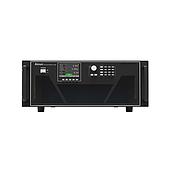
Electronic load testers for EV testing simulate changing electrical demand in a controlled laboratory environment. They can reproduce conditions associated with acceleration, steady cruising, regenerative braking, and stop-and-go traffic so engineers can evaluate electrical systems before or alongside road testing.
For new energy vehicles, this approach supports testing of battery packs, power electronics, charging systems, and battery management systems under repeatable load profiles rather than a single fixed operating point.
Summary: Electronic loads apply programmable electrical demand to EV systems. CC, CV, CP, and CR modes support different operating conditions. Bidirectional capability is relevant when simulating regenerative energy flow. Laboratory tests provide controlled, repeatable data for analysis.
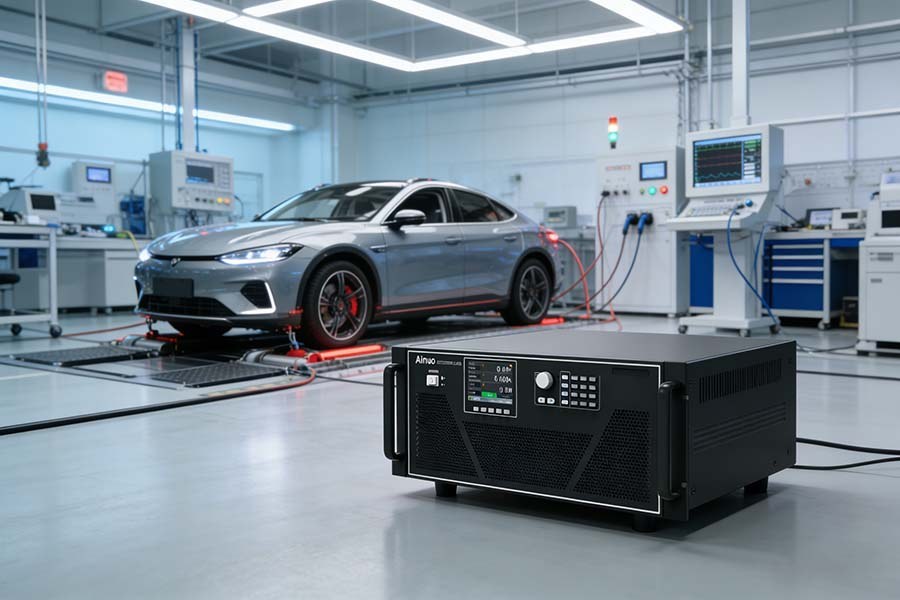
What is an electronic load tester in EV testing?
An electronic load tester is a device that simulates an electrical load on a power source. Unlike a conventional resistive load, it can be programmed to change its behavior over time and follow dynamic test conditions.
In EV and other new energy vehicle applications, it can be used to test battery cells and packs, evaluate inverters and DC-DC converters, validate charging systems, and represent vehicle energy-consumption patterns.
| Operating mode | How it is used in a test |
|---|---|
| Constant current (CC) | Maintains a specified current demand. |
| Constant voltage (CV) | Maintains a specified voltage condition. |
| Constant power (CP) | Maintains a specified power demand. |
| Constant resistance (CR) | Behaves as a specified resistance. |
Why is real-driving simulation important for EV electrical systems?
Vehicle energy demand is not constant in real operation. Acceleration, deceleration, road gradients, traffic stops, and energy recovery during braking create changing electrical conditions that a fixed load may not reveal.
Dynamic simulation helps engineers examine peak-load conditions, transient behavior, thermal behavior, efficiency, and battery degradation patterns under a defined profile. The controlled setting also makes the same test condition easier to repeat for comparison and debugging.
How can an electronic load tester reproduce acceleration and cruising?
Acceleration can be represented by a dynamic current profile that increases load demand rapidly for a short period. This reflects the sudden power request placed on the battery when the driver accelerates.
For steady cruising, a tester can use constant-power or constant-current operation to create a stable demand. These tests provide a controlled baseline for observing system behavior during sustained operation.
Can an electronic load tester simulate regenerative braking?
A load with bidirectional capability can support regenerative-braking simulation by feeding energy back into the system. This is relevant because regenerative braking converts vehicle kinetic energy into electrical energy for storage in the battery.
Bidirectional operation is an advanced capability, so regenerative tests depend on the configuration and capability of the specific test system. It is not a function that should be assumed for every electronic load.
How are stop-and-go driving and standardized driving cycles simulated?
Programmable load profiles can reproduce the frequent changes in demand associated with urban stop-and-go driving. These transitions are useful for examining transient behavior that may not appear during steady operation.
Standardized cycles such as WLTP, NEDC, and FTP-75 define speed-versus-time profiles. Using a vehicle model, engineers can convert those speed profiles into torque and power requirements, then translate the resulting demand into current or power commands for the electronic load.
- Convert driving-cycle data into torque and power requirements.
- Generate a load profile from the calculated demand.
- Program the profile into the electronic load control system.
- Run the test while the load adjusts to match the profile.
- Record voltage, current, temperature, and efficiency data for analysis.
Which EV components can be evaluated with electronic load testing?
Electronic load testing can be applied across several electrical subsystems, with the test profile tailored to the component and evaluation objective.
| Component or system | Examples of evaluation areas |
|---|---|
| Battery cells and packs | Capacity, energy density, charge/discharge efficiency, thermal behavior, aging, and degradation. |
| Inverters, converters, and onboard chargers | Transient response, efficiency mapping, and fault-condition simulation. |
| Charging systems | Different charging rates, grid fluctuations, and battery acceptance behavior. |
| Battery management system (BMS) | State-of-charge algorithms, state-of-health estimation, and protection mechanisms. |
What are the main benefits of laboratory-based EV load simulation?
The key benefit is repeatability: the laboratory can run the same profile under the same conditions, supporting direct comparison between designs or test iterations. A controlled setup also enables detailed adjustment of test parameters and data collection.
Laboratory simulation can support safer assessment of overload or short-circuit scenarios than uncontrolled testing. It may also reduce the need for extensive road testing and allow long-duration usage patterns to be represented in a shorter development timeframe.
What should engineers consider when setting up high-power EV load tests?
High-power EV testing may require equipment capable of handling hundreds of kilowatts, along with robust and scalable system design. The test setup must also address thermal management because high-power operation generates significant heat.
Electronic loads may be combined with thermal chambers, control systems, simulators, software platforms, or hardware-in-the-loop systems. Coordinating those elements carefully is important when the goal is to represent both electrical behavior and a broader vehicle test environment.
Note: Electronic loads do not directly reproduce temperature, road conditions, or driving habits. They can, however, be integrated with thermal chambers and control systems as part of a broader test setup.