A Rogowski current probe measures changing current with a coil that surrounds the conductor. The coil initially produces a voltage proportional to the rate at which the enclosed current changes; integrating that voltage produces an output proportional to the current signal.
For small-impedance measurement work, this operating principle is the key distinction to understand. A Rogowski probe does not provide DC measurement because a changing-current signal is required.
Summary: A Rogowski coil responds to the derivative of enclosed current. Its coil voltage must be integrated to represent current. It cannot operate at DC, but it can operate to a lower frequency than most AC clamp-on current probes.
What is a Rogowski current probe?
A Rogowski current probe is a current probe based on a Rogowski coil loop placed around a conductor. The coil produces a voltage that is proportional to the rate of change of the current enclosed by that loop.
This means the coil output is not initially a direct representation of current itself. It represents how the current is changing, so an additional integration step is needed before the probe output is proportional to the current signal.
Why does a Rogowski coil need integration?
Integration is required because the coil voltage is proportional to the derivative of current rather than to current directly. Integrating the coil voltage converts that derivative-related signal into an output voltage proportional to the measured current.
When evaluating a Rogowski current probe in a measurement setup, it is therefore important to distinguish between the raw coil behavior and the integrated probe output. The source describes the integrated output as the form that represents the current signal.
Can a Rogowski current probe measure DC?
No. A Rogowski current probe cannot perform at DC because its coil responds to changing current. With no change in current, the derivative-based coil response does not provide the current-proportional output described for an integrated signal.
This limitation follows directly from the operating principle, not from a stated performance specification for one individual model. DC requirements should therefore be considered separately from measurements involving changing current.
How does a Rogowski probe differ from an AC clamp-on current probe?
The source identifies the Rogowski probe's ability to operate to a frequency lower than most AC clamp-on current probes. At the same time, it states that the Rogowski probe cannot operate at DC.
The practical distinction is therefore not simply whether a probe clamps around a conductor. It is the relationship between its coil output, the required integration, and the current conditions the measurement must cover.
Which current probe models are included in the source comparison?
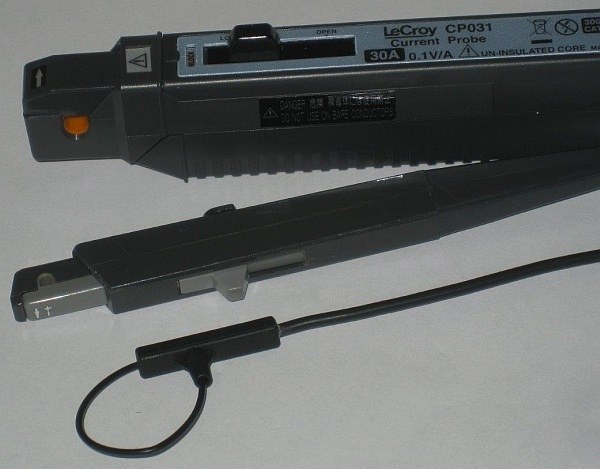
The source comparison names three clamp-on current probe models: PEM CWT015, Tektronix P6022, and Teledyne Lecroy CP031. It says the comparison highlights key performance attributes, but no individual numerical values or attribute results are provided in the available material.
| Model | How it is identified in the available source |
|---|---|
| PEM CWT015 | Current probe included in the three-probe comparison |
| Tektronix P6022 | Current probe included in the three-probe comparison |
| Teledyne Lecroy CP031 | Current probe included in the three-probe comparison |
What should be checked before using a Rogowski probe for a small-impedance measurement?
First, confirm that the current of interest is changing rather than DC. A Rogowski probe's stated principle depends on the rate of change of enclosed current, and its coil voltage must be integrated to obtain an output proportional to current.
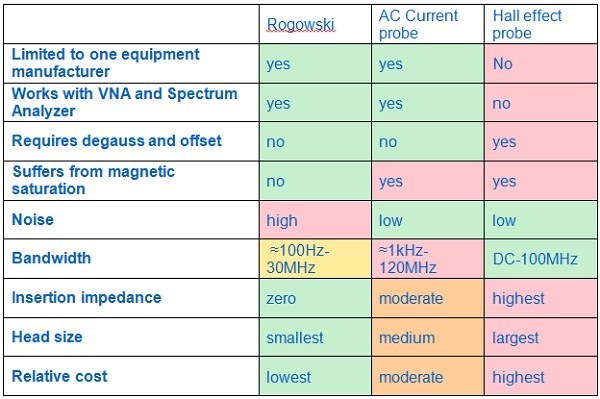
Second, compare the required measurement frequency range with the probe behavior described for the application. The source states that a Rogowski probe can operate to a lower frequency than most AC clamp-on current probes, while still not operating at DC.