Lethal hazards often do not appear suddenly; instead, they frequently develop through a gradual, long-term process. Insulation degrades as equipment ages, minor leakage points emerge, system characteristics shift over time, or silent sources of interference such as electrical noise creep in and affect the machinery.
Initially, these signs may not be severe enough to trigger an immediate production line shutdown; however, with the right measurement techniques, they can certainly be detected at an early stage.
The challenge lies in the fact that different areas of the plant present unique scenarios ranging from 1,500 V DC solar power systems, medium-voltage cabinets, and high-capacity motors to substations and hazardous zones prone to fire or explosion. Each requires specific measurement and predictive approaches; a "one-size-fits-all" formula simply does not work. Consequently, periodic data collection plays a crucial role: it enables the early detection of anomalies, allowing for proactive maintenance planning rather than waiting for a breakdown to occur before investigating the cause.
Warning signs that may appear before a malfunction occurs
Partial discharge can originate from a very small defect
The insulation within medium-voltage switchgear, transformers, and power cables is subjected to high electric field stress over extended periods. Over time, factors such as air voids, impurities, cracks, or areas of material degradation can develop, creating points of localized electric field concentration.
At these locations, ionization occurs, generating small energy pulses. A single discharge event may not cause immediate failure; however, if the phenomenon repeats over a prolonged period, the insulating material gradually degrades and weakens.
It is important to note that the signals emitted by this phenomenon typically fall within the ultrasonic range or manifest as electromagnetic signals, lying beyond the range of human sight and hearing. Consequently, by the time insulation breakdown and arcing occur, the situation has usually escalated to a much more critical level.
The Fluke ii900 and Fluke ii910 address this issue by using a microphone array to capture high-frequency sound signals and displaying the signal source directly on the screen. This allows engineers to scan the target area from a safe distance and quickly pinpoint locations requiring further assessment.
In addition to detecting compressed air leaks, the Fluke ii Series also supports the detection of discharge phenomena such as corona and partial discharge, depending on the specific application and measurement requirements.
1,500 V direct current can sustain an arc longer than alternating current
Large-scale solar power projects often employ high DC voltages to reduce current and minimize transmission losses. While the 1,500 V DC level offers significant design and transmission advantages, it necessitates more rigorous safety testing procedures compared to low-voltage systems.
Unlike AC, which features a periodic zero-crossing point allowing an arc a chance to extinguish as the current drops to zero (though actual extinction depends on various factors) DC lacks this characteristic. Consequently, once an arc ignites in a high-voltage DC circuit, it tends to persist, generating intense heat and making the situation far more hazardous to manage.
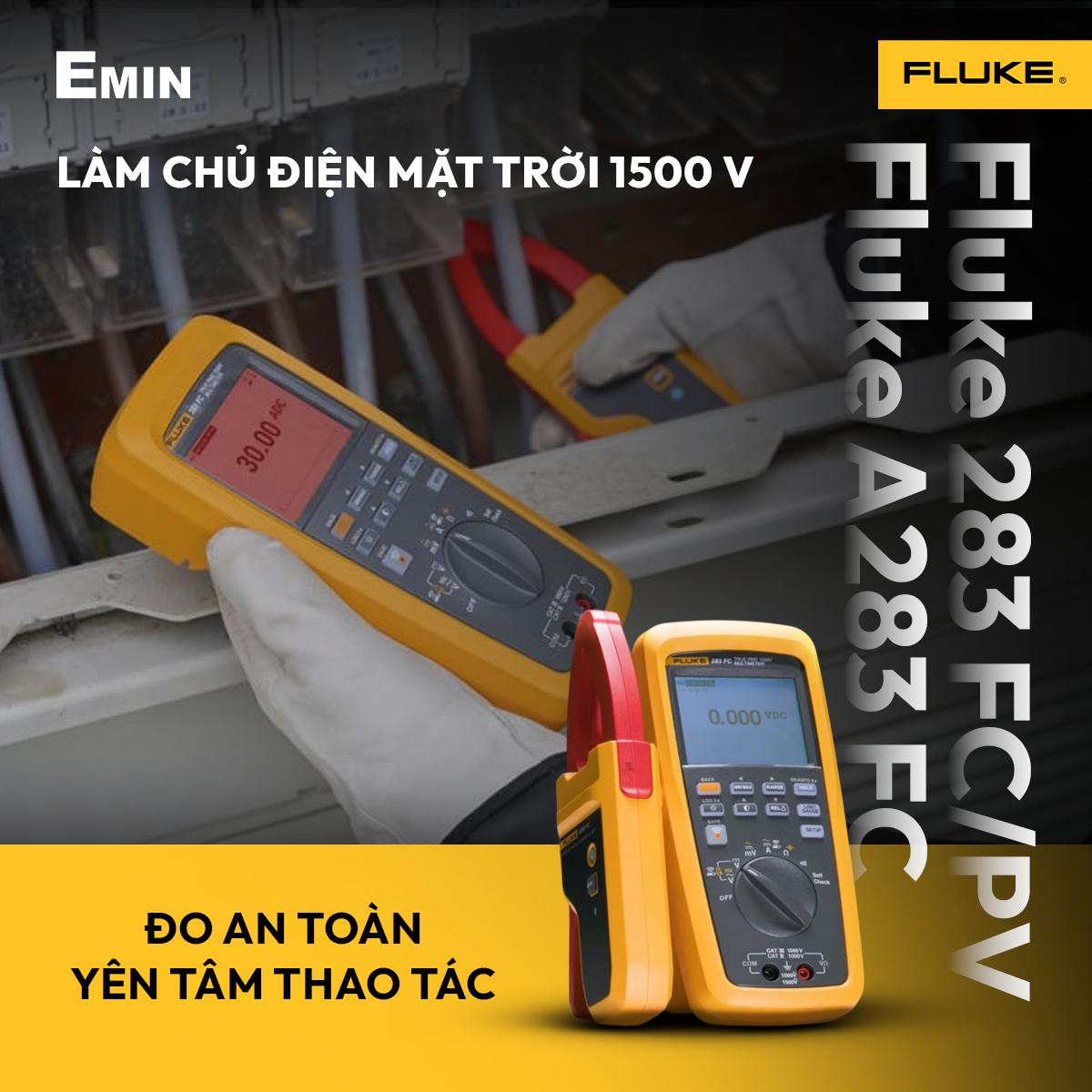
To meet testing requirements in this context, the Fluke 283 FC, paired with the A283 FC probe, enables DC voltage measurements up to 1500 V and AC/DC current measurements up to 60 A. Its clamp-style design allows technicians to take measurements without needing to insert conductors directly into the main unit. /fluke-283-fc-thiet-lap-chuan-an-toan-moi-cho-he-thong-solar-1500v-1415/ne.html
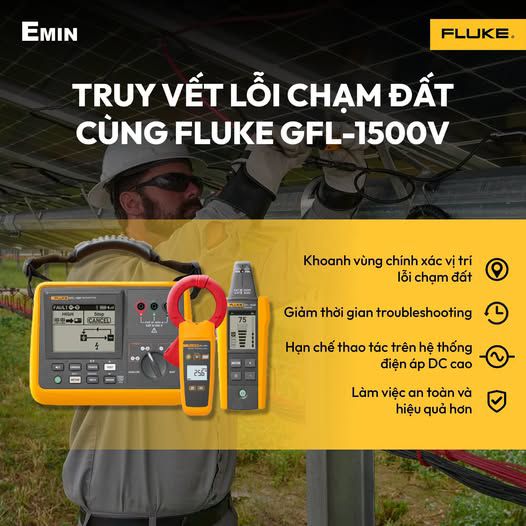
Additionally, the Fluke GFL-1500V was specifically developed to locate ground faults in high-voltage solar power systems, enabling rapid fault identification and significantly reducing the time required for manual troubleshooting across individual PV strings.
Finally, the Fluke T6 1000 PRO utilizes FieldSense technology, allowing for AC voltage and current measurements without requiring direct contact between test leads and live conductors in compatible applications.

How does insulation deteriorate?
Motors, transformers, and power cables are subjected to prolonged exposure to heat, humidity, vibration, and voltage surges, which can cause gradual insulation degradation even in the absence of visible external anomalies.
In this context, the decline in insulation resistance over time serves as a critical indicator. Comparing results across multiple measurements allows for the early detection of degradation trends before short circuits or phase-to-ground faults occur since a single reading rarely reflects the full state of the insulation; a series of measurements is required to clearly observe the rate and pattern of change.
To address these needs, the Fluke 1537 support high-voltage insulation resistance testing and include a residual voltage discharge function, while the Fluke 1587 FC combines a True RMS multimeter with an insulation tester, offering versatility for testing motors, cables, and electrical circuits.
Degraded grounding can affect the ability to discharge fault current
A grounding system must provide an appropriate path for fault currents and lightning surges; however, measured values can fluctuate over time due to corrosion, changes in soil moisture, mechanical impact, or structural modifications. Consequently, the measurement method must be selected based on the actual grounding configuration, as areas with complex grounding networks or locations unsuitable for driving ground rods present requirements vastly different from those of simple systems.
The Fluke 1625 2 KIT addresses these needs by offering the ability to measure both earth resistance and soil resistivity, alongside robust noise-filtering capabilities suited for demanding industrial environments.
Nevertheless, measurement results must be cross-referenced with design specifications and relevant technical requirements, as earth resistance values reflect only one aspect of the grounding system's condition. Factors such as conductor quality, connection points, and equipotential bonding are equally critical and must be evaluated in conjunction to provide a comprehensive overview of the system.
Abnormal heat usually appears first
Connectors, circuit breakers, busbars, or motor components can heat up due to poor contact, overloading, or imbalances; an abnormal temperature rise at any specific location is often a warning sign that warrants early investigation. In areas with explosion risks, measuring equipment must also comply with the specific hazardous area classifications and relevant safety standards.
The Fluke 568 Ex is specifically designed for such environments, holding certifications for hazardous areas while enabling remote temperature measurement of pipelines, tanks, and machinery assemblies without requiring close proximity to the heat source. This allows operators to monitor hotspots without opening cabinets or coming into direct contact with live, operating components.
What assessments are required for low-voltage electrical cabinets before energizing?
A new electrical system or a recently overhauled electrical panel requires the assessment of various parameters before being energized such as conductor continuity, insulation resistance, loop impedance, and the functionality of protective devices. The Fluke 1664 FC support a wide range of measurements for low-voltage electrical testing in accordance with IEC 61557 standards.
These measurements help identify wiring errors, issues with protective circuits, or non-compliant conditions before the electrical panel is put into service.
How should measurements be scheduled so as not to wait until an abnormality occurs?
A logical workflow typically begins with a broad, rapid survey, followed by in-depth assessment using specialized measurements for any areas showing signs of anomalies. The process can be structured as follows:
During the rapid survey phase, the Fluke ii900 or Fluke ii910 is used to detect compressed air leaks and signs of electrical discharge from a safe distance. This is followed by detailed testing using the Fluke 1535, Fluke 1537, Fluke 1587 FC, and Fluke 1625-2 KIT to evaluate insulation and grounding conditions.
Concurrently, measurements at high-voltage sources are performed using the Fluke 283 FC/PV, A283 FC, Fluke GFL 1500V, or Fluke T6-1000 PRO, depending on the specific configuration and requirements of each power source. Finally, data tracking serves to integrate the entire process: results must be recorded by device, location, and time, enabling the identification of clear trends across multiple surveys.
The value of a measurement solution lies not in the quantity of equipment deployed, but in its ability to accurately answer key technical questions: which machines show signs of degradation, where the issue is located, whether the level of change is concerning, and whether immediate action is required or the task can be scheduled for routine maintenance.
Measurement data provides a concrete basis for maintenance activities, replacing guesswork with reliable information. EMIN offers Fluke measurement solutions for a wide range of applications, including 1500V DC solar power systems, electrical cabinets, motors, power cables, grounding systems, and hazardous (potentially explosive) areas.