Selecting a photovoltaic EL detector starts with the inspection task, not with the longest specification list. A suitable system should align with the required defect visibility, available lighting conditions, mobility needs, and the way inspection records must be managed. This approach helps teams compare equipment based on practical use in photovoltaic module and string testing.
Start with the intended inspection scenario
Define where and how the detector will be used before comparing specifications. Outdoor power-station inspections may require flexible operation under changing light, while other work may focus on module-level or string-level measurements. The required inspection precision also matters: a workflow intended to identify subtle internal cracks or broken grid defects may call for different imaging capability than a general visual documentation task.
It is also useful to determine whether the team needs a portable device for frequent field movement or a setup that will remain in one inspection location. These requirements affect the value of device size, weight, accessories, and operating controls.
Evaluate imaging system specifications
The imaging system is central to a photovoltaic EL detector because it determines the detail available for review. The referenced CHNSpec equipment is described with imaging modules from 1.3 million to 5 million pixels and a maximum resolution of 2560×2048. These figures provide a starting point for comparing models when fine defect imaging is a priority.
Ambient-light handling should be reviewed alongside resolution. The source describes a hyperspectral filtering system intended to filter ambient-light interference. For field inspection, this is relevant because surrounding light conditions can vary. Rather than assessing resolution alone, consider the imaging system and light-management approach together in relation to the actual site environment.
Match detection modes to available light
Detection modes determine when and where an inspection system can be used. The referenced CHNSpec EL detectors support daytime EL, daytime PL, and nighttime EL modes. A combination of modes can be useful for teams that need to work across different lighting conditions instead of scheduling every inspection for nighttime operation.
Shutter adjustment is another consideration because it supports adaptation to the inspection environment. According to the supplied product information, nighttime EL shutter time is 15–100000us, while daytime EL and PL shutter time is 10–20000us. When comparing equipment, confirm that the available modes and adjustment range fit the planned workflow and the light conditions expected on site.
Consider portability and operation in the field
For mobile inspection, physical design can have a direct impact on usability. The referenced detector is stated to weigh less than 1 kg and measure 157mm×88.3mm×89.3mm, supporting one-hand carrying. These characteristics may be relevant when technicians need to move between arrays or perform repeated measurements outdoors.
The supplied information also describes operation through an 11.2-inch Android tablet, with automatic exposure, manual exposure adjustment, and overexposure prompts. Operational features should be assessed in light of the experience level of the inspection team. A system that provides both automatic and manual controls can support a more adaptable process when site conditions change.
Review traceability, endurance, and compatibility
Inspection data is more useful when it can be associated with the correct module and location. The referenced system supports barcode scanning or manual barcode entry, includes GPS positioning, and can export original images and annotated reports. These functions can help structure records for later review and traceability.
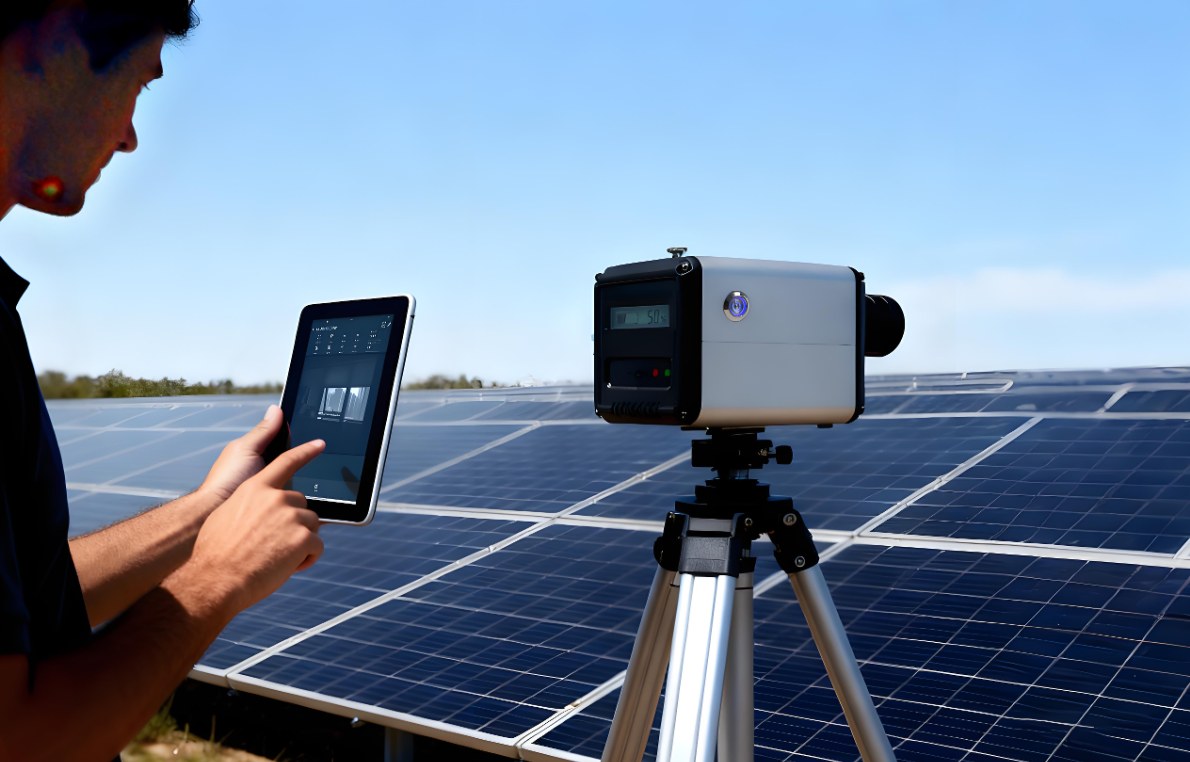
Finally, check power endurance and measurement compatibility against the work plan. The source states that a single charge supports extended outdoor operation and that the equipment is compatible with module and string measurements. Optional tripods, gimbals, and string controllers are also described. Choose only the configuration needed for the intended inspection scope, and prioritize a photovoltaic EL detector whose imaging, operating modes, portability, and data workflow fit that scope.