Wood coating thickness gauge can measured non-destructively with an ultrasonic coating thickness gage. The method measures the coating on the actual wood or wood-based part rather than relying on a separately coated metal coupon.
For total coating thickness, PosiTector 200 B1 is intended for common wood-finish applications. PosiTector 200 B3 adds measurement of up to three individual layers in a multilayer system, while PosiTector 200 C3 is intended for thicker polymer coatings.
What is dry film thickness measurement on wood?
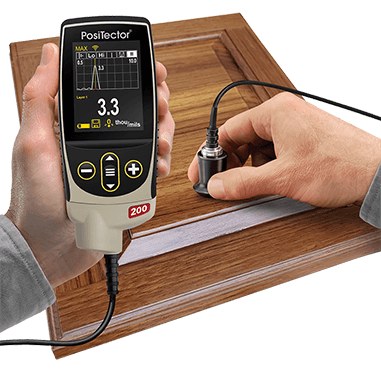
Dry film thickness measurement on wood determines the thickness of a cured coating film on a wood or wood-product surface. Ultrasonic measurement uses a probe and couplant to send a pulse into the coating and evaluate echoes returning from material interfaces.
This approach is applicable to coating films formed on the surface, including lacquer, primer, UV-cured coating, acrylic, powder coating, and other polymer coatings. It is non-destructive, so the finished part does not need to be cut for the measurement.
Why measure coating thickness directly on a wood part?
Direct measurement helps verify whether a finish is being applied within its required thickness range. Coatings applied too thickly can reduce efficiency, and regular checks can support process control, reduce rework, and help address finishing defects.
Magnetic and eddy-current thickness gages work on metal substrates, not wood. A coated metal coupon may be used as a substitute in some workflows, but it assumes that the coupon receives the same coating profile as the wood part; ultrasonic measurement instead evaluates the coated part itself.
Which PosiTector 200 model measures total coating thickness on wood?
PosiTector 200 B1 is designed for measuring the total thickness of a coating system when individual layer values are not required. Its stated measuring range is 13 to 1000 microns, or 0.5 to 40 mils, for most wood-finish applications.
Examples described for total-thickness measurement include lacquer on guitars, polymer-coated veneers and laminated composites, powder coating on MDF, and dry adhesive. Wet adhesive cannot be measured in this way because the probe must contact the material surface.
When is PosiTector 200 B3 the better choice for multilayer coatings?
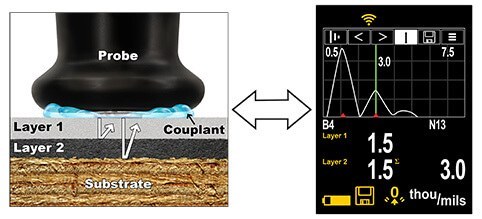
PosiTector 200 B3 is appropriate when both total system thickness and separate layer thicknesses are needed. It can measure up to three individual layers in a multilayer coating system and provides a graphic readout for coating-system analysis.
In graphics mode, peaks represent interfaces where the ultrasonic pulse encounters a change in material density. The display can help distinguish interfaces, while the user-adjustable measurement range can exclude echoes outside the selected limits.
Which model is used for thick polyester-based polymer coatings?
PosiTector 200 C3 is intended for thicker coating applications on wood-based materials such as MDF, plywood, chipboard, and particleboard. Its stated measuring range is 50 to 3800 microns, or 2 to 150 mils.
Graphics mode can also assist with evaluating thin primers or other layers that are difficult to distinguish automatically. A cursor can be positioned over a smaller echo peak for manual investigation.
How should rough wood coatings be measured?
Rough coating surfaces should be evaluated with several readings in the same general area and an average of the results. Surface texture can cause measured thickness to vary because the gage commonly measures from coating peaks to the substrate.
Severe roughness may produce low readings when an echo from the couplant/coating interface is stronger than the echo from the coating/substrate interface. The user-adjustable SET RANGE feature is described as a way to ignore roughness echoes, and memory mode can calculate a running average.
Can powder coating on MDF be measured ultrasonically?
Yes, powder coating on MDF is identified as a measurable application. MDF has a low-porosity, homogeneous surface, and the source describes typical single-coat MDF powder-coating thicknesses of 3 to 9 mils.
For textured powder-coated surfaces, using SET RANGE to ignore roughness echoes and reviewing averaged readings can provide more meaningful results. Memory functions can display statistics such as the number of readings, standard deviation, and high and low values.
What wood-related coatings cannot be measured reliably?
Coatings containing large solid particles, such as sand, may not be measured repeatably because the particles can deflect the ultrasonic vibration and prevent a clear echo from returning to the probe. This limits the ability to identify the coating-to-substrate interface.
Wood stains also cannot be measured ultrasonically because they penetrate into wood fibers rather than building a film on the surface. Ultrasonic coating thickness measurement is intended for surface films.
How is an ultrasonic wood-coating measurement taken?
A couplant is applied to the coated surface, then the probe is placed flat against it to initiate the measurement. Water can serve as couplant on smooth, horizontal surfaces, while glycol gel is described for rougher surfaces.
After the reading is taken, the probe and surface should be wiped clean with a tissue or soft cloth. Where finish compatibility is uncertain, testing the couplant on a sample surface first is a prudent step.
What affects the accuracy of ultrasonic coating thickness results?
Ultrasonic thickness results depend directly on the sound velocity of the finish being measured because the method measures pulse transit time. The source notes that sound-velocity values among common wood-industry coating materials generally do not vary greatly, so factory calibration usually needs no adjustment for most applications.
Coating roughness, unclear layer interfaces, and large particles can affect the returned echo and therefore the reading. Multiple readings, averaging, suitable couplant, and appropriate range settings are practical measures for obtaining meaningful results.