In ISO/IEC 17025-accredited food safety testing laboratories, sample preparation prior to chromatographic analysis (GC-MS/MS or LC-MS/MS) consistently accounts for the largest proportion of processing time. For complex analytical parameters, such as multi-residue pesticide analysis using the QuEChERS method or mycotoxin testing (Mycotoxins/Aflatoxins) in dried agricultural products, sample homogenization and solvent extraction require substantial mechanical force. Using conventional laboratory shakers can often result in solvent phase separation or incomplete extraction of target compounds.
To optimize recovery rates and minimize variations between analytical batches, laboratory technicians need to understand the key technical criteria when selecting a shaker.
Mechanical Requirements for QuEChERS and Mycotoxin Extraction
The QuEChERS extraction procedure (according to AOAC 2007.01 or EN 15662) requires vigorous mixing of finely ground food samples with an organic solvent (acetonitrile) and extraction salts (MgSO₄, NaAc). This process generates localized heat and requires intensive agitation to disrupt plant cell structures and release target compounds completely into the liquid phase.
When an orbital shaker with a small shaking diameter is used, the solution mainly follows a stable circular motion, generating insufficient shear force to break up agglomerated fine sample particles. Therefore, a reciprocating shaker with a large linear stroke or a high-performance orbital shaker is essential, depending on the extraction requirements. High-frequency reciprocating motion generates continuous mechanical impact along the length of 50 mL centrifuge tubes or extraction vessels, allowing the solvent to penetrate deeply into the solid sample matrix.
Equipment Specifications for Continuous Laboratory Operation
When selecting equipment for the sample preparation area of a testing laboratory, technical specifications should be evaluated based on the following practical criteria:
Shaking stroke and speed: For cereal powders, spices, or high-fiber vegetable samples, a reciprocating shaker should operate at 150–300 rpm with a stroke length of 20–30 mm. The motor should feature high torque and a reduction gearbox, together with microprocessor-based control to maintain stable speed even when the platform is operating at maximum load.
Models commonly available on the market that meet these requirements include the STUART SSL2 (20 mm reciprocating stroke, maximum load capacity of 10 kg, and digital microprocessor control) and the versatile J.P. SELECTA Rotabit, which can switch between orbital and reciprocating motion, with a speed range of 20–230 rpm.
Clamping system and platform versatility: Food testing laboratories typically handle various types of containers simultaneously, ranging from 50 mL Falcon tubes and centrifuge tubes to large-volume glass bottles. The shaker platform should feature a universal perforated platform combined with adjustable spring clamps or dedicated tube racks. This configuration securely holds dozens of tubes at once, effectively preventing hazardous solvent spills or splashes during high-speed operation.
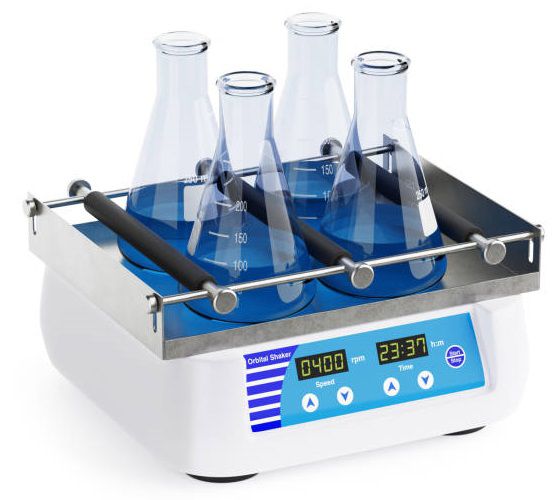
High-capacity orbital shakers, such as the Bluepard WSZ-20A (50–250 rpm) and Bluepard WSZ-50A (40–300 rpm), help maintain stable motion over several hours without excessive motor heating. Their platforms can accommodate universal perforated trays with adjustable spring clamps, securely holding dozens of extraction bottles or 50 mL Falcon tubes simultaneously and minimizing the risk of hazardous solvent splashes during high-speed operation.
Structural durability in solvent environments: Sample extraction areas are frequently exposed to volatile organic solvent vapors, including acetonitrile, methanol, and acetone. The equipment housing and mounting platform should therefore be made of stainless steel or coated with specialized chemical-resistant finishes to prevent surface corrosion and allow easy cleaning after each shift.
Which Type of Shaker Should You Use?
Selecting Shakers Based on Motion Principles for Mycotoxin Analysis (QuEChERS and Solid–Liquid Extraction)
In mycotoxin testing, including Aflatoxin, Ochratoxin A, and DON analysis in cereal and food matrices, sample preparation is generally divided into two stages with different mechanical requirements: extracting target compounds from the solid sample matrix and cleaning up the extract using dispersive solid-phase extraction (d-SPE).
Selecting the appropriate shaker based on its motion principle directly affects extraction recovery and overall laboratory throughput.
1. Initial extraction stage: Prioritize reciprocating or high-capacity orbital shakers
During the initial extraction stage, organic solvents such as acetonitrile and methanol must penetrate deeply into the ground sample matrix and facilitate effective phase separation with the extraction salt mixture. Depending on the type of container being used, laboratories can choose between the following two operating principles:
Reciprocating shaker (back-and-forth motion): The shaker platform moves continuously back and forth with a relatively large stroke (approximately 20 mm), generating strong mechanical impact that helps disrupt interactions between mycotoxins and the sample matrix. High-capacity reciprocating models such as the STUART SSL2 are particularly effective when extracting 20–40 centrifuge tubes of 50 mL simultaneously in QuEChERS workflows.
Orbital shaker (circular motion): The platform moves in a circular orbit, creating a stable swirling flow while minimizing solvent splashing around the neck of the vessel during extended shaking periods of 30–60 minutes. Wide-platform models such as the Bluepard WSZ-20A (50–250 rpm) are well suited to simultaneous extraction in multiple 250 mL Erlenmeyer flasks, providing consistent agitation energy throughout the sample batch.
2. d-SPE cleanup and sample reconstitution: Use a high-speed Vortex mixer
During extract cleanup using adsorbents such as PSA, C18, and GCB in small 2 mL or 15 mL tubes, the process typically takes only 30 seconds to one minute. However, it requires extremely intensive dispersion to ensure that the adsorbent particles come into immediate contact with the entire extract volume.
At this stage, a conventional platform shaker cannot generate sufficient speed or shear force. A Vortex mixer is therefore essential.
Operating through an eccentric drive mechanism with a small orbital diameter (3–4.5 mm) at high frequencies, Vortex mixers can reach speeds of 3,000–3,200 rpm. Models such as the VELP ZX3, Benchmark BV1000-E, and VELP WIZARD can generate a powerful vortex that homogenizes samples within seconds. The VELP WIZARD also features an infrared sensor that automatically activates the mixer when a tube is inserted, reducing the need for manual pressing when processing large batches of samples.
Controlling Matrix Interference and Ensuring Reproducibility in Sample Extraction
In addition to the equipment's mechanical characteristics, the accuracy of pesticide residue and mycotoxin tests is directly affected by the uniformity of shaking force across different positions on the same platform.
If centrifuge tubes or extraction vessels are positioned unevenly toward one side, the sudden reversal of inertial forces in a reciprocating shaker may generate resonant vibrations. This can reduce the actual shaking amplitude at the edges of the platform and lead to differences in recovery rates between replicate samples.
Therefore, laboratory technicians must always arrange containers symmetrically around the center of the shaker platform and use dedicated positioning racks for 50 mL tubes rather than improvised supports. For extraction batches involving volatile solvents that generate heat, technicians should check tube cap tightness before starting the shaker and set the electronic timer to stop the operation automatically at the specified time. This helps prevent over-extraction, which may dissolve additional matrix impurities and cause spectral interference during mass spectrometric detection.
Optimizing Laboratory Efficiency and Investment Planning
Investing in the right type of equipment not only reduces technicians' workload by eliminating manual shaking but also helps ensure reproducibility (RSD < 5%) across analytical batches involving stringent quantitative testing of mycotoxins and pesticide residues.
Specialized laboratory shakers from brands such as Lauda, Stuart, and DLAB are currently distributed by EMIN Vietnam as part of its comprehensive laboratory equipment portfolio. These products cover a wide range of load capacities and shaking amplitudes, meeting the requirements of agricultural and food testing centers as well as quality management authorities.
Customers are welcome to contact EMIN's engineering team for consultation on the most suitable equipment configuration based on their laboratory's actual testing methods and operational requirements.