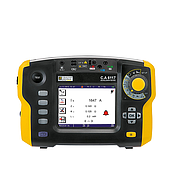
To determine the board's power consumption in this state, the card must be placed in the correct standby mode before measuring the current on the power supply rail. However, the current involved is so low that measurements taken with a standard multimeter may not always accurately reflect the circuit's actual behavior.
Where should the standby current draw be measured?
First, it is necessary to determine the state the board will maintain during actual operation.
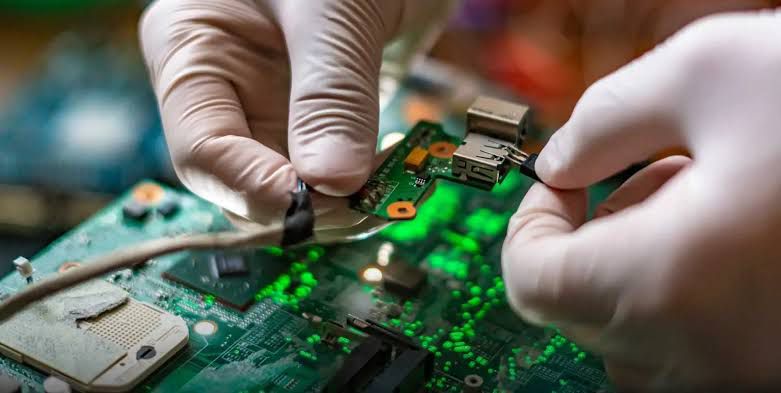
An IoT device might transition from an active state to Sleep Mode, then periodically wake up to read sensors, process data, or transmit signals. During the sleep interval, the MCU, RF module, and peripheral components reduce their power consumption to very low levels.
For instance, a battery-powered board might have an operating current of several tens of milliamperes (mA) but drop to just a few microamperes (µA) during sleep. This is the specific period that requires monitoring when the goal is to evaluate battery life.
The measurement process typically begins with the following steps:
+ Powering the board under expected operating conditions.
+ Placing the device into the appropriate Sleep or Standby mode.
+ Connecting the measuring instrument in series along the power supply line.
+ Waiting for the current to stabilize after the circuit changes state.
+ Recording the current consumption and monitoring the board's subsequent wake-up cycles.
The focus should not be on a single instantaneous figure. Some boards exhibit relatively low sleep current but occasionally produce high-current spikes when the MCU wakes up or the wireless module operates.
Why do multimeters sometimes fail to measure sleep current as expected?
This is precisely why measuring standby current can easily lead to misleading results.
When the meter is switched to current measurement mode, the current flows through the device's internal measurement circuitry. The internal resistance of this path creates a "burden voltage," thereby altering the actual voltage received by the circuit board.
At current levels of a few milliamperes (mA), this effect may be negligible. However, when measuring microamperes (µA) or lower, a discrepancy of just a few millivolts (mV) can cause the circuit to change state or behave differently than it would under normal conditions.
A common scenario involves a circuit board designed to enter a sleep mode consuming only a few µA; however, after connecting the meter, the firmware fails to transition into a full sleep state. The meter displays a higher-than-expected reading, leading the tester to incorrectly conclude that the circuit is consuming excessie power.
Furthermore, the sleep current may fall near the lower limit of the measurement range. At this point, the device's resolution, background noise, and sampling rate begin to directly impact the results.
What should be considered when measuring a quiescent current of a few microamperes?
The lower the current level to be measured, the more demanding the requirements for the measurement system.
Resolution: The instrument must be able to distinguish minute changes in current. For instance, 4 µA and 6 µA levels can carry vastly different implications when evaluating the power consumption of a battery-operated sensor.
Background noise: Measurements in the low-microampere range can fluctuate constantly if the surrounding environment has electrical noise or if the wiring setup is inadequate.
Burden voltage: This is a parameter easily overlooked when testing low current consumption. The higher the voltage drop across the measuring instrument, the more likely the power supply conditions for the circuit board are to be altered.
Measurement speed: Sleep current is not always constant. An MCU might wake up for a few milliseconds, read a sensor, and then return to a sleep state. An instrument with an appropriate sampling rate allows these fluctuations to be observed, rather than simply providing an average value.
When measuring sleep current, you should not look solely at the average value
Suppose a wireless sensor has the following duty cycle:
Sleep → wake up → read sensors → transmit data → return to sleep
The current may remain at a level of a few microamperes (µA) for the majority of the time, then spike to tens or hundreds of milliamperes (mA) for very brief intervals. If a measurement captures only an average value, these current pulses might be overlooked. For long-term battery-operated devices, the critical information lies within the operating cycle itself: the duration of sleep modes, the frequency of wake-up events, the power consumption of each event, and the total energy consumed during a complete cycle.
This is precisely why R&D laboratories often require equipment capable of monitoring low currents over time, rather than relying on simple, instantaneous measurements.
When should a low-current meter be used instead of a multimeter?
A high-end DMM can still handle many low-current measurements. However, when dealing with µA or nA ranges, leakage currents, or minute changes over time, the measurement requirements often exceed the capabilities of standard instruments.
Picoammeters, electrometers, or Source Measure Units (SMUs) are better suited for tests such as:
+ Measuring sleep current in MCUs and IoT boards.
+ Testing leakage current in semiconductor components.
+ Measuring current consumption of low-power sensors.
+ Evaluating battery consumption across different operating states.
+ Monitoring current fluctuations over time.
+ Testing components with leakage currents at the nA level or lower.
Notably, an SMU can both supply power and measure current within a single system, allowing for tighter control of test conditions when characterizing the power consumption of a circuit board.
Further reading: Can a standard meter measure such a very small current?
What kind of meter is needed to check the circuit board's current consumption?
The answer depends on the current level to be measured and the operating characteristics of the circuit board.
A high-resolution DMM may suffice for standard µA-range measurements. However, when measurements in the nA range are required such as for monitoring leakage current or observing minute fluctuations picoammeters, electrometers, and SMUs are more suitable.
EMIN’s range of low-level current and voltage source/measurement instruments serves as a valuable reference when measurement requirements exceed the capabilities of standard multimeters—particularly in R&D, as well as in the testing of electronic components, semiconductors, and low-power IoT devices.
Frequently Asked Questions
What is the typical sleep current for a circuit board?
There is no fixed value. Power consumption is determined by the specific MCU, sensors, RF modules, and power supply design of each board, ranging from the microampere (µA) range down to even lower levels.
Can a multimeter be used to measure sleep current?
Yes, provided the current falls within an appropriate measurement range and the meter's burden voltage does not alter the board's operating state.
Why do sleep current readings fluctuate between high and low levels?
The board may be executing cycles that involve waking up, reading sensors, processing data, or wireless transmission. It is necessary to monitor the current over time to distinguish between the baseline sleep current and current spikes occurring during active cycles.
Is specialized equipment required to measure nanoampere (nA) currents?
When current levels approach the limits of a standard digital multimeter (DMM), or when leakage current needs to be evaluated, instruments such as picoammeters, electrometers, or Source Measure Units (SMUs) are more suitable due to their ability to measure extremely low currents and provide better control over measurement conditions.
In summary: measuring standby current consumption is not simply about obtaining a µA reading on a display. For low-power boards, one must consider current levels, noise, burden voltage, and fluctuations over time to accurately assess the circuit's behavior.