Food producers, testing organizations, and consumers all need dependable ways to assess food quality, safety, and authenticity. Conventional testing methods may require lengthy procedures, hands-on sample preparation, or destructive sampling. Hyperspectral camera for food safety is attracting attention because it combines imaging with spectroscopy, enabling both spatial image information and spectral information to be examined together.
Rather than relying on a visual image alone, a hyperspectral approach analyzes spectral characteristics across an inspected item. The resulting data can be used to investigate multiple food properties and to support a broader view of product condition. Its potential spans quality inspection, component analysis, authenticity work, and contamination assessment.
What Is Hyperspectral camera?
Hyperspectral camera integrates spectroscopy and imaging technology. It collects extensive spectral data together with information about the location and appearance of features on an object. In food applications, this combination can help reveal differences that may not be apparent through ordinary visual inspection.
The value of this method lies not only in collecting data, but also in interpreting it. Spectral information must be processed and analyzed to identify characteristics relevant to a particular food product and inspection objective. Pattern-recognition methods and spectral databases can play an important role in that interpretation.
Food Quality Assessment Without Destructive Sampling
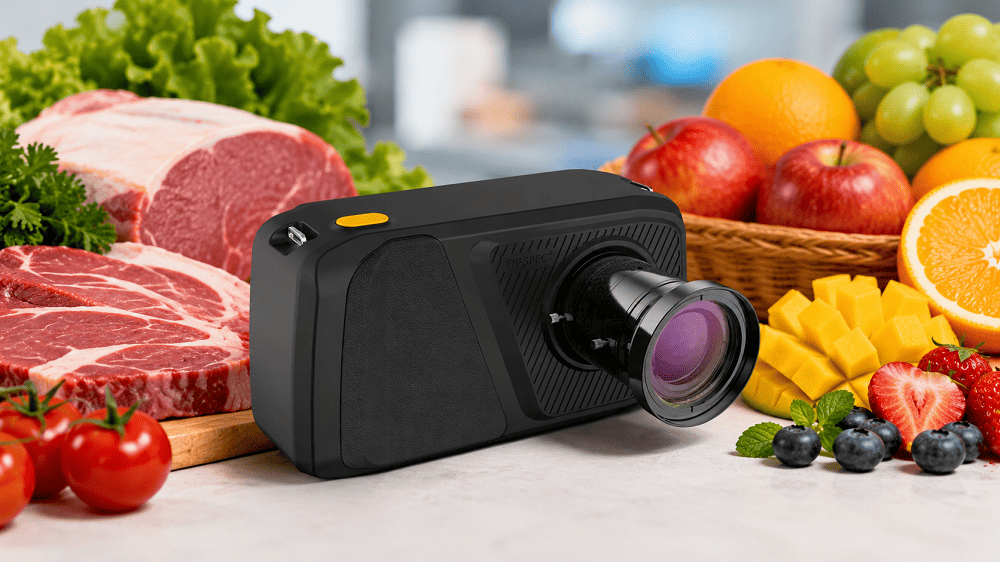
One promising use of portable multispectral camera is the non-destructive assessment of quality-related properties. For fruits and vegetables, spectral characteristics may be used to evaluate freshness, maturity, texture-related condition, or possible mechanical damage. The source information also identifies potential assessment of internal sugar content and acidity.
For meat products, hyperspectral analysis may support evaluation of moisture content, fat distribution, and protein content. Looking at these characteristics together can assist in assessing meat quality. Because the approach is non-destructive, it has potential where maintaining the integrity of a sample is important during inspection.
Component Analysis and Product Compliance
Food contains a wide range of nutritional and chemical components. Hyperspectral camera has potential to measure nutrients such as vitamins, minerals, and amino acids. It may also be applied to the assessment of additives and preservatives.
These uses do not eliminate the need for appropriate testing procedures or applicable requirements. Instead, they illustrate how spectral and imaging data may contribute to food inspection workflows. Reliable interpretation depends on suitable analytical methods, trained personnel, and quality-control practices.
Supporting Food Authenticity Assessment
Food origin, variety, and processing method can be associated with different spectral characteristics. When these characteristics are organized in a large spectral database and evaluated with pattern-recognition algorithms, hyperspectral technology may help distinguish products with different profiles.
This capability is relevant to food authenticity assessment. Honey and olive oil are examples identified in the source material as products for which genuine and non-genuine items may be differentiated through spectral analysis. In practice, the usefulness of an authenticity model depends on the quality and relevance of the reference data used to build it.
Potential for Contamination Detection
Hyperspectral camera may also assist in investigating food contamination. The source material describes potential detection of heavy metal pollution, pesticide residues, and microbial contamination. For pesticide residues, analysis of food-surface spectral characteristics may help identify their presence and distribution.
Microbial activity can cause spectral changes linked to microbial metabolites. Detecting these changes may support earlier warning or investigation of possible contamination. However, contamination assessment requires careful validation so that results are accurate and reliable for the intended application.
Challenges to Wider Adoption
Despite its potential, hyperspectral technology for food safety faces practical challenges. Equipment cost can limit access for smaller organizations. Data processing and analysis can also be complex, requiring specialized knowledge, algorithms, and operator capability.
Testing standards and methods still need further optimization and consistency to strengthen confidence in results. Future progress may include lower equipment costs, improved equipment stability and portability, stronger cross-disciplinary collaboration, and more efficient analysis methods. Complete testing standards and quality-control systems would also help support wider application.
Multispectral camera offers a forward-looking approach to food safety and quality assessment by bringing spectral and spatial data into one inspection process. Its potential applications include non-destructive quality evaluation, component analysis, authenticity assessment, and contamination investigation. As equipment, data analysis, standards, and quality control continue to develop, this technology may become an increasingly useful part of food safety testing.