When securing heavy packages or preparing goods for long-distance transportation, most packaging failures are not caused by the strap breaking across its body, but rather by the joint separating. Today's plastic strapping machines address this challenge through two fundamentally different physical principles: hot-blade sealing (using direct heat transfer) and friction welding (converting kinetic energy into thermal energy).
Physical Principles of the Two Plastic Strapping Joining Mechanisms
1. Hot-Blade Sealing (Heat Sealing)
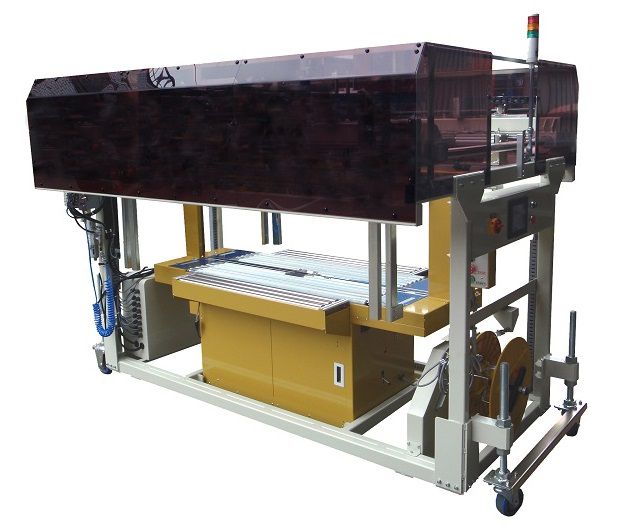
This mechanism is commonly used in semi-automatic strapping machines, such as the CHALI JN740 strapping machine and Mikyo packaging machines, as well as in certain standard automatic arch-type strapping machines from manufacturers such as SCZN and Strapack.
After the strapping machine tensions the strap around the package, a heated blade maintained at 250°C–320°C moves between the two overlapping strap layers. The heat melts the plastic surfaces within approximately 0.5–1.2 seconds. As soon as the blade retracts, a press bar immediately presses the two molten surfaces together to form a bond before the machine cuts off the excess strap.
The inherent weakness of hot-blade sealing lies in the heat transfer process from the outside inward. If the blade temperature is set too high or the pressing operation is delayed by even a fraction of a second, the plastic surface may burn and oxidize, producing carbon deposits. This makes the joint brittle and more likely to break under sudden lateral tension.
Conversely, if the temperature is insufficient, which can occur when the factory power supply experiences voltage drops or the working environment has strong drafts, only the outer plastic layer melts without adequate fusion into the inner material, resulting in joint slippage.
2. Friction Welding (Vibration Sealing)
This technology is standard in battery-powered plastic strapping tools and industrial handheld strapping machines, such as the Orgapack OR-T450, as well as products from Cyklop and Strapex.
Instead of using an electrically heated resistance element, the welding head of a battery-powered strapping tool uses a vibrating jaw to clamp the two strap layers together under high mechanical pressure. The jaw then moves horizontally at a high frequency, typically between 100 Hz and 250 Hz.
Dry friction between the two plastic surfaces generates localized heat directly at the contact interface, causing the polymer molecules to melt and intermix. When the vibrating jaw stops, the clamping force is maintained for another 1–2 seconds (the cooling time), allowing the polymer structure to solidify completely.
Because the heat is generated internally at the interface between the two strap surfaces, the resulting joint achieves uniform fusion without producing smoke or burning the material. This process also eliminates the need for preheating time required by conventional heat-sealing strapping machines.
Technical Comparison and Applications: Friction Welding vs. Hot-Blade Sealing
Choosing between these two mechanisms does not depend on which technology is more advanced. Instead, the decision should be based on package weight, strap material, and the actual operating conditions of the packaging line.
| Evaluation Criteria | Hot-Blade Sealing | Friction Welding |
|---|---|---|
| Heat generation | Direct heating by an electrical resistance element (250°C–320°C) | High-frequency frictional kinetic energy between two strap surfaces |
| Joint strength (Joint Efficiency) | Approximately 60%–70% of the original strap's breaking tensile strength | Approximately 75%–85% of the original strap's breaking tensile strength |
| Strap material and tensioning force range | Optimized for 9–15 mm PP strapping used for carton packaging (50–450 N tensioning force) | Suitable for both PP and high-strength PET strapping (2,500–7,000 N tensioning force) |
| Warm-up time and cycle speed | Requires 45–90 seconds to heat the blade; fast strapping cycles (1.5–2.5 seconds per strap) once the temperature stabilizes | Immediate operation (zero warm-up time); requires an additional 1–2 seconds of cooling time per cycle |
| Environmental conditions | Sensitive to strong drafts, high humidity, and fluctuations in factory power supply voltage | Stable operation in cold storage facilities, sea freight containers, outdoor environments, and dusty or humid conditions |
| Maintenance and operating costs | Requires removal of burnt plastic residue from the heating blade; relatively low replacement costs for cutting blades and heating elements | No smoke or carbon residue; mechanical wear occurs on the clamping teeth and vibrating jaw after tens of thousands of cycles |
| Typical equipment applications | Semi-automatic machines (CHALI JN740, Mikyo) and fixed-frame automatic strapping machines | Battery-powered handheld plastic strapping tools, pneumatic strapping tools, and high-capacity pallet strapping machines |
When to Choose Each Technology
Hot-blade sealing is recommended when:
- Strapping light- to medium-duty cardboard cartons weighing less than 40 kg using PP straps.
- Handling goods with uniform dimensions, with operations performed at a fixed workstation or on an automated conveyor line requiring continuous strapping cycles at an optimized investment cost.
Friction welding is essential when:
- Securing heavy packages and pallets with high-strength PET straps as an alternative to steel strapping machines.
- Handling export goods transported by sea or stored in cold storage facilities where condensation may occur.
- Strapping goods that undergo shrinkage or elastic recovery after packaging, such as sawn timber, ceramic tiles, paper rolls, and compressed cotton bales.
Technical Adjustment of Parameters for Proper Weld Fusion
Regardless of which plastic strapping joining mechanism is used, technicians must control the following three key parameters to eliminate strap slippage and joint failure:
1. For Hot-Blade Sealing Machines
Do not increase the temperature to its maximum setting simply to speed up the machine. Adjust the temperature control so that, when the welded joint is manually pulled apart for inspection, the plastic stretches into fine threads rather than breaking in a brittle manner.
If excessive white smoke and a strong burning odor are observed, the temperature has exceeded the decomposition threshold of the PP plastic material.
2. For Battery-Powered Plastic Strapping Tools (Friction Welding)
Pay attention to the synchronization between welding time and cooling time.
The thicker the strap (0.8–1.27 mm), or the more impurities present in recycled PET strapping, the more important it is to increase the cooling time by an additional 0.2–0.5 seconds.
If the tool is removed too early, before the inner plastic layer has fully solidified, the strap's elastic recovery force can immediately pull the joint apart.
3. Maintain the Cleanliness of Strapping Materials and Equipment
Cardboard dust, grease, and accumulated plastic debris in the strap guide channels and clamping teeth can reduce the friction coefficient in battery-powered tools or create a burnt insulating layer on hot-blade sealing machines.
The welding head assembly should be cleaned with compressed air after each production shift.
To compare tensioning force specifications, compatible strap size ranges, and equipment configurations suitable for your factory's actual production line, you can explore the range of genuine strapping machines from Signode, Strapack, Orgapack, Chali, and SCZN distributed by EMIN Vietnam.
Contact EMIN's technical team for assistance in selecting a suitable strapping machine based on your packaging requirements and production conditions.