Weighing Systems Industry 4.0
Connected weighing infrastructure is becoming increasingly important wherever mass data needs to move reliably from the scale into production systems, quality records, or remote monitoring dashboards. In this context, Weighing Systems Industry 4.0 support more than weight indication alone: they help link weighing points with digital workflows, machine control, and traceable process data.
This category is relevant for manufacturers, system integrators, laboratories, and industrial users looking for weighing components that can be embedded into automated environments. Depending on the application, that may involve a compact transmitter for signal conversion, a digital interface for networked weight data, or a more specialized weighing setup for controlled and repeatable procedures.
Where Industry 4.0 weighing fits in industrial environments
Modern weighing systems are often part of a wider automation architecture rather than isolated instruments. In production and handling processes, weight values may be used for filling, batching, verification, material flow control, or compliance documentation. A suitable weighing device therefore needs to communicate clearly with higher-level systems and operate consistently under real process conditions.
That is why transmitters and network-capable weighing components are widely used in automated installations. They allow load-cell or scale signals to be integrated into PLC-based control strategies, SCADA environments, and digital reporting structures. When a project also involves machine logic, it can be useful to review related solutions such as industrial controllers that manage process decisions around weight-based events.
Key product types in this category
A large part of this category is centered on weighing transmitters, which convert weighing signals into forms that can be processed by automation systems. These devices are typically selected when a weighing platform or load-cell arrangement must become part of a machine, conveyor, dosing station, or remote data environment.
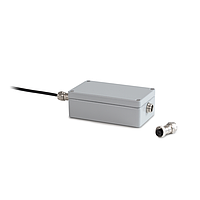
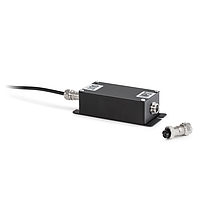
Examples from this range include the KERN YKV-01 IoT-Line Digital weighing transmitter, the KERN YKV-02 IoT-Line Digital weighing transmitter, the KERN CE WT1-Y4 Weighing transmitter, and analogue variants such as the KERN CE WT4-Y1 Analogue weighing transmitter and KERN CE WT1-Y2 Analogue weighing transmitter. For users building a complete weighing point, a product such as the KERN KDP 300-3-2024a universal weighing platform illustrates how the sensing hardware and the signal interface can work as part of one broader solution.
Digital and analogue options for different integration strategies
Choosing between digital and analogue transmission depends largely on the structure of the system around the weighing point. Digital weighing transmitters are often preferred when clean data exchange, remote communication, and easier connectivity to software platforms are priorities. In Industry 4.0 settings, this can simplify data collection, condition monitoring, and cross-system visibility.
Analogue weighing transmitters remain relevant in many machine retrofits and control cabinets where existing signal standards and conventional automation hardware are already in place. In these cases, the weighing channel needs to be dependable and easy to interpret within established control loops. If the process also relies on counting pulses, speed feedback, or sequence monitoring, related devices such as counters and tachometers may be part of the same automation concept.
Representative manufacturers and solution focus
KERN is a central manufacturer in this category, especially for weighing transmitters and weighing-related components intended for integration into industrial and connected applications. The KERN portfolio shown here is particularly relevant for users who need compact hardware to transfer weight data from a platform into an automation or monitoring environment.
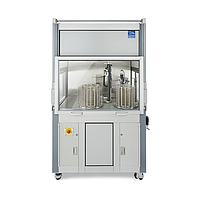
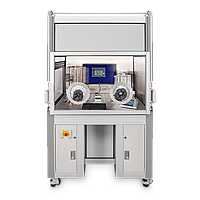
Comde-Derenda appears in a more specialized application area with systems such as the MWS-1 Manual Weighing System and AWS-1RE Automatic Weighing System. These products point to weighing scenarios where environmental control, repeatability, and structured handling of samples or filters are important. They represent a different end of the category: not just signal transmission, but controlled weighing workflows in demanding technical contexts.
How to choose the right weighing system for an Industry 4.0 project
The first step is to define the role of weight data in the process. Some applications only need stable transmission of a measured value into a control cabinet, while others require a network-ready path for logging, analytics, or distributed monitoring. The selection should therefore begin with the intended communication method, the level of automation, and whether the weighing point is local, embedded, or remotely supervised.
It is also important to consider the physical side of the system: platform compatibility, installation space, environmental conditions, and expected operating range. In integrated projects, weighing rarely stands alone; it may sit alongside machine safety, switching devices, and power distribution elements. For that reason, engineers may also review adjacent product groups such as contactors or circuit protection when designing a complete panel or machine architecture.
Application scenarios across production, testing, and controlled environments
Industry 4.0 weighing can support a broad range of workflows. In manufacturing, it may be used for dosing, checkweighing, raw material verification, and in-line process monitoring. In assembly and packaging environments, weight values can become one of several criteria used to confirm product completeness or detect deviations.
In laboratory-linked or highly controlled applications, weighing systems may also form part of documented procedures where traceability and stable conditions matter as much as the measured value itself. The Comde-Derenda systems in this category are examples of how weighing can extend into structured sample handling and regulated workflows, while transmitter-based solutions are better suited to embedded industrial integration.
Why this category matters for scalable automation
As factories move toward connected operations, weighing devices increasingly serve as data sources within larger digital ecosystems. A suitable transmitter or automated weighing setup can help bridge the gap between the physical process and the software layer that records, evaluates, and acts on production information. That makes weighing technology relevant not only to metrology teams, but also to automation engineers, OEMs, and maintenance planners.
Whether the requirement is a compact KERN transmitter for machine integration or a specialized Comde-Derenda weighing system for controlled procedures, the right choice depends on how the measurement will be captured, transmitted, and used. Reviewing the category with that system-level perspective makes it easier to select equipment that supports both present process needs and future digital expansion.
直接联系认证专家