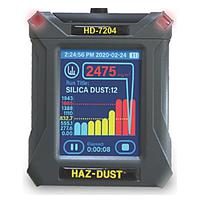
粒子计数器
When clean manufacturing, controlled environments, or laboratory air quality are under review, reliable particle measurement becomes a practical requirement rather than a nice-to-have. A particle counter helps teams understand how many airborne particles are present, making it easier to monitor cleanliness, investigate contamination risks, and support process control in sensitive applications.
On this category page, you can explore instruments used for particle monitoring in laboratory and industrial environments. Whether the goal is routine checks, validation support, or troubleshooting unexpected contamination events, selecting the right device depends on the working environment, the required level of detail, and how the measurement data will be used.
Why particle counting matters in controlled environments
Airborne particles can affect product quality, testing accuracy, and environmental control in many sectors. In laboratories, cleanrooms, and production areas, even small changes in particulate levels may indicate issues with filtration performance, operator movement, packaging processes, or ventilation balance.
A particle counter provides a structured way to detect and quantify these changes. Instead of relying only on visual inspection or general air handling assumptions, teams can use measured data to assess cleanliness trends, compare zones, and support maintenance or quality procedures with more confidence.
Typical uses of particle counters
These instruments are commonly used where particulate control is closely linked to process stability. Examples include laboratory spaces, pharmaceutical support areas, electronics assembly, medical device production, and other environments where airborne contamination can influence outcomes.
Depending on the application, particle counting may be part of routine environmental monitoring, commissioning work, filter verification, or periodic audit preparation. In some workflows, users may also compare results with related instruments such as an air particle counter when the focus is specifically on airborne cleanliness assessment in controlled spaces.
What to consider when choosing a particle counter
The most suitable model depends on how and where measurements will be performed. Buyers typically review factors such as portability, sampling approach, display and data handling, ease of operation, and whether the instrument will be used for spot checks or more structured monitoring routines.
It is also important to think about the measurement context. A unit used for general laboratory checks may differ from one selected for cleanroom-related work, where documentation, repeatability, and process traceability can be more important. If your workflow includes broader contamination review, it may also be helpful to compare this category with air-focused counting solutions or other laboratory counting tools depending on the sample type.
Particle counters within a broader laboratory workflow
In practice, particle counting is often only one part of a larger quality or inspection process. Teams may combine airborne or environmental counting with microbiology checks, manual counting tasks, or product-specific inspection methods to build a more complete picture of process conditions.
For example, some laboratories also use a colony counter for microbiological analysis, while other workstations may rely on a tally counter for straightforward manual counting tasks. These tools serve different purposes, but together they support more consistent data collection across laboratory operations.
Key benefits for technical buyers and facility teams
For B2B users, the value of a particle counter goes beyond a single reading. The device can support environmental monitoring, help identify process deviations earlier, and provide measurable input for maintenance decisions or quality documentation. This is especially relevant in facilities where cleanliness performance must be reviewed regularly.
Another benefit is improved troubleshooting. When unexpected contamination concerns arise, particle measurements can help narrow down whether the issue is linked to airflow, filtration, personnel movement, material transfer, or changes in housekeeping practices. Clearer data often leads to faster corrective action and less guesswork.
How to approach selection for procurement or engineering review
If you are sourcing for a laboratory, production site, or controlled area, it helps to define the operating scenario first. Consider where the instrument will be used, who will operate it, how often measurements will be taken, and whether results need to be shared across quality, engineering, or maintenance teams.
From there, shortlisting becomes more practical. Some users prioritize mobility and ease of routine checks, while others focus on data consistency and integration into established monitoring procedures. A good selection process usually starts with application fit rather than choosing purely by appearance or broad product labels.
Finding the right particle counter for your application
This category is intended for buyers who need dependable tools for particle monitoring in laboratory and industrial environments. By comparing application needs, workflow requirements, and the role of particle counting within your wider contamination control strategy, it becomes easier to identify an instrument that fits your process rather than forcing your process around the instrument.
If your work involves cleanliness assessment, controlled-area review, or routine environmental checks, a well-matched particle counter can become a valuable part of everyday quality control. Use this category as a starting point to compare relevant options and narrow the selection based on actual operational needs.
直接联系认证专家