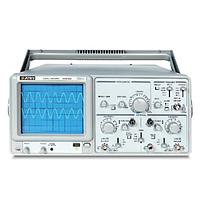
Analog Oscilloscope
For many service benches, training labs, and maintenance environments, waveform analysis does not always require a complex interface or deep menu structure. An Analog Oscilloscope remains a practical choice when the priority is direct signal visualization, familiar front-panel control, and straightforward observation of voltage over time.
In this category, you can find instruments suited to general electronic troubleshooting, educational use, and routine signal checking. The range includes compact single-channel models and traditional dual-channel bench units, making it easier to match the scope to the type of circuit, frequency range, and working style involved.
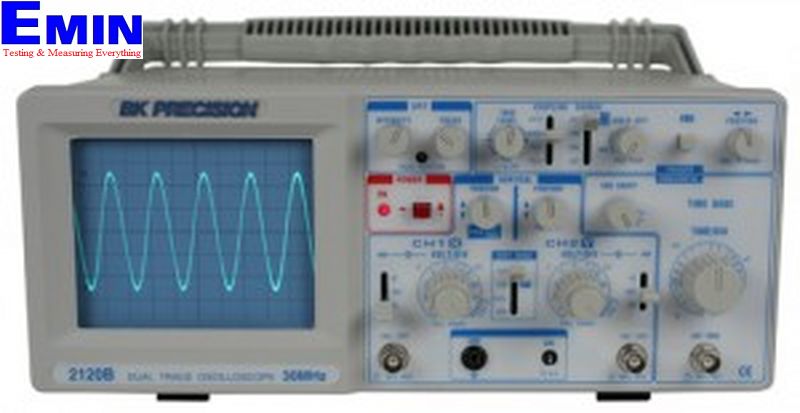
Where analog oscilloscopes still make sense
Although many users now compare analog instruments with a digital oscilloscope, analog models still have a clear role in day-to-day electrical and electronics work. They are often selected for classroom training, basic repair, visual monitoring of repetitive signals, and situations where operators prefer dedicated knobs over software-style navigation.
For repetitive waveforms such as sine, square, or simple modulation signals, an analog platform can provide an immediate view of signal behavior. This is useful when checking signal presence, comparing channels, observing timing relationships, or verifying whether a circuit is oscillating, clipping, or drifting.
Typical configurations in this category
The products shown in this category cover more than one form factor. Some models use a compact modern display format while still focusing on analog-style measurement behavior and simplified operation, while others follow the more traditional CRT bench design common in laboratory and maintenance setups.
Examples include the OWON AS101 Oscilloscope (10MHz, 100MS/s, 1-Channel) and OWON AS201 Oscilloscope (20MHz, 100MS/s, 1-Channel), which are suitable for users looking for a compact single-channel instrument for basic waveform work. For applications requiring comparison between two signals, the MATRIX MOS-620 Dual Channel Analog Oscilloscope (20MHz) represents a more conventional dual-channel bench approach.
Key factors to consider before choosing
One of the first selection points is bandwidth. For low-frequency electronics, power supply testing, audio-related circuits, and general educational use, a 10 MHz or 20 MHz instrument may be sufficient. The required bandwidth should always be aligned with the highest frequency content of the signal you expect to observe, not just its nominal operating frequency.
The next factor is the number of channels. A single-channel scope can be enough for simple inspection and signal tracing, but dual-channel capability becomes important when comparing input and output signals, checking phase relationships, or troubleshooting interactions between two nodes in a circuit.
Users should also look at trigger options, input coupling, and X-Y mode support. Trigger stability helps produce a usable display for repetitive signals, while AC, DC, and ground coupling options support different measurement situations. X-Y mode can be helpful in specific comparison and pattern-observation tasks.
Representative brands and models
OWON appears in this category with compact instruments such as the AS101 and AS201. These models are relevant for users who need a lighter, space-saving unit for bench use, technical training, or portable service tasks where moderate bandwidth and straightforward setup are enough.
MATRIX is represented by the MOS-620, a dual-channel 20 MHz analog oscilloscope designed in a more traditional format. This type of instrument is often preferred in lab environments where simultaneous two-channel observation and conventional oscilloscope controls remain important.
Common application scenarios
Analog oscilloscopes are commonly used in electronics education because they help learners understand waveform shape, amplitude, period, triggering, and time base operation in a very direct way. For repair work, they are useful when tracing signals through analog stages, power circuits, low-frequency control boards, and basic communication sections.
They can also support maintenance teams working on legacy equipment where the task is not advanced protocol decoding, but rather confirming signal continuity and basic waveform integrity. In these cases, a simpler instrument may reduce setup time and make routine checks more efficient.
If mobility is more important than a bench format, some users may also want to compare this category with a handheld oscilloscope. For computer-integrated analysis and data capture workflows, a PC oscilloscope may be a better fit.
How to match the instrument to your workload
For training, introductory electronics, and basic service work, a compact 10 MHz to 20 MHz scope can often cover the essential measurement tasks. If your signals are repetitive, your diagnostics are straightforward, and space is limited, a smaller single-channel unit may be enough.
For broader troubleshooting, especially when comparing two test points at once, a dual-channel bench model usually provides more flexibility. This is especially relevant in amplifier stages, timing checks, and input-versus-output verification where viewing both waveforms together can speed up diagnosis.
It is also worth considering the physical working environment. Bench space, portability needs, operator experience, and the type of probes or accessories used in your workflow all affect whether a compact unit or a more traditional form factor is the better long-term choice.
Why this category remains relevant
Despite the shift toward digital measurement platforms, analog oscilloscopes continue to serve users who value immediate waveform visibility, simple controls, and dependable operation for standard signal observation. They are particularly relevant in learning environments, repair stations, and facilities maintaining established electronics systems.
Choosing the right model comes down to a few practical questions: the frequency range you need to observe, whether one or two channels are required, and whether your work favors compact portability or a classic bench instrument. By comparing the available options in this category, buyers can narrow the selection to a scope that fits actual testing needs rather than unnecessary complexity.
Get exclusive volume discounts, bulk pricing updates, and new product alerts delivered directly to your inbox.
By subscribing, you agree to our Terms of Service and Privacy Policy.
Direct access to our certified experts