Semiconductor Packaging Equipment
Advanced chip assembly depends on stable thermal processes, controlled atmospheres, precise handling, and repeatable production conditions. On a packaging line, equipment selection affects not only throughput, but also yield, process consistency, and how easily a factory can scale from development work to higher-volume manufacturing. This is why Semiconductor Packaging Equipment is typically evaluated as part of a broader process ecosystem rather than as isolated machines.
In this category, buyers can explore equipment used in critical backend semiconductor processes, especially where temperature control, nitrogen environments, conveyorized thermal profiles, and integration with production systems matter. The range is relevant for manufacturers building or upgrading packaging lines, engineering teams refining process windows, and sourcing teams comparing platforms for long-term deployment.
Where packaging equipment fits in semiconductor manufacturing
Semiconductor packaging sits between device fabrication and final electrical validation. At this stage, components and substrates must be joined, protected, stabilized, and prepared for downstream verification. That makes packaging equipment a practical bridge between material handling, thermal treatment, and quality control.
For companies building a complete backend workflow, packaging tools are often considered alongside IC testing equipment and wafer and chip inspection systems. Looking at these categories together helps define how process capability, traceability, and final product quality will be managed across the line.
Key process needs in this equipment category
Packaging applications often require a combination of thermal uniformity, atmosphere control, repeatable transport, and process data management. In many production environments, small temperature deviations can affect solder behavior, substrate integrity, voiding risk, or long-term reliability. Because of that, equipment is usually judged by how consistently it maintains the intended process profile under real operating conditions.
Another important factor is line compatibility. Engineering teams may need standalone systems for batch operation, or conveyorized machines that align with continuous production. Features such as PLC-based control, Windows interfaces, and standard communication protocols can be valuable when connecting packaging equipment to MES-driven workflows or broader smart-factory requirements.
Typical equipment examples in this range
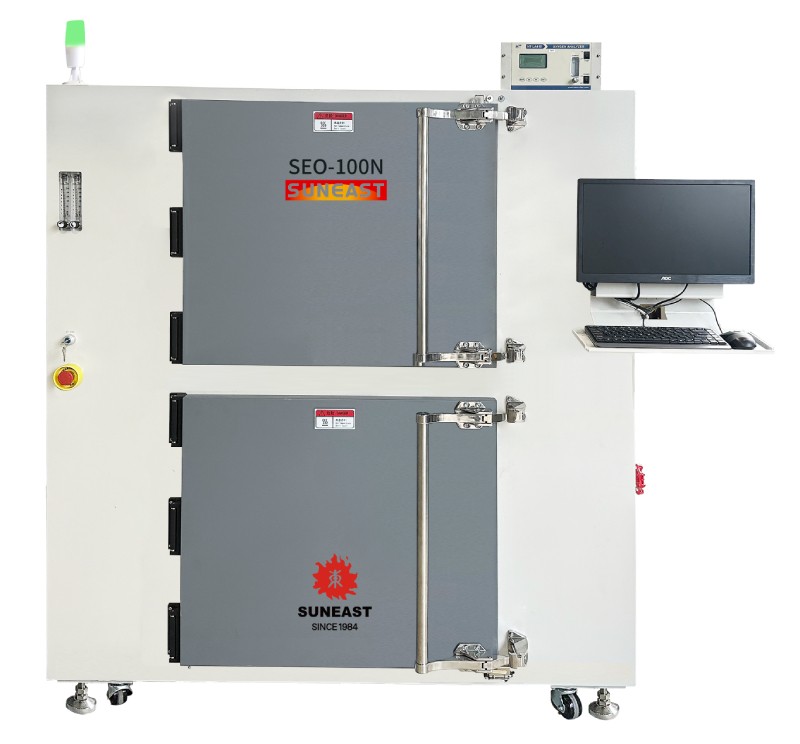
A clear example is the Suneast portfolio represented in this category. For thermal processing in controlled environments, the Suneast SEO-100N semiconductor oven provides a dual-box configuration, adjustable hot air circulation, water-cooling support, and nitrogen monitoring with real-time oxygen display. This type of oven is relevant where batch-based heating, curing, drying, or stabilization processes require controlled oxygen content and stable temperature performance.
For continuous soldering and thermal profile applications, the category also includes conveyorized reflow platforms such as the Suneast SEMI-08N, SEMI-10N, and SEMI-13N. These systems differ in heating-zone count and overall process length, allowing users to match equipment size and thermal capability to the complexity of the package, substrate, and target throughput. Rather than comparing models only by size, buyers should look at how zone configuration, cooling approach, and conveyor control support the intended process recipe.
Batch ovens and reflow ovens: different roles, different selection logic
Although both equipment types operate in elevated-temperature processes, they serve different production goals. A semiconductor oven is commonly used for batch thermal treatment, where products remain in a chamber for a defined time under controlled temperature and atmosphere conditions. This can be useful for curing, drying, preheating, or other process steps that benefit from stable dwell conditions and flexible shelf-based loading.
A semiconductor reflow oven, by contrast, is designed for continuous movement through multiple heating and cooling zones. This supports profile-based processing, where ramp-up, soak, peak temperature, and cooling stages must be controlled as the workpiece travels through the machine. For packaging lines that depend on repeatable thermal transitions and line integration, reflow systems are often a better fit than static chamber equipment.
What to evaluate before choosing packaging equipment
Selection starts with the process itself. Buyers should define whether the application is batch or inline, whether nitrogen control is required, and what temperature range is needed for the material set being used. If oxygen-sensitive processing is part of the requirement, attention should be given to atmosphere management, monitoring capability, and how the equipment supports stable low-oxygen operation over time.
Capacity planning is equally important. Heating-zone count, chamber size, shelf arrangement, conveyor speed, and cooling method all influence throughput and process flexibility. In production settings, support for standard communication protocols and process data storage may also be important, especially if packaging equipment must align with traceability requirements or exchange data with upstream and downstream systems.
It is also useful to consider related process steps in the same investment cycle. For example, teams working on advanced assembly may review SMU semiconductor test solutions for characterization needs, or compare materials and devices with semiconductor components used elsewhere in the production flow.
Why thermal control and atmosphere management matter
In semiconductor packaging, process stability often depends on more than reaching a target temperature. Uniform heat distribution, repeatable heating and cooling rates, and atmosphere control can all influence joint quality, material stress, contamination risk, and final device reliability. This is especially relevant when packaging structures become denser, more sensitive, or more demanding in terms of profile control.
Equipment with features such as PID closed-loop control, forced cooling, nitrogen filling, oxygen monitoring, and adjustable transport parameters can help teams maintain tighter process windows. The practical value is not just technical precision on paper, but more predictable results from lot to lot and easier process transfer from development to production.
Suitable users and application scenarios
This category is relevant for semiconductor packaging houses, electronics manufacturers with advanced backend capabilities, pilot production teams, and process engineers developing thermal recipes for packaged devices. It may also be useful for organizations expanding from R&D to small-batch manufacturing and needing equipment that balances process control with future scalability.
Depending on the application, users may prioritize different criteria. Some need compact batch equipment for controlled thermal treatment, while others need multi-zone reflow systems that support continuous operation and production integration. In both cases, the right choice usually comes from matching the equipment architecture to the actual packaging step rather than choosing solely by nominal power or machine size.
Final considerations for sourcing
Choosing semiconductor packaging equipment is ultimately about process fit, not just equipment availability. The best starting point is a clear understanding of package type, thermal profile requirements, atmosphere sensitivity, throughput targets, and integration needs. From there, comparing platform style, control approach, and production compatibility becomes much more straightforward.
This category brings together equipment suited to those decisions, including batch semiconductor ovens and multi-zone reflow systems from Suneast. If you are planning a new packaging line or refining an existing process, reviewing the available options here can help narrow the shortlist to equipment that supports stable operation, repeatable results, and practical long-term deployment.
Get exclusive volume discounts, bulk pricing updates, and new product alerts delivered directly to your inbox.
By subscribing, you agree to our Terms of Service and Privacy Policy.
Direct access to our certified experts