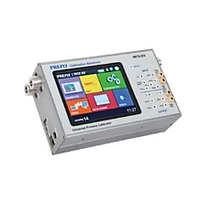
Process Signal Calibrator
Reliable loop verification and signal simulation are essential when commissioning transmitters, troubleshooting control loops, or maintaining process instrumentation in the field. A Process Signal Calibrator helps technicians measure, source, and simulate the electrical signals commonly used in industrial automation, making it easier to validate device response without removing instruments from service for long periods.
On this page, you can explore handheld calibrators and related process measurement tools suited to 4-20 mA loops, voltage checks, RTD and thermocouple work, and broader multifunction tasks. The range includes focused loop calibrators as well as advanced instruments for teams that need wider coverage across maintenance, calibration, and process verification.
Where process signal calibrators are used
In process plants, utility systems, OEM machinery, and building automation, technicians often need to confirm whether a problem comes from the sensor, the transmitter, the loop wiring, or the receiving controller. A process signal calibrator provides a practical way to inject or read known signals so each part of the loop can be checked methodically.
Typical tasks include verifying 4-20 mA transmitter output, sourcing loop current for input cards, measuring DC voltage, simulating sensor signals during startup, and checking signal stability during maintenance. For applications that go beyond loop work into broader field verification, users may also compare options in multifunction calibrators when one instrument must cover several signal types.
Common signal types covered in this category
The most common requirement in this category is current loop calibration, especially for 4-20 mA instrumentation. This is the standard signal used by many pressure, level, flow, and temperature transmitters because it is robust, widely supported, and practical for long cable runs in industrial environments.
Many models in this range also support voltage measurement or sourcing, which is useful when checking analog I/O, panel signals, and device outputs. Some instruments extend into temperature simulation through RTD or thermocouple functions, allowing maintenance personnel to verify temperature transmitters and indicators without relying on a live process input.
For thermal applications specifically, it may be helpful to review dedicated temperature calibrators when the job focuses more on sensor types, temperature accuracy, and probe simulation than on general process loops.
Examples of instruments in the range
FLUKE is strongly represented in this category with several models that cover different field needs. The FLUKE-707/APAC is a practical current loop calibrator for sourcing and measuring mA and checking loop voltage, while the FLUKE-715 expands into volt and mA loop work for technicians who need both source and measure functions in one handheld unit.
For users who want meter and calibrator functions together, the FLUKE-787B Process Meter and FLUKE-789 ProcessMeter combine electrical measurement with loop sourcing, helping reduce the number of tools carried into the field. These instruments are often useful during troubleshooting because the technician can both verify the circuit and inject a known process signal from the same device.
More complex applications may call for broader capability. The FLUKE-725/APAC/EMEA and FLUKE-726/APAC/EMEA support multiple process variables including current, voltage, temperature, and in some cases pressure-related workflows, making them relevant for maintenance teams handling diverse instrumentation assets across a plant.
How to choose the right process signal calibrator
The best choice usually depends on the type of instruments you maintain most often. If your daily work centers on transmitters and analog loops, a dedicated loop calibrator such as the FLUKE-707/APAC or FLUKE-715 may be enough. These tools are well suited to routine commissioning, loop checks, and quick signal injection during field service.
If your team also works with temperature devices, look for support for RTD and thermocouple functions. Models such as the FLUKE-712B/EN RTD Calibrator, FLUKE-714B/EN Thermocouple Calibrator, and FLUKE-724/APAC/EMEA Temperature Calibrator are examples of instruments designed for those signal types.
When operations involve a wider combination of current, voltage, resistance, frequency, or pressure-related calibration tasks, a multifunction approach may offer better long-term efficiency. In those cases, the overlap with pressure calibrator solutions can also matter, especially when transmitters and pressure modules are part of the same maintenance workflow.
Loop troubleshooting and field maintenance benefits
A major advantage of this equipment is faster fault isolation. Instead of replacing parts by trial and error, technicians can simulate a known input, observe controller or display behavior, and identify whether the issue lies in the transmitter, loop power, PLC input, or field wiring. This supports more efficient maintenance and reduces unnecessary downtime.
Portable calibrators are also valuable for preventive maintenance programs. During scheduled inspections, teams can verify signal integrity, confirm output scaling, and document whether a device remains within expected performance limits. Features such as loop power, source/simulate modes, and step or ramp functions can be especially useful when checking the response of receiving devices across the measurement span.
Specialized tools for non-intrusive current checks
Not every process task requires a full handheld calibrator with broad sourcing functions. In some situations, non-intrusive current measurement is more important, particularly when the objective is to check loop current without breaking the circuit. Instruments such as the FLUKE-771 Process Clamp Meter, FLUKE-772 Process Clamp Meter, and FLUKE-773 Clamp Meter address that need.
These tools are useful for maintenance teams working on live systems where opening the loop may be inconvenient or risky for the process. Depending on the model, they can combine clamp-based mA measurement with additional simulate or source capability, making them practical for quick diagnostics and verification work in busy field environments.
Why brand and application fit both matter
Well-known manufacturers such as Chauvin Arnoux, Emerson, FLUKE, HIOKI, YOKOGAWA, Additel, EXTECH, PCE, Sika, and Triplett appear in this broader category landscape because process calibration needs vary widely by industry and maintenance practice. Brand preference may be influenced by site standards, calibration procedures, training familiarity, or the need to align with existing instrument fleets.
Still, the most important factor is not the label alone but the fit between the instrument and the job. A compact loop tool may be ideal for routine transmitter checks, while a broader unit may save time in plants where technicians handle mixed signal types every day. Reviewing the available functions in context of your actual maintenance workflow is usually the most effective way to narrow the shortlist.
Frequently asked questions
What is the difference between measuring, sourcing, and simulating?
Measuring reads the signal coming from a device or loop. Sourcing generates a signal from the calibrator to test another device. Simulating typically imitates the behavior of a field device within a loop so the receiving equipment can be checked under realistic conditions.
When should I choose a multifunction model instead of a loop calibrator?
If your work regularly includes current, voltage, temperature, resistance, frequency, or pressure-related tasks, a multifunction model can reduce tool changes and improve field efficiency. If you mainly work on 4-20 mA transmitters, a dedicated loop calibrator may be more straightforward.
Are process clamp meters part of this category?
They can be highly relevant when the goal is to measure loop current quickly without opening the circuit. Clamp-style process meters complement traditional calibrators, especially in troubleshooting and live maintenance scenarios.
Choosing the right process signal calibrator comes down to signal type, workflow, and the level of field flexibility your team needs. Whether you need a simple 4-20 mA loop tool, a temperature-capable handheld unit, or a broader multifunction platform, this category helps you compare solutions that support accurate maintenance, commissioning, and process verification.
Get exclusive volume discounts, bulk pricing updates, and new product alerts delivered directly to your inbox.
By subscribing, you agree to our Terms of Service and Privacy Policy.
Direct access to our certified experts