Attenuators Interconnects
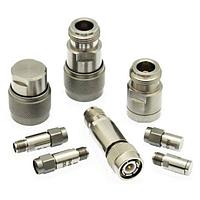
Signal chains in RF and microwave systems often need more than simple connectivity. When power levels must be reduced in a controlled way to protect instruments, improve matching, or stabilize measurements, attenuators interconnects become a practical part of the interconnect design rather than an afterthought.
This category brings together connectorized RF attenuators used in test setups, communication hardware, lab benches, and integration projects where impedance control and repeatable attenuation matter. Whether you are building a compact bench assembly or extending a higher-frequency path, the right attenuator helps maintain signal integrity while fitting naturally into the rest of the RF interconnect ecosystem.
Where connectorized attenuators fit in an RF interconnect system
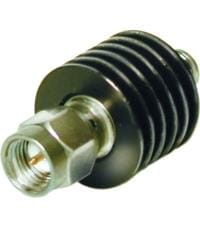
A connectorized attenuator is typically installed inline between two RF connection points to introduce a defined loss value, expressed in dB. In practical use, this helps reduce excessive signal amplitude before it reaches a sensitive receiver, analyzer, or downstream component. It can also support more stable measurements by improving level control within a test configuration.
Because these devices are part of the broader interconnect path, selection should not be separated from the rest of the assembly. Connector style, impedance, operating frequency, and mechanical interface all need to align with adjacent components such as RF cable assemblies or mating interfaces already used in the system.
Key parameters that influence selection
The most important starting point is usually the required attenuation value. Different applications may call for a light reduction of just a few dB or a more substantial step-down to protect measurement equipment or condition the signal for a specific stage. In this category, examples range from lower values such as 2 dB and 3 dB up to much higher attenuation options for specialized needs.
Frequency range is equally important. A part intended for a few gigahertz may not be suitable in a microwave setup running far beyond that. The listed products in this category cover a broad span, from lower-frequency BNC-based options up to 40 GHz designs using 2.92 mm or similar high-frequency interfaces.
Users should also confirm impedance and power handling. Most products shown here are 50 Ohm components, which is standard for many RF and microwave systems. Power rating matters because an attenuator must dissipate part of the signal energy as heat, so a mismatch between expected input power and component rating can shorten service life or affect performance.
Connector formats and integration considerations
Mechanical compatibility often determines whether an attenuator can be dropped directly into an existing setup. SMA remains a common choice for general RF and microwave use, while BNC may be more suitable in lower-frequency bench environments. For higher-frequency applications, 2.92 mm and RPC-2.92 formats are often selected where bandwidth and precision mating are more demanding.
Gender configuration also matters during system integration. Many products in this category are male-to-female styles intended for direct inline insertion, while some are male-to-male formats that may fit specific adapter chains. If your assembly already depends on RF adapters or other interface conversions, it is worth checking the full mating path before selecting the attenuator.
Examples from leading manufacturers in this category
Several established brands are represented here, including Mini-Circuits, Hirose Electric, HUBER+SUHNER, Rosenberger, and Amphenol SV Microwave. Each brand is commonly associated with RF interconnect products used in lab, communications, and integration environments, and the category includes examples across different attenuation levels, power ratings, and connector families.
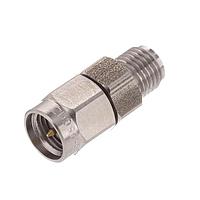
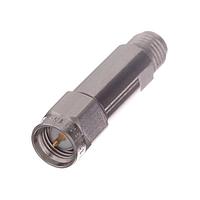
For instance, the Mini-Circuits BW-S12W5+ is a connectorized SMA attenuator with a 12 dB attenuation level and a 5 W power rating, suitable for applications that need stronger signal reduction with moderate power handling. The BW-S6-2W263A+ and BW-S20-2W263A+ illustrate how similar inline formats can support different attenuation targets within a 50 Ohm signal path.
On the higher-frequency side, products such as the Amphenol SV Microwave M3933/30-24S and Rosenberger 02AS102-K03S3 show the type of connectorized attenuator used where 2.92 mm-class interfaces and operation up to 40 GHz are relevant. Hirose Electric options such as the AT-502 and AT-203(40) are useful examples for applications where BNC or SMA connectivity and lower attenuation values are preferred.
Common use cases in test, measurement, and system protection
One of the most common reasons to add a fixed attenuator is instrument protection. Engineers often place attenuation at the input of a spectrum analyzer, signal analyzer, or receiver front end when there is a risk that the incoming signal level may be too high. This can help reduce overload risk while preserving a known and repeatable test condition.
Another common use case is level conditioning in development and validation setups. During RF characterization, teams may need to compare signals under different insertion conditions, create more realistic line loss, or improve repeatability across multiple benches. In these cases, a connectorized attenuator offers a simple physical solution without redesigning the whole path.
Attenuators can also support better integration when mixed interconnect elements are involved. In installations that include coaxial RF connectors and supporting accessories, choosing an attenuator with the correct interface and loss value can simplify assembly while keeping the signal path predictable.
How to choose more efficiently for procurement and engineering teams
For B2B buyers, the fastest way to narrow the selection is to define four basics first: connector type, attenuation in dB, frequency limit, and power rating. That short list usually eliminates most mismatches before deeper evaluation begins. After that, environmental range, gender configuration, and physical format can be reviewed to confirm compatibility with the intended installation.
It is also useful to think in terms of the complete RF path, not only the single part. An attenuator that looks correct on paper may still create extra complexity if it forces additional adapters, changes cable routing, or introduces a less suitable connector interface. Reviewing the whole interconnect chain early usually leads to a cleaner and more reliable implementation.
Building a more complete RF interconnect solution
Attenuators rarely work in isolation. They are usually selected alongside cables, connectors, adapters, and accessory hardware as part of a broader RF build. If you are refining a test bench or specifying parts for production integration, it may be helpful to review related categories such as RF connector accessories when strain relief, caps, or interface support elements are also needed.
A good category page should help users move from a general requirement to a practical shortlist. In that sense, this range of connectorized attenuators supports both quick replacement needs and more deliberate engineering selection, especially when attenuation level, frequency capability, and interface type all need to be balanced.
Final considerations
Choosing the right attenuator is mainly about matching the electrical and mechanical requirements of the real signal path. A clear view of attenuation target, connector interface, operating frequency, and expected power makes the selection process much more straightforward.
For teams working with RF and microwave hardware, this category provides a focused starting point for sourcing inline attenuation components that fit practical interconnect needs. Reviewing a few representative options from recognized manufacturers can help you identify the most suitable part for your application without overcomplicating the design.
Get exclusive volume discounts, bulk pricing updates, and new product alerts delivered directly to your inbox.
By subscribing, you agree to our Terms of Service and Privacy Policy.
Direct access to our certified experts