
Other Development Tools
When a design project does not fit neatly into amplifier, data conversion, clocking, or filter evaluation, engineers often end up looking for a more flexible set of platforms. Other Development Tools covers exactly that space: evaluation boards, demo kits, controller boards, and application-focused hardware that helps teams validate devices, test interfaces, and shorten early-stage development work.
This category is useful for engineers working across embedded electronics, industrial communication, sensing, motion, and power design. Instead of being limited to one IC family, it brings together tools for practical bench evaluation, proof-of-concept work, and subsystem verification before a design moves toward integration or production.
What you can expect in this category
Products in this range are typically selected when the main goal is to evaluate a device or function in context, rather than to study a broad product class. That may include checking signal behavior on a logic device, validating an RS-485 optocoupler setup, trying a PLC/DCS analog output concept, or testing a complete application such as an ultrasonic flow meter reference design.
Because of that broad scope, the category naturally includes different hardware formats. Some tools are simple evaluation PCBs, while others are controller boards, demo assemblies, or system-level development kits intended to demonstrate how multiple components work together in a real design environment.
Typical use cases for engineers and technical buyers
These tools are often used in proof-of-concept and design verification workflows. Development teams may use them to measure performance under known supply conditions, review interface behavior such as SPI, I2C, USB, or RS-485, and reduce uncertainty before committing to a custom PCB revision.
They are also relevant for industrial and automation projects where subsystem behavior matters as much as the IC itself. For example, an evaluation platform for an analog output module can support early PLC or DCS architecture testing, while a flow meter reference design can help teams study sensing and metering concepts before system integration.
Examples of tools available in this range
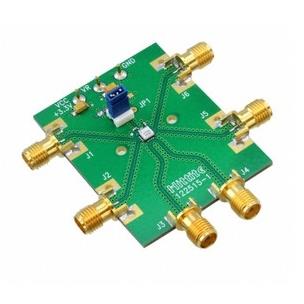
Several products in this category illustrate how varied the selection can be. From Analog Devices, examples include the 122517-HMC746LC3C evaluation PCB and the 125614-HMC851LC3C evaluation PCB assembly for logic gate evaluation, the EVAL-SDP-CS1Z controller board, and the EVAL-CN0202-SDPZ board for PLC/DCS analog output evaluation. These tools are useful where engineers need direct access to a device under test and a practical way to connect it to a lab setup.
There are also more application-oriented platforms, such as the MAXREFDES70# ultrasonic heat meter/flow meter reference design. In a different area, Fairchild evaluation boards such as FEBFOD8332-GEVB and FEBFOD8012-RS485-GEVB support optocoupler-related development and interface validation. For motion and compact electromechanical evaluation, ams OSRAM offerings such as DK-M3-F-1.8-TRK-1.5-S and DK-M3-LS-1.8-6 show how this category can also include smart modules and micro-stage development hardware.
How to choose the right development tool
A practical starting point is the target device or target function. Some boards are tightly tied to a specific component, such as HMC746LC3C, HMC851LC3C, FOD8332, FOD8012, or LTC6957HMS-2. Others are better understood as reference platforms for an application concept, such as flow measurement, analog output, switching, or motion control.
Next, review the available interface and supply requirements. In this category, interface types may include USB, SPI, I2C, RS-485, or specialized board connectors, while supply conditions vary from low-voltage logic rails to higher-voltage system evaluation. Matching these details to your bench equipment, host controller, and test method can save significant setup time.
It is also worth checking whether you need a standalone evaluation board or a tool that depends on a companion controller. Some hardware is intended to work with daughter boards, interposer boards, or controller platforms, so understanding the full evaluation chain helps avoid ordering mismatched tools.
Where these tools fit in a broader development workflow
Not every project begins with a complete system prototype. In many cases, teams first validate one critical block, such as timing distribution, signal isolation, logic behavior, analog output accuracy, or switching performance. This is where mixed-purpose development tools become especially valuable, because they allow focused testing without forcing the engineer into a full custom build too early.
If your work is centered on a more defined signal chain, it may also be useful to compare nearby categories. For example, timing-focused projects may be better served by clock and timer development tools, while precision signal-chain evaluation may align more closely with data conversion IC development tools. This category remains the practical choice when the hardware is application-specific or does not sit cleanly within a narrower development-tool segment.
Representative applications across industry
The products found here can support a wide range of technical environments. Industrial automation teams may use them for analog output and communication interface testing. Electronics design groups may rely on them for logic, clocking, or switching evaluation. Sensing and instrumentation projects can benefit from reference designs that help verify performance before custom firmware and mechanics are finalized.
Some tools in this category also bridge the gap between semiconductor evaluation and system behavior. Examples include ultrasonic metering, smart micro-stage motion hardware, and disconnect switch demo platforms. That makes the category especially relevant for B2B buyers who need hardware that demonstrates not just a component, but a usable engineering path toward integration.
Why this category matters for sourcing and comparison
For technical purchasers, a broad development-tools category simplifies sourcing when project requirements are still evolving. Instead of filtering too early into a narrow product type, buyers can compare boards based on evaluation purpose, interface, supported device, and fit within the lab workflow. This is often more useful at the concept stage than looking only at final production components.
It also helps teams standardize how they evaluate new devices from different suppliers. Whether the requirement is a controller board, a dedicated evaluation PCB, an optocoupler demo board, or an application-oriented test platform, the category gives engineers a place to identify suitable hardware quickly and move from datasheet review to hands-on validation.
Final considerations before ordering
Before selecting a tool, confirm the exact device being evaluated, the interface needed for communication or measurement, and whether any companion boards are required. It is also helpful to align the board with the phase of your project, whether that is initial concept validation, subsystem testing, or application-level demonstration.
Used well, Other Development Tools provides a practical route from idea to measurable results. For engineering teams working outside standard evaluation categories, this range supports faster learning, clearer comparison, and more confident design decisions across industrial, embedded, and electronic development projects.
Get exclusive volume discounts, bulk pricing updates, and new product alerts delivered directly to your inbox.
By subscribing, you agree to our Terms of Service and Privacy Policy.
Direct access to our certified experts


