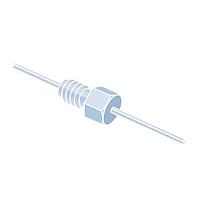
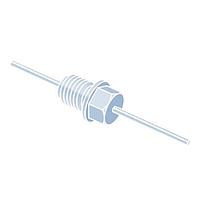
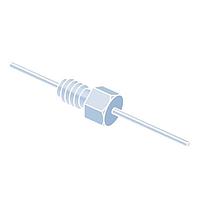
EMI Feedthrough Filters
Unwanted electrical noise often shows up at the worst possible point in a design: where signals or power lines pass through an enclosure, panel, or shield boundary. In those situations, choosing the right EMI feedthrough filters helps reduce conducted interference while preserving the integrity of the equipment around them. These components are widely used in industrial electronics, communications hardware, power systems, and other applications where EMC performance matters from the start.
Compared with general-purpose suppression parts, feedthrough-style solutions are especially useful when noise must be controlled at the point of entry or exit. They support cleaner system integration, help limit coupling between compartments, and are often selected when designers need compact filtering close to connectors, chassis walls, or grounded structures.
Where EMI feedthrough filters fit in an EMC strategy
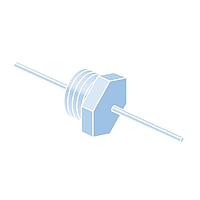
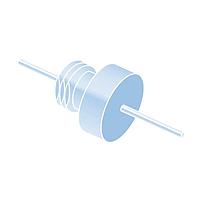
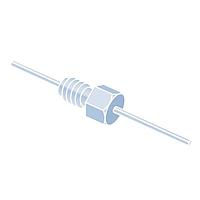
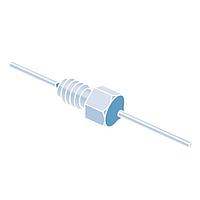
A feedthrough filter is typically designed so the conductor passes through the component while high-frequency noise is diverted to ground. This makes it a practical choice for installations where wiring crosses a metal barrier or where sensitive circuits need localized suppression. In real systems, these filters are often part of a broader EMC approach that can also include shielding, grounding, and complementary filtering stages.
On category pages like this, buyers usually compare several related component types. If your design requires suppression on balanced lines or cable bundles, common mode filters and chokes may also be relevant. When the goal is broader circuit-level conditioning, engineers may also review EMI filter circuits alongside feedthrough options.
Typical forms found in this category
This category covers components used for line filtering in compact and panel-oriented designs, including capacitor feed-through parts and related three-terminal filtering devices. While the exact package, mounting style, and electrical behavior depend on the selected series, the underlying purpose is similar: suppress high-frequency interference with minimal disruption to the intended signal or power path.
Examples in this range include parts such as the Murata DSN6NC51H470Q55B feed through capacitor, the KEMET AFCL060247DJT2T, and KYOCERA AVX devices such as W3H15C4738AT1F and W3H15C1038AT1F. The category also includes parts described as three-terminal filters, such as TDK YFF31PC1C224M and TDK YFF31PC1C104M, which are commonly considered when compact PCB-level EMI suppression is needed.
How engineers usually choose the right part
Selection usually starts with the electrical line being filtered: signal, control, or power. Designers then look at capacitance, rated voltage, temperature range where available, package dimensions, and mounting constraints. In feedthrough applications, mechanical integration is just as important as nominal electrical values because the part often sits at a physical transition point in the system.
For example, some listed products are compact SMD-style parts intended for dense layouts, while others are more suitable for higher-current or panel-mount use. A part such as the TDK B85121A2104A750 power line filter is clearly positioned differently from a miniature feedthrough capacitor like Murata NFM2012P13C104RT1M00. Looking at current path, grounding method, enclosure design, and available installation space will usually narrow the shortlist quickly.
Key application areas
EMI feedthrough filters are commonly specified in equipment where noise can couple into or out of an enclosure through wiring. Typical examples include industrial control panels, motor drive systems, telecom assemblies, instrumentation, embedded electronics, and power conversion equipment. They are also relevant in designs where compliance considerations push engineers to filter at the boundary rather than only on the PCB interior.
These components can also support modular system design. A feedthrough device mounted near a bulkhead or connector can reduce interference before it spreads deeper into the system, which is often more effective than trying to suppress the same noise later. In environments with additional shielding requirements, related materials such as EMI shielding and absorber products may be considered as part of the same design workflow.
Representative manufacturers and product families
This category includes products from established suppliers used across the passive EMI suppression market. Buyers commonly evaluate options from Murata, KEMET, KYOCERA AVX, and TDK depending on the target application, assembly method, and filtering objective. Each manufacturer typically serves slightly different needs across miniature signal filtering, board-level suppression, and heavier-duty line filtering.
Representative products in this selection include Murata NFM40R11C471T1 and Murata NFM39R02C101T1M00 for compact feedthrough filtering, KYOCERA AVX KNH21C473DA3T for capacitor feed-through applications, and TDK B85121A2405E750 for designs requiring another form factor within the same functional family. These examples are useful as reference points when comparing packaging style and intended integration approach rather than as one-size-fits-all choices.
Practical evaluation points before ordering
For B2B sourcing, the most useful comparison is not just capacitance value. Teams typically verify mounting style, grounding concept, dielectric behavior in the intended environment, allowable voltage, and whether the part is meant for signal-level suppression or more robust line filtering. Small differences in package geometry can affect assembly yield and enclosure compatibility, especially in high-density products.
It is also worth checking whether a standalone feedthrough part is sufficient or whether the application will benefit from a more complete suppression network. In some projects, engineers review EMI kits during prototyping to compare approaches before standardizing the final bill of materials.
Finding the right fit for your design
The value of this category lies in giving engineers and procurement teams access to multiple feedthrough filtering formats for different EMC challenges. Whether you are sourcing a compact three-terminal filter for board-level suppression or a larger line-oriented solution for a power path, the right choice depends on where the noise is entering, how the system is grounded, and what physical constraints the design imposes.
By reviewing package style, voltage rating, capacitance range, and installation method in context, it becomes easier to identify a suitable EMI feedthrough filter for long-term product reliability and EMC performance. For projects with stricter noise-control requirements, this category can also serve as a starting point for building a broader suppression strategy across filtering, shielding, and enclosure-level design.
Get exclusive volume discounts, bulk pricing updates, and new product alerts delivered directly to your inbox.
By subscribing, you agree to our Terms of Service and Privacy Policy.
Direct access to our certified experts