Signal Conditioning
Clean, stable signal paths are essential when electronic systems need to measure, transmit, or process data accurately. In practical designs, that often means using the right signal conditioning components to manage interference, route signals reliably, and support consistent electrical performance across the wider circuit.
Within passive component selection, this category is relevant for engineers and buyers working on communication hardware, control electronics, embedded systems, and industrial assemblies where signal integrity matters. It brings together products that play a supporting but important role in how signals are connected, protected, and organized inside the overall system.
Why signal conditioning matters in real applications
Signals are rarely ideal once they move beyond a schematic. Noise, impedance mismatch, routing constraints, connector transitions, and environmental conditions can all affect how reliably a system performs. That is why signal conditioning is often considered early in the design stage rather than treated as an afterthought.
In industrial and B2B environments, this becomes even more important because assemblies may need to operate under vibration, temperature variation, or long service intervals. A well-chosen signal conditioning solution helps maintain dependable transmission paths and supports better overall system behavior, especially when multiple subsystems must interact cleanly.
What you can expect in this category
This category focuses on passive elements and related hardware used to support signal handling within electronic assemblies. Depending on the application, that may include parts used for routing, interface transition, or organized signal distribution where mechanical robustness and connection reliability are critical.
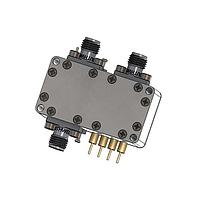
Several featured items here are relay box products from Amphenol, such as the Amphenol EX-13-3-16-377PN-01 Relay box and the Amphenol EX-17-3-C24-R313PN-G Relay box. These examples illustrate how signal conditioning in practice is not limited to purely abstract circuit functions; it also includes structured hardware that supports signal management within larger interconnect and control systems.
Typical use cases for signal conditioning components
Engineers may look for these products when building systems that require orderly signal routing between modules, panels, or field-connected devices. This is common in industrial equipment, communication platforms, test setups, and electronic subsystems where signals must be distributed with repeatable connection quality.
Signal conditioning products can also be relevant when a design needs cleaner interfacing between passive networks and other functional blocks. For example, a system may combine these components with filters to control unwanted frequency content, or with other passive devices to improve stability across the full signal chain.
How to choose the right option
Selection usually starts with the role the component must play in the assembly. Some projects prioritize compact integration, while others focus more on connector format, wiring layout, maintainability, or compatibility with an existing harness and enclosure design. In B2B procurement, consistency across repeated builds is often just as important as the initial technical fit.
It is also worth considering the broader electrical environment. A signal path may interact with nearby RF elements, power sections, or sensitive analog stages, so the right product should align with the complete architecture rather than a single point requirement. If the application involves tuned paths or frequency-sensitive behavior, related categories such as antenna components or other passive building blocks may also influence the final design decision.
Featured product examples in this range
The listed portfolio includes multiple relay box configurations from Amphenol, including the EX-13-3-C20-640SN-01 Relay box, EX-13-3-B-20-38PR-BS Relay box, and 88-569763-98S Relay box. These products are useful references for buyers who need organized, application-oriented hardware within a signal handling ecosystem rather than standalone commodity parts.
Additional examples such as the EX-13-3-C24-R386SN-R-420 Relay box and EX-17-3-16-328SN Relay box show that the category can cover different connection and packaging needs within a similar functional context. Instead of comparing by model name alone, it is usually more effective to evaluate how each option fits the target interface, installation method, and service environment.
Relationship to the wider passive component ecosystem
Signal conditioning rarely works in isolation. In many designs, it supports or depends on surrounding passive elements that shape the electrical response of the circuit. Components such as resistors, capacitive networks, and inductive elements may all contribute to the final signal quality, depending on the application.
That broader context is especially important for designers balancing board-level electrical performance with mechanical interconnection requirements. A practical solution often combines passive components, structured interconnect hardware, and application-specific layout decisions to achieve the needed performance over time.
For engineering teams and technical buyers
For sourcing teams, signal conditioning products are often selected not just for function, but for repeatability, documentation clarity, and compatibility with established design standards. For engineering teams, the priority is usually preserving signal integrity while keeping assembly and maintenance practical.
This is why category-level review can be valuable before narrowing down to a specific model. Looking at the available range helps identify whether the need is centered on routing, interface organization, or support hardware around the signal path, which leads to faster and more accurate product selection.
Final considerations
When signal quality, connection reliability, and system organization all matter, choosing the right signal conditioning components can simplify both design and procurement. The products in this category are best evaluated in the context of the full application, including installation constraints, surrounding passive circuitry, and long-term maintenance needs.
For teams working across industrial electronics, communications, and embedded hardware, this category provides a practical starting point for finding components that support dependable signal handling in real-world assemblies.
Get exclusive volume discounts, bulk pricing updates, and new product alerts delivered directly to your inbox.
By subscribing, you agree to our Terms of Service and Privacy Policy.
Direct access to our certified experts

![Quantic X-Microwave XR-B7J6-0204D Low Pass Filter Low Pass Filter, LFCG-1000+ [PCB: 1014]](/s-cdn/c8/c80590a6abf86462aa5c4ecc2ff04946f83a57cb.jpg)