
RF Amplifier
Stable gain, controlled noise, and enough output power are core requirements in many wireless designs, from broadband front ends to microwave signal chains. Choosing the right RF amplifier is not only about frequency coverage; engineers also need to balance gain, linearity, power consumption, package style, and the role the device plays inside the wider RF path.
On this category page, you can explore RF amplifier devices used in integrated wireless and high-frequency circuits, including general-purpose MMIC amplifiers, application-focused parts for LTE/WiMax or CATV ranges, and higher-frequency solutions for microwave and millimeter-wave designs. The goal is to help buyers, designers, and sourcing teams narrow down suitable parts faster for development, validation, or production.
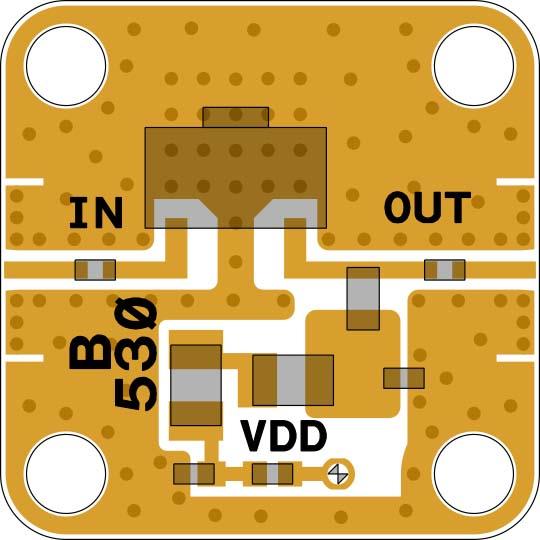
Where RF amplifiers fit in an RF signal chain
An RF amplifier is typically used to increase signal level at a specific point in the chain while preserving signal quality as much as possible. Depending on placement, it may serve as a low-noise stage near the receiver front end, a driver stage before a power block, or a broadband gain stage in test, communication, or distribution equipment.
In practical system design, the amplifier rarely works alone. It is commonly selected alongside devices such as directional couplers, matching networks, filtering stages, and control circuitry. In more complex architectures, it may also sit close to RF multiplexers to route signals across different bands or paths.
Key parameters that matter when selecting a device
The first filter is usually frequency range. Some designs require broadband coverage from tens of megahertz up to several gigahertz, while others target narrow but much higher operating bands in the tens of gigahertz. A part that performs well at sub-1 GHz will not automatically suit 24 GHz, 33 GHz, or 80 GHz class applications.
After frequency, buyers typically compare gain, output compression level such as P1dB, and noise figure. Gain affects signal boost, P1dB gives a practical indication of output capability before compression becomes significant, and noise figure is especially important when the amplifier is used near a sensitive receiver input. Supply voltage, current draw, and surface-mount package style also matter for thermal design, PCB layout, and production compatibility.
Representative products across different frequency bands
This category includes examples from Analog Devices, Broadcom, Maxim Integrated, and Infineon, covering a broad range of RF and microwave needs. For lower-frequency broadband applications, devices such as the Analog Devices HMC627ALP5E and HMC625ALP5E illustrate solutions aimed at LTE/WiMax-related ranges, while the HMC469MS8GETR addresses Cellular/CATV use up to 5 GHz.
For wider or more demanding microwave coverage, the Analog Devices HMC926LP5E reaches from 700 MHz to 2.7 GHz with high gain, while the HMC943LP5E extends into the 24 to 31.5 GHz range for much higher-frequency designs. At the millimeter-wave end, parts such as the HMC8118-SX and HMC8119-SX show how this category can support 70 GHz to 80 GHz class applications where packaging, layout discipline, and signal integrity become even more critical.
The Broadcom AMMP-6333-BLKG is another useful example for 18 to 33 GHz work, while the Maxim Integrated SC1905A-00A00 reflects the broader mix of RF amplifier solutions available for integration into compact, surface-mount assemblies. Not every part here serves the same purpose, so it is worth matching product selection to the exact stage of your RF chain rather than only comparing headline gain values.
Understanding application-driven amplifier choices
Application context often determines what “good performance” actually means. In broadband infrastructure or distribution environments, a designer may prioritize flat gain and acceptable noise behavior over a wide operating span. In wireless communication hardware, linearity and output compression behavior can be more important because signal distortion directly affects modulation quality and spectral compliance.
In microwave and millimeter-wave systems, layout parasitics, interconnect losses, and shielding practices become a larger part of success or failure. That is one reason engineers frequently review adjacent categories such as RF shields when building dense high-frequency boards, especially where unwanted coupling or emissions can degrade amplifier performance.
Manufacturers and ecosystem context
Analog Devices appears prominently in this category, with several amplifier options spanning lower-frequency wireless bands through microwave and millimeter-wave ranges. This makes it easier for design teams to evaluate multiple devices within a familiar ecosystem when comparing gain blocks, MMIC amplifiers, and frequency-specific solutions.
Broadcom, Maxim Integrated, and Infineon also help broaden the selection. The Infineon BF1009SE6327HTSA1, while not a conventional drop-in general-purpose gain block, is relevant as an RF transistor device within the wider high-frequency design ecosystem. For some projects, engineers compare integrated amplifiers with transistor-based approaches depending on biasing strategy, board space, and how much tuning flexibility they want in the final design.
How to narrow the shortlist efficiently
A practical sourcing workflow starts with operating band, then moves to gain and output level, then to noise figure and supply conditions. Once those basics are aligned, package type, thermal constraints, and assembly compatibility usually decide whether a part is truly suitable for prototyping or production release.
It also helps to think one level beyond the amplifier itself. If your design includes frequency translation or phase control, related categories such as phase detectors and shifters may become part of the same evaluation process. Reviewing the surrounding RF architecture early can reduce redesign effort later.
What buyers and engineers should check before ordering
For B2B purchasing, the right part is the one that fits both the electrical target and the supply chain reality of the project. Check whether the amplifier is intended for general-purpose RF use or for a more defined application class such as CATV, LTE/WiMax, or LMDS/MMDS. That distinction can influence system fit more than a single gain number in isolation.
Teams should also verify mounting style, voltage rails, current budget, and whether the available performance window matches the intended PCB design. In higher-frequency builds, even a strong device can underperform if the surrounding board stackup, grounding, and shielding are not aligned with the target operating band.
Conclusion
This RF Amplifier category supports a wide range of wireless, broadband, microwave, and millimeter-wave design needs, with products suited to different gain, frequency, and output requirements. By focusing on signal-chain role, operating band, linearity, and integration constraints, engineers and procurement teams can identify more relevant parts and move from search to selection with greater confidence.
If you are comparing options for a new design or replacing an existing device, use the category filters and product pages to review the most relevant electrical and packaging details before finalizing your shortlist.
Get exclusive volume discounts, bulk pricing updates, and new product alerts delivered directly to your inbox.
By subscribing, you agree to our Terms of Service and Privacy Policy.
Direct access to our certified experts
