
Heat Sinks
Managing heat is a basic requirement in reliable electronics design. When semiconductors, processors, power devices, and control boards run above their intended temperature range, performance can drift, lifetime can shorten, and unplanned shutdowns become more likely. A well-matched heat sink helps move thermal energy away from critical components so systems can operate more consistently in industrial, embedded, and power electronics environments.
Within this category, buyers can compare passive and board-level cooling options for different package styles, mounting methods, and installation constraints. The range includes compact solutions for TO-220 devices, clip-on and bolt-on formats, and larger assemblies suited to board-level cooling, making it easier to select thermal hardware that fits both the component and the mechanical layout.
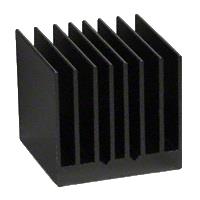
Where heat sinks fit in electronic thermal management
A heat sink works by increasing the available surface area that can release heat into the surrounding air. In passive designs, this happens through natural convection and radiation. In more demanding applications, the heat sink may operate with airflow from fans and blowers to improve heat transfer and reduce thermal resistance.
This makes heat sinks relevant across many B2B use cases, including power supplies, motor drives, industrial controllers, LED assemblies, telecom hardware, embedded computers, and interface boards. Selection is rarely only about size; it also depends on mounting style, airflow conditions, material choice, and the thermal load generated by the device being cooled.
Common heat sink types in this category
This category includes several practical formats used in electronics assembly. Passive heat sinks are often chosen for applications where silent operation, simplicity, and low maintenance are priorities. They are common for transistor packages, regulators, and moderate-power semiconductors where natural convection can provide sufficient cooling.
Board-level heat sinks are used when thermal control needs to be integrated directly into PCB-based designs. They may be mounted vertically, clipped onto a package, or fixed with hardware depending on the package style and mechanical stability required. Some products are designed for specific package families such as TO-220, while others support larger processor-related cooling needs.
For example, the Aavid TV-1500 and Aavid 534302B03553G illustrate compact passive options intended for package-level thermal control, while the Delta Electronics, Inc. FHS-A9025S18 represents a larger board-level approach for CPU-related cooling. These examples show how the category spans from individual semiconductor cooling to broader system-level thermal support.
How to choose the right heat sink
The first step is understanding the thermal path from the heat-generating component to ambient air. Buyers typically review the component power dissipation, allowable junction temperature, ambient operating conditions, and whether airflow is available. A lower thermal resistance can improve cooling performance, but the physical dimensions and mounting method still need to match the real assembly.
Mechanical fit matters just as much as thermal performance. Width, height, and length affect clearance around nearby parts, enclosure space, and connector access. Mounting formats such as clip, bolt-on, twisted screw, or PC pin can influence assembly speed, serviceability, and vibration resistance in industrial equipment.
Material and finish also play a role. Aluminum is widely used because it balances thermal performance, weight, and cost, while black anodized surfaces are common in many designs. In more complex systems, engineers may also monitor hot spots with board mount temperature sensors to validate thermal behavior during development or in-field operation.
Representative manufacturers and product examples
Aavid is strongly represented in this category, with multiple form factors for compact semiconductor cooling and board-mounted applications. Products such as the Aavid 374924B60024G, Aavid 2227B, Aavid 2285B, and Aavid SW63-2 reflect the kind of variety engineers often need when matching package geometry, airflow assumptions, and available board space.
Amphenol also appears in the range with heat sink options that can support application-specific thermal requirements, while Delta Electronics, Inc. adds examples of larger cooling hardware for board-level processor use. Rather than choosing by brand alone, it is usually more effective to compare mounting style, target package, thermal resistance, and installation constraints side by side.
Applications across industrial and embedded systems
Heat sinks are used anywhere excess heat can affect stability, accuracy, or service life. In power conversion equipment, they help cool switching devices and regulators. In embedded systems and industrial computing, they support processors, chipsets, and interface components that must remain within design limits even in compact enclosures.
They are also important in automation panels, communication equipment, lighting assemblies, and control boards where temperature rise can build up over time. In these environments, thermal protection may be paired with components such as thermal cutoffs or sensing devices to create a more complete thermal management strategy.
Practical buying considerations for B2B sourcing
For OEMs, panel builders, and maintenance teams, a suitable heat sink should be evaluated as part of the entire assembly process. Buyers often look beyond the headline dimensions to confirm package compatibility, mounting hardware requirements, orientation, and whether the cooling method is passive or intended to work with airflow.
It is also useful to think about future service conditions. If the equipment will operate in warm cabinets, dusty industrial spaces, or variable duty cycles, thermal margin becomes more important. A slightly different fin geometry, mounting approach, or larger profile can make a meaningful difference in long-term reliability.
When comparing products in this category, examples such as the Aavid PAAD14020BM PF00, Aavid 437469, Aavid 6399BP2G, and Amphenol HST ABK 6.0/1.27 (00) can serve as reference points for understanding the available range. The goal is not simply to find a part that fits, but to choose one that supports stable thermal performance in the real application.
Supporting a more complete thermal design
A heat sink is often one part of a broader thermal design approach. In some systems, airflow, temperature sensing, shutdown protection, and enclosure layout all influence the final result. That is why thermal component selection is often tied closely to adjacent categories such as airflow devices, sensors, and protective components rather than treated as an isolated purchase.
For design engineers and procurement teams alike, this category provides a practical starting point for package-level and board-level cooling needs. By comparing form factor, mounting method, and thermal behavior in context, it becomes easier to shortlist heat sinks that align with both electrical requirements and mechanical realities.
Choosing the right thermal hardware usually comes down to fit, heat load, and operating environment. A carefully selected heat sink can help improve reliability, reduce thermal stress, and support more predictable system performance over time.
Get exclusive volume discounts, bulk pricing updates, and new product alerts delivered directly to your inbox.
By subscribing, you agree to our Terms of Service and Privacy Policy.
Direct access to our certified experts