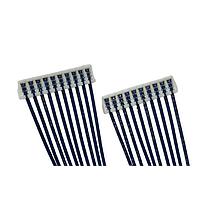
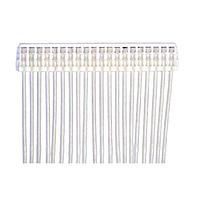
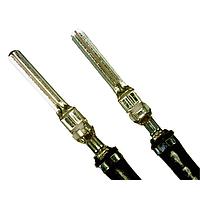
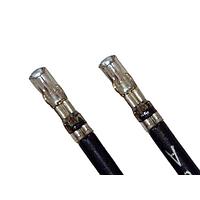
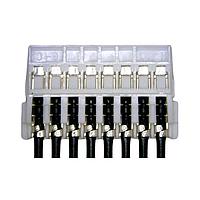
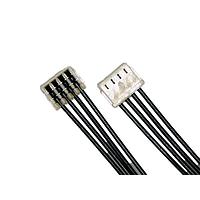
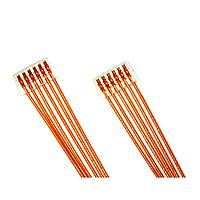
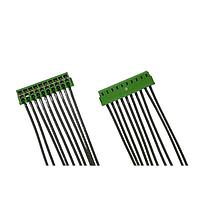
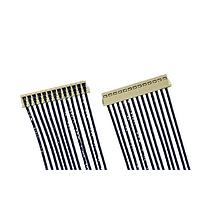
Rectangular Cable Assemblies
When equipment inside a cabinet, machine, test fixture, or embedded system needs a fast and reliable board-to-board or board-to-device connection, cable assemblies with rectangular interfaces are often the practical choice. They help simplify routing, reduce wiring errors, and make maintenance easier in applications where space, pin count, and repeatable mating matter.
Rectangular Cable Assemblies are commonly used wherever multiple signals need to be carried through compact connectors in an organized harness format. This category is especially relevant for engineers, buyers, and maintenance teams looking for ready-made interconnect solutions that fit electronic control systems, instrumentation, prototyping, and industrial equipment.
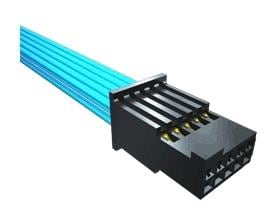
Where rectangular cable assemblies fit in real applications
Unlike round-interface cable formats used for networking or external I/O, rectangular cable assemblies are often selected for internal connections where pin density, keyed mating, and cable organization are more important than exposed field use. They are frequently found in control electronics, compact instrumentation, development platforms, and machine subsystems that require stable multi-position interconnects.
In many designs, these assemblies support signal transfer between daughter boards, interface modules, display sections, or controller assemblies. They can also be useful in serviceable equipment because a pre-terminated assembly reduces manual wiring effort and helps maintain consistent connector orientation during installation.
Common construction features in this category
Products in this range may vary in length, number of positions, and end configuration, but several patterns appear consistently. Many examples in this category use IDC termination, a practical approach for mass termination of ribbon-style conductors, especially when repeatability and compact connector geometry are important.
Another useful feature is the presence of a polarizing key, which helps prevent incorrect mating during assembly or servicing. Depending on the product, buyers may also see socket-to-socket or socket-to-cable formats, making it easier to match the assembly to a board header, internal module, or mating connector already defined in the system design.
What to evaluate before selecting a cable assembly
The first step is to confirm the connector interface and pin count required by the mating hardware. In this category, examples include compact 10-position, 20-position, and 30-position formats, so the assembly should be chosen based on the actual signal requirement rather than simply matching physical appearance.
Cable length is also important. A shorter assembly may help reduce clutter and improve airflow in enclosures, while a longer one gives more flexibility for routing around brackets, power modules, or moving subassemblies. Buyers should also check connector pitch, termination style, and whether the intended application benefits from unshielded ribbon-style construction or needs a different cable family altogether.
Representative products from leading brands
This category includes a strong concentration of solutions from 3M, a widely recognized manufacturer for interconnect and cable assembly products. Examples such as the 3M 45110-010030-3749/10-D-3, 3M 45120-010030-3749/20-D-3, and 3M 45130-010030-7700/30-C-06 illustrate how the range spans different position counts and lengths for compact internal connections.
There are also options such as the 3M M3UGK-1606J, 3M M3GGK-4006R, and 3M M3AEK-5018J, which are useful references for buyers comparing series variations within the same overall connector family. For development-oriented or electronics project environments, Adafruit is also represented in this category with the Adafruit 1199 rectangular cable assembly.
How these assemblies support assembly efficiency and serviceability
Pre-assembled cable solutions can reduce the time and variability associated with manual crimping or point-to-point wiring. In production and maintenance settings, that can translate into faster installation, easier replacement, and a lower chance of pin mapping mistakes, especially when systems use repeated connector patterns across several modules.
For service teams, clearly defined multi-position assemblies are often easier to document and replace than loose discrete conductors. This matters in equipment where uptime is important and where access inside the enclosure may be limited. A keyed rectangular assembly can make field replacement more straightforward without requiring the technician to rebuild the harness on site.
Related cable types for other interface needs
Not every multi-conductor application is best served by a rectangular interface. If the connection point is based on a standard computer peripheral format, it may be more appropriate to review computer cables instead. Likewise, systems using legacy serial-style connectors may be better matched to D-Sub cables.
For data communications or external network infrastructure, rectangular board-level cable assemblies generally serve a different purpose than Ethernet patching and network interconnects. In those cases, a dedicated category such as Ethernet and networking cables is usually the more relevant place to compare options.
Who typically buys from this category
These products are relevant to OEMs, panel builders, test engineers, repair teams, and technical procurement professionals who need dependable interconnect components without the extra work of custom cable preparation. They are also suitable for prototyping environments where fast integration and repeatable connector alignment are more important than building each cable from individual parts.
In B2B purchasing workflows, rectangular cable assemblies are often selected as part of a broader bill of materials for control electronics, embedded hardware, or measurement systems. Having access to multiple lengths, position counts, and series types helps teams standardize on an assembly approach that supports both production and maintenance requirements.
Choosing the right option for your system
A good selection process starts with the mating connector format, required number of conductors, available installation space, and routing path inside the equipment. From there, it makes sense to compare assembly length, end configuration, and practical features such as keyed alignment and IDC-style construction.
If your application depends on compact, organized, multi-position internal connections, this category provides a focused starting point for evaluating suitable assemblies. By matching the cable format to the real electrical and mechanical needs of the system, buyers can streamline integration and improve long-term serviceability.
Get exclusive volume discounts, bulk pricing updates, and new product alerts delivered directly to your inbox.
By subscribing, you agree to our Terms of Service and Privacy Policy.
Direct access to our certified experts