Ribbon / IDC Cables
When compact, organized signal routing matters, flat cable formats are often the practical choice for board-to-board, panel-to-board, and internal equipment wiring. Ribbon / IDC Cables are widely used in electronic assemblies because they simplify conductor identification, support neat cable management, and fit well in space-constrained designs where round cable bundles may be less convenient.
In industrial and OEM environments, these cable solutions are commonly selected for repeatable interconnect layouts, mass termination workflows, and multi-conductor signal distribution. This category is especially relevant for engineers, buyers, and maintenance teams looking for reliable cable assemblies or bulk flat cable options for prototyping, production, or replacement needs.
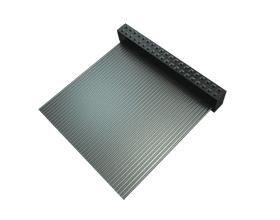
Where ribbon and IDC cable formats are commonly used
Flat ribbon cable is a familiar choice inside control electronics, embedded systems, instrumentation, computing hardware, and test fixtures. Its parallel conductor layout helps keep wiring organized and makes it easier to route multiple signals between connectors without creating unnecessary bulk. In many applications, this supports cleaner assembly work and faster identification during service or troubleshooting.
IDC termination, or insulation displacement contact termination, is often paired with ribbon cable to speed up connection of multiple conductors in a single operation. This makes the format useful in production environments where consistent termination and repeatable harness construction are important. Depending on the design, buyers may be looking for finished assemblies or cable rolls that can be cut and terminated to suit a specific interface.
Understanding the difference between cable assemblies and bulk flat cable
This category can include both pre-terminated assemblies and un-terminated flat cable. Prebuilt options are useful when the connection style, length, and mating interface are already defined, helping reduce assembly time and installation variability. Bulk cable, on the other hand, is more suitable when teams need flexibility for custom lengths or in-house termination.
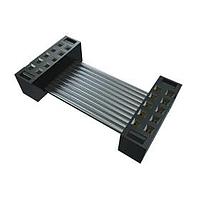
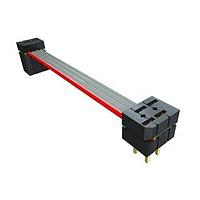
For example, the Amphenol GP-IE515546DS-000.3 Flat/Ribbon Cable Assembly and the 3M 8KH3-0734-0250 Twin Axial Cable Assemblies, Pcie X8 Jumper illustrate how flat cable concepts can be applied in ready-to-install interconnect solutions. At the same time, products such as the 3M 3625/10 100M Flat Cable 10Conductors 28AWG 100m Tinned Copper Gray/Red Edge 300V Roll are more aligned with custom cable preparation and production use.
Key selection points for Ribbon / IDC Cables
Choosing the right cable starts with the electrical and mechanical requirements of the application. Buyers typically compare conductor count, wire gauge, pitch, cable length, and expected routing space. In flat cable designs, pitch has a direct effect on connector compatibility, while conductor count influences how many signals or power lines can be grouped into a single cable run.
Environmental conditions also matter. Temperature range, insulation characteristics, and voltage rating should be checked against the installation environment, especially in enclosed equipment or industrial cabinets. Some listed examples in this category, such as 3M 3302/16 Flat Cable 16Conductors 28AWG 30.48m/91.44m Tinned Copper 300V Roll, show how standard flat cable options can support structured internal wiring where a known pitch and voltage class are needed.
Another practical consideration is how the cable will be terminated. If the design uses IDC connectors, the cable must match the connector system correctly. If the goal is a finished jumper or interface lead, it may also be worth reviewing related computer cable options when the application extends beyond internal board-level wiring.
Typical product styles found in this category
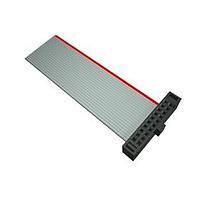
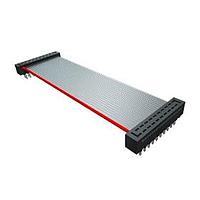
Not every ribbon cable serves the same role. Some items are supplied as standard gray flat cable with a colored edge marker to identify conductor orientation, while others use color-coded conductor patterns that can make assembly and maintenance easier. The selection may also include dedicated ribbon cable assemblies intended for direct installation, rather than raw cable for workshop termination.
Examples from this category include 3M 1700/36SF Ribbon Cables, 3M 1785/40SF Ribbon Cables, and 3M 3770/12 Ribbon Cables, alongside Amphenol items such as 135-2802-337, 135-2801-034, and 191-2811-060 Ribbon Cables. These examples are useful for understanding the range of formats available, from standard ribbon constructions to more application-specific assembly styles.
Manufacturers commonly associated with this range
3M is widely recognized in flat cable and interconnect ecosystems, particularly for applications where repeatable cable geometry and compatibility with common termination systems are important. In this category, 3M examples help illustrate both bulk flat cable rolls and finished ribbon cable products used across electronics manufacturing and equipment integration.
Amphenol is another relevant manufacturer here, especially where cable assemblies and interconnect-oriented solutions are needed. For buyers comparing options, it can be useful to look at both the cable form and the broader connector ecosystem behind it, since long-term serviceability often depends on matching the cable to a practical termination and mating strategy.
How Ribbon / IDC Cables fit into a broader cable selection
Ribbon and IDC formats are usually chosen for internal signal distribution, short structured cable runs, or compact interconnect layouts. They are not always the right fit for every interface. If the application requires shielded external connectivity, rugged networking, or standard I/O interfaces, another cable family may be more appropriate.
For example, projects involving structured data links may be better served by Ethernet and networking cables, while legacy or panel I/O applications may call for D-Sub cable assemblies. Looking at the cable in the context of the full signal path usually leads to a better purchasing decision than focusing on cable shape alone.
What to review before placing an order
Before selecting a part, it helps to confirm whether you need a finished assembly or a bulk cable roll, then verify the conductor count, pitch, and target termination method. Cable length should be chosen with enough margin for routing, but not so much that excess cable creates strain, airflow obstruction, or unnecessary clutter inside the enclosure.
It is also worth checking whether the cable will be used in a prototype, a one-off maintenance repair, or a production build. For recurring builds, standardized flat cable options can make documentation and assembly processes easier. For field replacement, a ready-made assembly may reduce installation time and lower the risk of wiring errors.
Choosing with application fit in mind
The right ribbon or IDC cable is usually the one that matches the connector system, installation environment, and assembly workflow rather than the one with the broadest general specifications. Whether you need a bulk 3M flat cable for custom termination or an Amphenol assembly for a defined interconnect path, the goal is the same: dependable multi-conductor routing that is easy to install, identify, and maintain.
By comparing cable structure, termination method, and intended use case, buyers can narrow this category to the options that genuinely fit their equipment design. That approach makes cable selection more efficient and helps ensure the chosen product supports both current integration needs and future servicing requirements.
Get exclusive volume discounts, bulk pricing updates, and new product alerts delivered directly to your inbox.
By subscribing, you agree to our Terms of Service and Privacy Policy.
Direct access to our certified experts