
Cable Ties
Keeping cable runs organized is a small detail that has a big impact on installation quality, serviceability, and long-term reliability. In control panels, production equipment, network cabinets, and general electrical assemblies, cable ties help secure conductors, separate bundles, and reduce the risk of movement, abrasion, or accidental strain.
This category brings together cable management options used across industrial, commercial, and infrastructure projects. Whether the priority is fast bundling during assembly, cleaner routing in dense cabinets, or more flexible fastening for sensitive wiring, choosing the right tie style and material can make day-to-day installation and maintenance much easier.
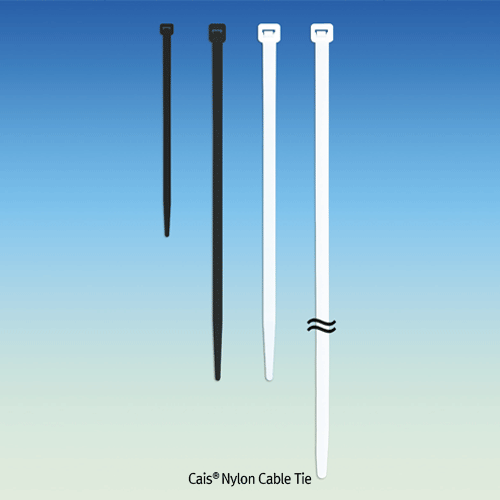
Where cable ties are used in technical environments
In B2B applications, cable ties are not only used for basic bundling. They are commonly selected for routing internal panel wiring, securing harnesses in machinery, organizing communication cables, and keeping field wiring neat during installation. A properly chosen tie helps maintain bundle integrity without adding unnecessary bulk or complexity.
They are also useful in environments where technicians need clear cable paths for troubleshooting or future expansion. When wires are grouped consistently and supported correctly, it becomes easier to identify circuits, reduce clutter, and keep maintenance work efficient. In broader cable-management projects, cable ties are often used alongside products in hook-up wire and other wiring categories.
Common cable tie types and selection logic
Not every bundle requires the same fastening method. Standard nylon ties are widely used for general wire management, while specialized formats can better suit routing, identification, or repeated adjustments. The right choice usually depends on bundle size, installation method, expected stress, and whether the tie will be removed or repositioned later.
For example, reusable or releasable styles can be practical when technicians need ongoing access to the cabling. Hook-and-loop options may be preferred for data or communication wiring where gentler fastening is important. Heavier-duty ties are often selected for larger bundles or where mechanical strength matters more than frequent rework.
- Standard cable ties for everyday bundling and routing
- Releasable ties for maintenance-friendly installations
- Mounting or fastening variants for more controlled cable positioning
- Hook-and-loop styles for adjustable bundling and sensitive cable jackets
Examples from leading manufacturers
This category includes solutions from established cable management brands such as HellermannTyton and Panduit. These manufacturers are widely specified in professional electrical and wiring applications where consistent quality and dependable installation performance are important.
Representative products in this range include HellermannTyton MK8-P4-2, HellermannTyton 111-01620, HellermannTyton T40L-W(100pcs), and HellermannTyton RELK2M NAT (PK100). For applications that benefit from adjustable fastening, the Panduit UGCTE5S-X6 hook-and-loop cable tie is another relevant example. These products illustrate the variety available within the category, from standard bundling ties to more application-specific cable management options.
How to choose the right cable tie for your application
A practical starting point is the bundle diameter and the amount of holding force required. Larger cable groups, heavier harnesses, or bundles subject to movement may need a wider or more robust tie, while compact control wiring can often be managed with smaller formats. Over-specifying can make installation awkward, while under-specifying can lead to loose routing or premature replacement.
It is also important to consider the cable jacket and the installation environment. Some applications need a fastening method that can be tightened securely without damaging insulation, while others may benefit from a tie that can be reopened during commissioning or service. In installations involving communications or optical links, a gentler bundling approach may be preferable near related fiber optic cabling.
When evaluating options, buyers typically look at:
- Length and width relative to the cable bundle
- Whether the tie is intended for one-time or reusable fastening
- Required mechanical hold for the installation
- Ease of routing in tight or high-density spaces
- Compatibility with the overall cable management method
Why cable management quality matters
Well-organized wiring supports both appearance and function. In industrial cabinets and machinery, tidy cable runs can improve airflow, reduce snagging risk, and make it easier to inspect terminations or replace components. This is especially valuable in systems where multiple wire types, signal paths, or service loops need to coexist in limited space.
Good cable management also helps standardize assembly work across repeated builds. Using appropriate ties consistently can support cleaner harness layouts, reduce installation variability, and simplify downstream service. Where projects involve mixed cable types, it may also be helpful to review related options such as specialized cables to ensure the fastening method suits the cable construction and application.
Typical product variations in this category
Although many buyers search for a cable tie as a simple commodity item, the category often includes meaningful differences in form and use. Some products are optimized for compact panel work, others for longer wraps around larger bundles, and others for easy release or repeated adjustments. Even within one manufacturer range, the intended use can vary significantly.
Examples in this category reflect that range. HellermannTyton CTM30C2, MST9L, MST9G-P03, 118-00079, and 113-05019(100pcs) show how buyers may encounter multiple formats suited to different bundling tasks. Instead of selecting by part number alone, it is more effective to match the tie to installation conditions, cable type, and service expectations.
Supporting procurement and project requirements
For OEMs, panel builders, contractors, and maintenance teams, cable ties are often purchased in volume and used across many stages of a project. Selection therefore needs to balance availability, installation speed, and fit for purpose. A consistent tie strategy can help streamline assembly work, improve stock planning, and reduce variation between builds.
This is also why buyers often prefer recognized suppliers such as HellermannTyton and Panduit when standardizing cable management components. In multi-site operations or repeat machine builds, using proven product families can make replenishment and maintenance planning more straightforward.
Find cable ties that fit your wiring and bundling needs
The most suitable cable tie depends on how the cables are routed, how often the bundle may need to be reopened, and how much support the installation requires. For simple wire grouping, standard ties may be enough; for more sensitive or adjustable cable management, releasable or hook-and-loop options can be a better fit.
Explore this category to compare cable ties for general electrical work, control panel assembly, communications cabling, and broader industrial cable management tasks. A well-matched fastening solution helps create cleaner installations, easier maintenance access, and more dependable cable organization over time.
Get exclusive volume discounts, bulk pricing updates, and new product alerts delivered directly to your inbox.
By subscribing, you agree to our Terms of Service and Privacy Policy.
Direct access to our certified experts
