T-Handle
When fasteners sit deep inside machinery, behind panels, or in narrow maintenance spaces, tool geometry matters just as much as torque. A T-Handle gives technicians a practical combination of reach, leverage, and control, making it a common choice for assembly, maintenance, automotive work, and general industrial service tasks.
On this page, you can explore T-handle tools used for hex driving, nut driving, and socket-based tightening. The category is suitable for users who need a compact hand tool for repeated fastening work without moving up to larger ratcheting or powered systems.

Why T-handle tools are widely used
The main advantage of a T-handle design is the balanced grip. With force applied through a cross handle, the operator can usually generate more controlled turning effort than with a straight screwdriver-style tool, while still keeping the wrist in a comfortable position. This is especially useful in repetitive tightening or loosening work.
Another reason these tools remain popular is access. Many T-handle wrenches and drivers are built with a long shaft that reaches recessed fasteners more easily. For maintenance teams working on equipment frames, vehicle assemblies, or service points inside machines, that extra reach can save time and reduce the need to disassemble surrounding parts.
Common types found in this category
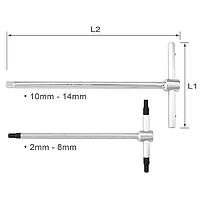
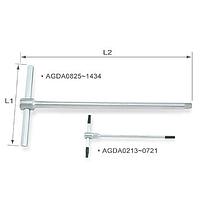
This category covers several practical formats rather than a single tool style. A classic example is the hex-key version, such as the TOPTUL AGDB0518 T-Type Hex Key Wrench 5x180mm, which is suited to internal hex fasteners where direct alignment and stable hand force are important.
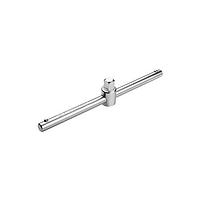
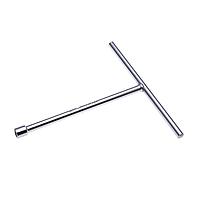
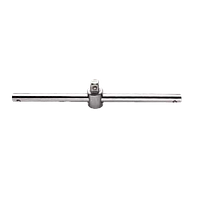
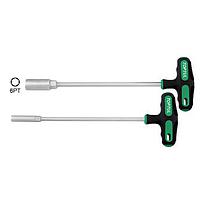
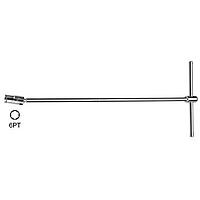
There are also nut driver T-handles, represented here by the TOPTUL GEA0410 Hex Nut Driver T-Handle Set (4 pcs), which fits common nut sizes for service and installation tasks. For socket-based applications, a tool such as the TOPTUL CTCK1625 Sliding T-Handle 1/2" L=250mm provides a flexible way to drive sockets, while the TOPTUL CJBT1627 gearless reversible ratchet handle adds faster operation when repeated turning is needed.
Some T-shaped tools are designed around specific workshop needs. The KTC XH-17-23 Cross Rim Wrench is a good example of a multi-size format used where wheel-related service work requires quick access to several common sizes in one tool.
Choosing the right T-handle for the job
A good starting point is the fastener type. Internal hex screws call for T-handle hex keys, while hex nuts are better matched with a nut driver format. If the work involves interchangeable sockets, a square-drive T-handle or ratchet handle is often the better option because it supports a wider range of sockets and service tasks.
Length is also important. Long-shaft versions help when fasteners are recessed or partially obstructed, while shorter tools can feel more rigid and easier to control in open work areas. The KTC THF2 series, including short and long flexible T-shaped wrench variants, shows how handle length and overall reach affect usability in different maintenance environments.
It is also worth considering whether you need fixed simplicity or added flexibility. A basic T-handle wrench is straightforward and durable for direct turning, while a sliding or reversible design can improve efficiency when the working position changes frequently. If your tasks often expand beyond a single driver format, a socket wrench set may also be a useful companion category.
Where T-handle tools fit in maintenance and assembly work
T-handle tools are commonly used in equipment installation, line maintenance, automotive service, and general workshop repair. Their shape makes them practical for medium-torque fastening where the user needs a controlled manual feel rather than the speed of a power tool. They are especially helpful when a fastener must be seated carefully to avoid cross-threading or misalignment.
In service operations, these tools often sit between basic hand drivers and larger wrench systems. A technician may use a T-handle for access and positioning, then move to a different tool if final torque control or higher torque is required. For broader workshop coverage, users often pair them with items from a hex wrench set range for compact storage and size flexibility.
Representative brands and product examples
Several established tool brands are associated with this category. Among the options highlighted here, TOPTUL appears in T-type hex key, nut driver, sliding handle, and ratchet handle formats, making it relevant for users building a more complete fastening toolkit around one brand family.
KTC is also represented with flexible T-shaped wrench models in multiple sizes, such as THF2-10L, THF2-12L, THF2-13L, THF2-14L, and THF2-17L, along with shorter THF2 versions. These examples help illustrate a typical selection logic: choose the size and reach that best match the fastener position and the available swing space around the work area.
Other manufacturers available in the broader tool ecosystem for this category include SATA, STANLEY, Koken, YATO, TOP Kogyo, CROSSMAN, Flag, and TOP (Taiwan). Selection often depends on preferred handle style, workshop standards, and compatibility with the rest of the user's hand tool inventory.
Selection factors that matter in real use
For B2B buyers and maintenance teams, practical details usually matter more than broad marketing claims. Check the drive or size standard first, then consider shaft length, handle width, and whether the tool needs to work in deep or partially blocked positions. A long tool can improve access, but only if there is enough clearance to rotate the handle.
Another key factor is workflow. If operators frequently switch between sizes, sets such as a nut driver assortment may reduce downtime. If the work is varied and field-based, combining T-handle tools with a repair kit can make day-to-day service work more efficient by keeping complementary tools together.
How this category supports a complete hand tool setup
T-handle tools are not meant to replace every wrench or driver in a workshop. Instead, they fill a very useful middle ground: better leverage than a straight driver, more direct feel than many larger ratcheting systems, and easier access to certain fastener positions. That makes them valuable in both dedicated service kits and fixed maintenance stations.
If you are comparing options in this category, focus on the specific fastening task, the required access length, and whether a fixed, sliding, flexible, or reversible format makes the most sense. A well-chosen T-handle tool can improve speed, comfort, and consistency in everyday assembly and maintenance work without adding unnecessary complexity.
Get exclusive volume discounts, bulk pricing updates, and new product alerts delivered directly to your inbox.
By subscribing, you agree to our Terms of Service and Privacy Policy.
Direct access to our certified experts