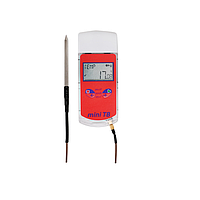
Humidity - Temperature Datalogger
Stable environmental data is critical in storage rooms, laboratories, production areas, clean spaces, and building services. When conditions need to be verified over time rather than checked at a single moment, a humidity - temperature datalogger gives teams a practical way to record trends, review alarms, and document compliance requirements with more confidence.
On this page, buyers can explore instruments designed to monitor temperature and relative humidity across different operating ranges and logging intervals. These devices are widely used for condition tracking, preventive maintenance, transport validation, and general environmental monitoring where traceable records matter.

Why humidity and temperature logging matters
Many processes are affected not only by peak values, but by how conditions change throughout the day or across an entire storage cycle. Short-term measurements from a handheld meter are useful for spot checks, but they do not always show drift, recurring fluctuations, or excursions outside an acceptable range. A logger fills that gap by creating a continuous history that can be reviewed later.
This is especially relevant where products, materials, or test results are sensitive to moisture and heat. Warehouses, pharmaceutical areas, electronics handling, museums, food storage, HVAC validation, and general industrial facilities often need continuous monitoring to support quality control and troubleshooting.
What to expect from this category
Products in this category typically combine onboard sensors, internal memory, and configurable sampling intervals in a compact form factor. Depending on the model, users may export records in common file formats, connect through USB, or use software for evaluation and reporting. Protection features such as IP-rated housings can also be important when the logger is used in field or plant environments.
Some applications require only ambient temperature tracking, while others need combined temperature and relative humidity records in one device. If your use case is focused primarily on mixed environmental conditions, this category is closely related to broader Ethernet and wireless data loggers for remote monitoring and networked installations.
Representative product types in this range
A compact example is the TESTO 174 T Mini Temperature Data Logger, which is suited to routine temperature recording in refrigerators, rooms, cabinets, and transport environments. Its small size, internal memory, and configurable measurement interval make it useful where space is limited and periodic data retrieval is acceptable.
For applications that need both ambient temperature and humidity in one instrument, the Amprobe TR200-A Temperature and Relative Humidity Data Logger provides combined monitoring with onboard display and alarm indication. This type of logger is often selected for indoor environmental supervision, storage checks, and general facility monitoring where relative humidity trends are as important as temperature stability.
In more specialized process environments, some dataloggers also extend beyond basic ambient logging. For example, the EXTECH SDL100-0 pH/ORP/Temperature Datalogger shows how logging functions can support broader measurement tasks when temperature needs to be recorded alongside process variables. If your requirement is centered on electrical parameters instead, you may also want to review the electric datalogger range.
How to choose the right logger
The first step is defining what must be measured and where the device will be installed. For ambient room applications, a standard integrated sensor may be enough. For colder storage, transport, or demanding environments, pay attention to the logger’s operating range, enclosure protection, and memory capacity. A unit intended for dry indoor use may not be ideal for exposed or frequently cleaned areas.
Sampling interval is another important factor. Fast sampling can capture short events, but it also consumes memory more quickly. Longer intervals are often sufficient for room monitoring, while transport validation or sensitive storage may require more frequent logging. Buyers should also check how data is retrieved, whether reporting software is available, and how easy it is to export records for audits or internal documentation.
Where network visibility is required, a standalone USB logger may not be enough. In that case, it can be more efficient to compare with wireless and Ethernet-based logger options that support centralized data access and multi-point monitoring.
Typical industrial and commercial applications
Humidity and temperature dataloggers are used across many sectors because environmental conditions affect both product integrity and process consistency. Common examples include monitoring storage rooms for raw materials, checking climate stability in laboratories, documenting conditions during shipping, and tracking HVAC performance in offices or technical spaces.
They are also valuable during commissioning and maintenance work. A logger can help identify overnight temperature drops, humidity spikes during equipment shutdown, or recurring issues linked to ventilation cycles. In this sense, the instrument serves not just as a recorder but as a practical diagnostic tool for facility teams and quality personnel.
Brands and ecosystem considerations
This category includes products associated with recognized instrumentation manufacturers such as Amprobe, TESTO, and EXTECH, while the wider catalog also reflects strong measurement ecosystems from brands like VAISALA, OMEGA, Dwyer, HIOKI, and Jumo. Choosing among them usually depends less on brand name alone and more on the fit between the logging method, environment, software workflow, and maintenance expectations.
For many B2B buyers, the real decision is about system compatibility and operating routine. A small standalone logger may be ideal for local checks and periodic audits, while larger monitoring programs may require expandable architectures, remote access, or integration with related data acquisition tools. If the goal is to track incidents rather than environmental values over time, the event data logger category may be more relevant.
Using logged data effectively
Collecting measurements is only the first step. The value of a datalogger comes from turning stored records into actionable information: identifying deviations, comparing time periods, confirming storage conditions, and supporting process improvement. Exportable data and basic reporting features are often enough for many facilities, especially when records need to be shared with QA, engineering, or external stakeholders.
It also helps to define clear alarm thresholds, logging intervals, and review procedures before deployment. A well-configured logger supports better decision-making than one that simply stores data without a clear monitoring plan. For routine operations, that means fewer blind spots and faster response when conditions move outside expected limits.
Final considerations
Choosing the right humidity and temperature datalogger is mainly about matching the device to the environment, the required record quality, and the way your team reviews data. Whether the priority is compact temperature logging, combined humidity monitoring, or a broader measurement workflow, this category supports practical options for day-to-day industrial and commercial use.
By comparing measurement range, memory, interval settings, ingress protection, and data handling method, buyers can narrow the selection to the most suitable solution without overcomplicating the system. A well-matched logger makes environmental monitoring easier to manage and more useful over the long term.
Get exclusive volume discounts, bulk pricing updates, and new product alerts delivered directly to your inbox.
By subscribing, you agree to our Terms of Service and Privacy Policy.
Direct access to our certified experts