
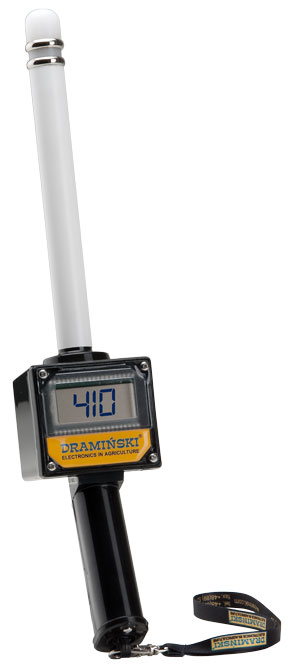
DRAMINSKI EDS Estrous Detector For Sheep And Goats
Electronic estrous detector enables the breeder to determine an exact time during the ovarian cycle when ovulation occurs.
Electronic estrous detector – why should you have it?
- Makes it easier to determine an optimum mating time for females with atypical estrous cycles
- It enables users to detect an asymptomatic estrous period (silent heat)
- Makes insemination more effective
- Improves the economic performance of farms
- Easy to clean and disinfect
- Water resistant casing
- Light and ergonomic casing
Principle of operation
By registering changes in the electrical resistance of mucus, the breeder can establish symptoms of a forthcoming estrous.
In addition to detecting the best date of mating, the estrous detector may also be used to confirm early pregnancy (from 19 to 23 day following mating). If the female animal is not pregnant, the device determines another estrous period occurring in these days.
Measurements are easy to make and consist in inserting the probe with two electrodes to the animal’s vagina and reading the measurement.
To detect estrous or early pregnancy you should make one or two measurements per day for several consecutive days.
The set includes:
- DRAMIŃSKI EDS estrous detector,
- 1 x 9V 6F-22 type battery,
- reusable transport packaging (made of plastic),
- manual.
| Unit weight | 345 g (with battery) | |
| Dimensions | 38.0 x 7.0 x 9.0 cm | |
| Length of the probe | 20 cm | |
| Power supply | 1 x 9 V battery, type 6F-22 | |
| Battery low indication | automatic | |
| Power input | about 18 mA | |
| Measurement control | single chip microcomputer | |
| Estimated working time on one battery pack | about 22h | |
| Display | LCD, 3.5 digits | |
| Measuring range | 0-1990 units | |
| Measurement resolution | 10 units | |
| Recommended working temperature | from 0°C to 50°C | |
| Recommended storage temperature | from 5°C to 45°C |
Get exclusive volume discounts, bulk pricing updates, and new product alerts delivered directly to your inbox.
By subscribing, you agree to our Terms of Service and Privacy Policy.
Direct access to our certified experts