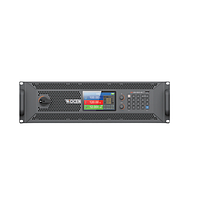
Power Supply Tester
Reliable power conversion and verification are critical in electronics manufacturing, maintenance, and laboratory testing. When a power unit must be checked for output stability, protection behavior, communication, or operating range, choosing the right Power Supply Tester helps engineers shorten validation time and improve confidence in test results.
This category brings together instruments used to evaluate DC power supplies and related power equipment under controlled conditions. It is especially relevant for production test benches, service centers, R&D environments, and electrical inspection tasks where repeatable measurement, load simulation, and data capture are part of the workflow.
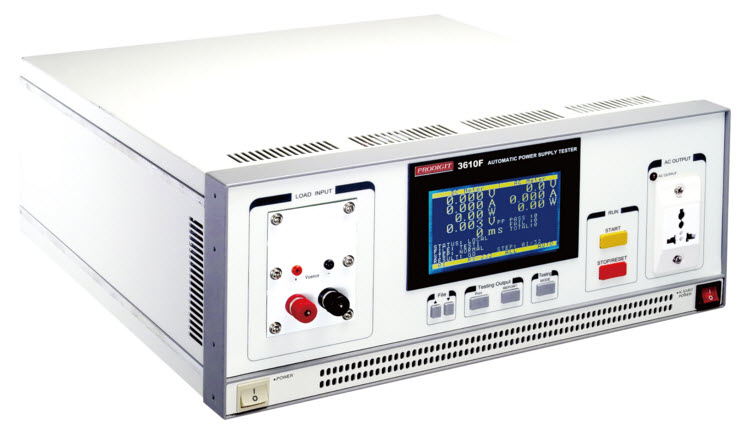
Where power supply testers fit in a test setup
In many applications, a power supply cannot be assessed by voltage reading alone. Engineers often need to verify output accuracy, current behavior, response to changing conditions, protection thresholds, and long-duration operation. A dedicated tester supports these tasks by combining measurement, control, and practical interfaces for bench or line testing.
Depending on the method being used, the tester may work alongside programmable sources, measuring devices, or an AC/DC electronic load to create realistic operating conditions. This allows users to evaluate performance more systematically instead of relying on simple pass/fail checks.
Typical use cases in industry and labs
Power supply testing is relevant across several technical scenarios. In production, it helps confirm that assembled units meet expected output behavior before shipment. In maintenance and repair, it supports troubleshooting by revealing unstable regulation, abnormal current delivery, or interface-related issues.
In R&D, test engineers may use these instruments to compare designs, verify control logic, or document behavior across different input and temperature conditions. For educational and technical training environments, a tester also provides a structured way to demonstrate how regulated DC power systems respond under load and during fault simulations.
What to consider when selecting a power supply tester
The first factor is the operating range. Users should match the tester to the voltage, current, and power levels involved in their application, while leaving enough margin for realistic test conditions. Resolution and measurement accuracy also matter when the goal is to validate output stability or capture small changes during adjustment and load transition.
Another key point is connectivity. USB, RS232, RS485, CAN, and LAN can all play a role depending on whether the instrument is used on a bench, integrated into an automated station, or connected to a wider control system. If the test process includes dynamic loading or energy handling, it may also be useful to review related solutions such as a DC electronic load or a regenerative DC electronic load.
Representative instruments in this category
Examples in this category illustrate two different testing needs. The WOCEN MP-003-750 programmable DC test power supply is suited to applications that require controlled DC output with programmable behavior, communication options, and integration into broader test systems. With a high-voltage, high-power profile, it can support demanding verification tasks where repeatability and remote control are important.
The Wrindu RDBT-8602 DC Power Supply Comprehensive Tester, from Wrindu, represents a more inspection-oriented approach. It is designed for comprehensive checking of DC power supply performance, with measurement capability, data recording, and standard interfaces that are useful in routine evaluation and service workflows.
These examples show that not every tester serves the same purpose. Some are closer to programmable source platforms used in system-level validation, while others focus on practical test coverage for specific classes of power equipment.
How power supply testers work with electronic loads
A realistic power test environment usually involves more than one instrument. While the tester handles measurement, control, and evaluation logic, the load side determines how the power source is stressed during the test. This is why power supply testers are often paired with electronic loads in development, quality assurance, and maintenance applications.
For example, a standard load can help verify regulation across current ranges, while specialized tools may be better for application-specific simulation. In LED driver development or verification, an LED DC Electronic Load Simulator may be more appropriate than a general-purpose load because it reflects the behavior expected in LED-related testing.
Features that improve day-to-day testing efficiency
In practical use, efficiency depends on more than raw specifications. A clear display, accessible controls, reliable communication, and stable operation over long working periods all affect how quickly technicians can complete tests and how easily engineers can document results. These are especially important in repetitive bench tasks and semi-automated production environments.
Protection functions are another major consideration. Overvoltage, overcurrent, overheating, short-circuit response, and alarm handling help reduce risk during setup and abnormal operating conditions. When a tester is expected to run continuously or support varying product types, these protections become part of overall workflow reliability rather than just a safety checkbox.
Choosing by application instead of specification alone
A common purchasing mistake is focusing only on the highest available voltage or current. In reality, the better choice depends on test objective: production screening, troubleshooting, qualification, burn-in support, or automated validation. The right tester is the one that aligns with the process, the expected interfaces, and the level of control or reporting needed by the team.
It is also useful to think in terms of the complete test ecosystem. A bench built around a programmable source, a suitable load, and a tester with the right communication options will usually provide better long-term value than selecting each instrument in isolation. That approach makes future expansion easier when requirements shift toward automation or broader product coverage.
Conclusion
Power supply testers play an important role in verifying electrical performance, supporting diagnostics, and building repeatable test procedures for DC power equipment. Whether the need is a programmable platform for controlled output testing or a comprehensive tester for inspection and routine verification, the category supports a wide range of technical workflows.
When reviewing options, it helps to look beyond headline ratings and consider how the instrument will be used with loads, interfaces, and reporting methods in the real test environment. A well-matched solution can improve measurement consistency, streamline daily work, and make power-related testing more dependable over time.
Get exclusive volume discounts, bulk pricing updates, and new product alerts delivered directly to your inbox.
By subscribing, you agree to our Terms of Service and Privacy Policy.
Direct access to our certified experts