
Insulation Tester
When electrical assets begin to age, insulation condition becomes one of the first indicators of risk. In maintenance, commissioning, and troubleshooting work, an Insulation Tester helps technicians verify whether cables, motors, switchgear, transformers, and other equipment still provide adequate resistance against leakage current and breakdown.
This category brings together handheld and high-voltage instruments used for insulation resistance measurement across a wide range of applications. From compact field units for routine service checks to advanced testers for higher test voltages, the selection is relevant for industrial plants, utilities, panel builders, facility maintenance teams, and testing contractors who need reliable data before energizing or returning equipment to service.
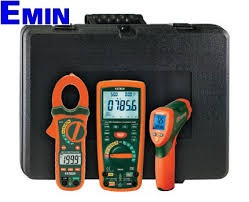
Where insulation testers are used in practice
Insulation resistance testing is widely used during preventive maintenance, installation acceptance, shutdown inspections, and fault investigation. Common targets include low- and medium-voltage cables, motor windings, generators, control panels, distribution boards, and electrical machines exposed to heat, dust, moisture, or chemical contamination.
In many workflows, the insulation test is not performed in isolation. Technicians often combine it with voltage checks and basic continuity verification, and in broader troubleshooting they may also use a multimeter for general electrical measurements. Where grounding performance is part of the same inspection program, an earth resistance tester can provide additional context for system safety and reliability.
Key measurement ranges and functions to consider
The most important starting point is test voltage. Lower ranges such as 50 V, 100 V, 250 V, 500 V, and 1000 V are common for general maintenance and installation work, while 2500 V, 5000 V, or even 10 kV models are more suitable for higher-voltage assets and more demanding insulation assessments.
The second factor is the available insulation resistance range, which may span from megohms to gigohms and, on some advanced instruments, into the teraohm region. Depending on the job, users may also need functions such as live-circuit warning, timer-based testing, capacitance or leakage current measurement, and automatic calculation of PI and DAR values for deeper insulation trend analysis.
Safety category, environmental durability, and power source also matter in real field use. Instruments in this category include compact battery-powered handheld models for mobility as well as larger rechargeable units designed for higher-voltage work and extended test sessions.
Representative solutions from major brands
For portable routine insulation checks, models such as the HIOKI IR4056-21 and IR4053-10 are positioned around practical multi-range testing up to 1000 V, making them suitable for maintenance teams that need quick readings in the field. The KYORITSU 3022A also fits this general-purpose segment, especially where standard insulation testing and continuity-related tasks are part of regular service work.
For higher-voltage applications, the FLUKE 1535/APAC, 1537/APAC, and FLUKE-1550C address jobs that require broader resistance ranges, timed tests, and more advanced insulation analysis. At the upper end, the FLUKE-1555 FC and KYORITSU 3127 serve applications where test voltages up to 5 kV or 10 kV are needed for large equipment, long cable runs, or more demanding commissioning and diagnostics.
Another useful example is the Chauvin Arnoux C.A 6522, which combines insulation and continuity testing in a single platform. That type of instrument can be attractive for maintenance departments looking to reduce the number of separate devices carried into the field.
Choosing the right tester for your application
A practical selection process starts with the asset you need to test. For building services, control circuits, and low-voltage installations, a compact handheld instrument with standard test voltages may be sufficient. For motors, industrial cables, rotating equipment, and utility-related work, it is often necessary to move toward models with higher output voltage, larger resistance range, and better diagnostic functions.
It is also worth considering how frequently the instrument will be used and under what site conditions. Teams performing repetitive inspections may value fast reading stabilization, backlit displays, and long battery life, while commissioning specialists may prioritize high short-circuit current, timer functions, leakage current measurement, and data-oriented features that support test documentation.
If your workflow includes locating insulation degradation or leakage paths in more complex systems, complementary tools such as a ground fault locator may be relevant alongside insulation resistance testing. The right combination depends on whether your goal is routine compliance checking, predictive maintenance, or fault isolation.
Handheld meters vs. high-voltage insulation testers
Handheld insulation testers are generally preferred for portability, fast deployment, and daily maintenance use. They are well suited for electricians and technicians working on distribution panels, appliances, branch circuits, and standard industrial equipment where 250 V to 1000 V testing covers the requirement.
High-voltage insulation testers are intended for applications where standard handheld ranges may not provide enough diagnostic depth. These instruments are commonly used for larger motors, long feeders, switchgear, transformers, and utility infrastructure, where 2500 V, 5000 V, or higher test voltage helps reveal insulation weakness that might not appear at lower levels.
The choice is not simply about buying a higher voltage model. The more important question is whether the test method matches the insulation system, maintenance standard, and asset criticality of the equipment under evaluation.
What matters for B2B procurement and maintenance teams
For industrial buyers, instrument selection usually involves more than a headline specification. The complete package may include probes, guard leads, earth cords, carrying cases, rechargeable or replaceable power options, and safety features that influence how efficiently the tester can be used on site.
Examples in this category show the range clearly. The KYORITSU 3125B supports multiple test voltages up to 5000 V and reaches very high insulation resistance ranges, while the FLUKE-1537/APAC combines insulation testing with voltage and resistance measurement. Products such as the EXTECH 380260 and FLUKE-1577 illustrate how some users prefer a more compact, multifunction-style instrument for field troubleshooting rather than a dedicated high-voltage platform.
From a purchasing perspective, the best fit often depends on maintenance policy, test procedure, operator skill level, and the typical asset base in your facility. Standardization by brand may also be important for training, accessory compatibility, and calibration planning.
FAQ
What is the difference between an insulation tester and a standard multimeter?
A multimeter is used for voltage, current, resistance, and general electrical checks, while an insulation tester applies a dedicated DC test voltage to measure high resistance in insulation systems. The two tools are complementary rather than interchangeable.
When is a 5 kV or 10 kV insulation tester necessary?
Higher-voltage models are typically chosen for larger assets, higher-voltage equipment, long cable runs, and applications that require more rigorous insulation diagnostics. The correct test voltage should always match the equipment type and applicable maintenance procedure.
Why are PI and DAR functions useful?
PI and DAR help evaluate insulation behavior over time rather than from a single spot reading. These values are often used in maintenance programs to identify moisture ingress, contamination, or insulation aging trends.
Find an insulation tester that matches your testing scope
This category covers a broad range of insulation resistance instruments, from portable meters for daily maintenance to advanced high-voltage testers for deeper asset evaluation. By comparing test voltage, measurable resistance range, safety features, and supporting functions, buyers can narrow the selection to the tools that fit their actual field requirements.
If you are selecting for a plant, contractor team, utility environment, or service department, it is usually best to start from the asset class and testing method rather than the model alone. That approach leads to a more practical choice and better long-term value from your insulation testing equipment.
Get exclusive volume discounts, bulk pricing updates, and new product alerts delivered directly to your inbox.
By subscribing, you agree to our Terms of Service and Privacy Policy.
Direct access to our certified experts