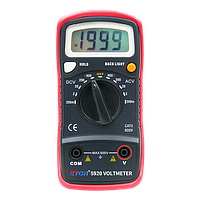
Other electric meter
Not every electrical measurement task fits neatly into a standard product class. In many labs, maintenance teams, test benches, and power-system service environments, engineers often need instruments that serve a very specific purpose beyond a typical handheld meter. This is where the Other electric meter category becomes useful: it brings together specialized electrical test and measurement tools for applications such as coil analysis, AC voltage and noise measurement, digital signal capture, phase rotation checks, and interface connectivity.

Built for specialized measurement tasks
Some measurement requirements demand more than general-purpose voltage, current, or resistance readings. In production, repair, and validation workflows, users may need to analyze switching coils, capture fast waveforms, verify digital test signals, or measure low-level AC voltages and noise with higher sensitivity.
This category is intended for those specialized electrical instruments that support targeted diagnostic and test work. Rather than acting as a replacement for mainstream tools, these devices typically complement broader setups that may also include a multimeter or other core measurement equipment.
Typical applications across industry and test environments
The product mix in this category is relevant to several technical environments. In electrical maintenance, technicians may need phase rotation indication, voltage verification, or coil-related diagnostics. In electronics and R&D, users often require waveform digitizers, low-level AC voltmeters, or signal-oriented modules for automated test systems.
Utility and power-service teams may also use coil analyzers and power supply units when evaluating control circuits or switching mechanisms. In comparison, applications focused on grounding performance or insulation paths may be better served by tools such as an earth resistance tester or a dedicated fault-location instrument.
Examples of instruments found in this category
A good way to understand the scope of this category is to look at a few representative products. The Triplett VCT1000 combines voltage and current testing with phase rotation indication, making it relevant for field electrical checks where users need fast confirmation of supply conditions and phase sequence.
For low-level AC measurement and noise analysis, instruments such as the NF M2177A, NF M2174A, and NF M2170A support applications where waveform content, frequency range, and measurement sensitivity matter more than the broad utility of a general handheld tester. These are typically more suitable for bench measurement, signal evaluation, and specialized electronic testing.
On the more system-oriented side, Astronics modules such as the 6084-2105 dual-channel digitizer, PXIe-1803 PXI Express digitizer, and PXIe-6943 digital test instrument fit into automated test environments where synchronized acquisition, digital stimulus/response, and modular expansion are important. For users working with dedicated coil testing, the Koyo KL-902 Coil Tester and DV Power coil analyzer units address a different but equally specialized measurement need.
How to choose the right instrument
Selection starts with the actual measurement objective. If the task is routine troubleshooting on panels, motors, or installations, a compact tester with voltage indication and phase rotation features may be the most practical option. If the work involves waveform analysis, noise measurement, or automated validation, bench instruments and modular digitizers are often a better fit.
It is also important to consider the test environment. Portable field service work usually favors simple operation, fast readings, and rugged handling. Bench and rack-based environments, by contrast, often prioritize channel count, interface compatibility, data capture depth, and integration with software-driven workflows.
Another key factor is measurement range and signal type. Some instruments in this category are designed for very low AC voltage measurement, while others are intended for high-speed signal acquisition or coil energization and analysis. Reviewing the intended signal range, frequency range, and installation method will usually narrow the options quickly.
Brand and platform considerations
Because this category covers several use cases, brand choice often follows the surrounding system architecture. Teams that already work with KEYSIGHT test environments, for example, may also need supporting accessories such as the KEYSIGHT 10833A GPIB cable for instrument communication and legacy bench integration.
Users building modular ATE platforms may prefer solutions from Astronics, while low-level AC and noise measurement applications often align naturally with NF instruments. For substation and breaker-related coil diagnostics, DV Power products such as the POB30AD, POB40AD, and SAT40A II series are more relevant because they combine measurement and power-supply functionality for coil-focused work.
Where these products fit in a broader measurement workflow
Special-purpose electric meters are rarely selected in isolation. In practice, they are part of a larger workflow that may include verification, root-cause analysis, documentation, and repeatable testing. A technician might begin with basic electrical checks, then move to a dedicated tester for phase rotation or coil behavior, and finally use a digitizer or noise meter to investigate signal quality in more detail.
This layered approach is common in maintenance, quality assurance, and design validation. It also explains why this category covers tools that seem very different at first glance: they solve specific measurement problems that standard instruments do not always address efficiently.
When a specialized meter is the better choice
If your application involves low-level AC signal measurement, modular waveform capture, coil testing, digital test sequencing, or phase rotation verification, a specialized instrument can improve both accuracy and workflow efficiency. The right device depends less on broad product labels and more on the exact signal, circuit, or subsystem you need to evaluate.
For buyers comparing options in this category, it helps to define the task clearly: field troubleshooting, laboratory analysis, automated test integration, or power-equipment service. Once that need is clear, the available instruments become much easier to match to the job. This category is designed to support those less common but highly important electrical measurement requirements with tools that are purpose-built for the task.
Get exclusive volume discounts, bulk pricing updates, and new product alerts delivered directly to your inbox.
By subscribing, you agree to our Terms of Service and Privacy Policy.
Direct access to our certified experts