Spectrum analyzers
Finding the right instrument for RF signal visibility often comes down to one question: how clearly can you see what is happening across frequency, amplitude, and time? Spectrum analyzers are essential tools for engineers who need to evaluate wireless signals, identify interference, verify emissions, and troubleshoot electronic systems in design, production, field service, and maintenance environments.
On this page, you can explore instruments and related options used for frequency-domain analysis across a wide range of applications, from general RF testing to field measurements and signal investigation. Depending on the task, users may need a compact basic analyzer for routine lab work, a portable RF platform for onsite diagnosis, or supporting accessories that expand measurement capability.
Where spectrum analyzers are used
In practical engineering, these instruments are used wherever signal integrity, spectral purity, and frequency occupancy matter. Common use cases include telecommunications, wireless device development, broadcast systems, EMC pre-compliance work, maintenance of RF links, and troubleshooting unwanted emissions in industrial electronics.
A spectrum analyzer helps users observe carrier signals, harmonics, spurious content, noise floor behavior, and occupied bandwidth. In many workflows, it is used alongside other test equipment such as a multimeter for general electrical checks, while the analyzer focuses specifically on RF and high-frequency behavior that cannot be seen with basic electrical instruments.
What to look for when selecting a model
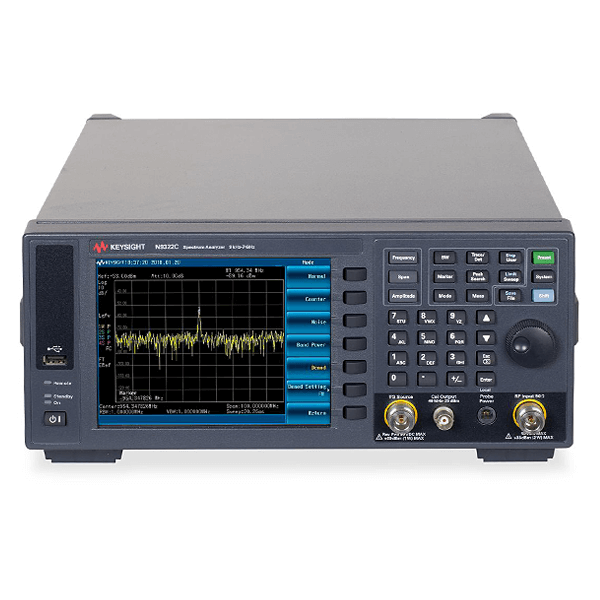
The most important selection factor is frequency range. The analyzer must comfortably cover the signals you need to measure today, with enough margin for future requirements. For example, an entry-level unit such as the KEYSIGHT N9321C covers 9 kHz to 4 GHz, while the KEYSIGHT N9322C extends to 7 GHz and the KEYSIGHT N9324C reaches 20 GHz for broader RF work.
Beyond frequency coverage, buyers should review amplitude accuracy, displayed average noise level, phase noise, resolution bandwidth, attenuator control, and connectivity. These parameters directly affect how reliably weak signals can be separated from noise, how closely spaced spectral components can be resolved, and how confidently measurement results can be used for development or maintenance decisions.
Basic analyzers, field platforms, and measurement options
Not every workflow requires the same instrument format. Basic spectrum analyzers are well suited to bench testing, education, routine verification, and general RF troubleshooting. Models such as the KEYSIGHT N9322C and KEYSIGHT N9323C are representative of this class, offering practical frequency coverage and core measurement functions for day-to-day lab use.
For technicians and engineers working outside the lab, a portable platform can be more appropriate. The KEYSIGHT N9912C FieldFox RF Analyzer illustrates this approach, combining multiple RF functions in one field-ready instrument. In environments where installation, service, and rapid fault isolation matter, this type of platform can reduce the need to carry several separate devices.
Some products in this category are not standalone analyzers but expansion options and accessories that support a wider measurement workflow. Examples include the KEYSIGHT N9951A-233 Spectrum Analyzer Option, the N9951A-210 VNA Transmission / Reflection Option, and the N9951A-211 VNA Full 2 Port S Parameter Option. These are relevant when users need broader RF characterization from a compatible platform rather than a single-purpose instrument alone.
Supporting accessories in the RF measurement chain
A useful spectrum analysis setup often depends on more than the main instrument. Accessories such as probes, calibrators, and noise-related tools help improve measurement consistency or enable specific test tasks. The KEYSIGHT N9311X-100 Close Field Probe Set, for example, is relevant when investigating localized RF emissions or near-field behavior around electronic assemblies.
Likewise, the KEYSIGHT N9311x-201 Mechanical Calibrator plays a supporting role in RF and reflection-related workflows, while the KEYSIGHT 346CK01 Noise Source may be used in signal chain characterization contexts. These items are best understood as part of a broader test ecosystem rather than substitutes for the analyzer itself.
Brand ecosystem and platform considerations
Many buyers evaluate instruments not only by specifications, but also by the wider product ecosystem. On this page, you can explore solutions from manufacturers active in electronic measurement such as KEYSIGHT, as well as other established names including Rohde & Schwarz, ANRITSU, TEKTRONIX, YOKOGAWA, and OMICRON. The right choice often depends on how the instrument fits your existing workflow, software environment, calibration practice, and future expansion plans.
For teams comparing vendors, it is often useful to think in terms of application fit rather than brand preference alone. A lab focused on routine RF inspection may prioritize straightforward operation and stable core performance, while a field service team may value portability and multi-function capability. In either case, selecting within a broader manufacturer ecosystem can simplify training, support, and accessory compatibility.
Typical evaluation criteria for B2B purchasing
In industrial and technical purchasing, analyzer selection is usually tied to the measurement objective. If the task is signal monitoring or transmitter verification, attention often goes to sweep performance, dynamic range, and marker functions. If the goal is troubleshooting low-level interference, users may pay closer attention to noise floor, phase noise, and resolution bandwidth behavior.
Connectivity and serviceability also matter. Bench instruments like the KEYSIGHT N9324C list common interfaces such as LAN, USB, and GPIB, which can be important for automated test environments or result documentation. Calibration interval, operating conditions, and physical form factor should also be reviewed, especially for organizations planning regular deployment across production lines, service teams, or educational labs.
Where the analyzer is part of a wider electronics validation workflow, related categories may also be relevant. For example, teams working with component characterization or device-level electrical testing may also review SMU semiconductor test equipment to complement RF-domain measurements in development and analysis processes.
Choosing the right spectrum analyzer for your application
If your requirement is straightforward frequency-domain analysis in the lab, a basic analyzer with suitable range and sensitivity is usually the logical starting point. If your work involves installation sites, antenna systems, or RF maintenance in the field, a portable multi-function analyzer may offer better workflow efficiency. If you already operate a compatible RF platform, software options and accessories can extend capability without changing the entire setup.
It is also important to match the instrument to the type of signals you expect to measure. Weak signal detection, broadband scans, interference hunting, and combined RF tasks do not place identical demands on an analyzer. A careful review of measurement goals will often narrow the shortlist more effectively than comparing model names alone.
Final thoughts
This category brings together instruments and related options used to observe, verify, and troubleshoot RF behavior across a wide range of professional applications. Whether you are comparing entry-level bench units, portable RF analyzers, or supporting accessories, the best choice will depend on the signals you measure, the environment you work in, and the level of analysis required.
By focusing on application needs, frequency coverage, measurement sensitivity, and ecosystem compatibility, buyers can select a solution that supports both current projects and future test requirements with greater confidence.
Get exclusive volume discounts, bulk pricing updates, and new product alerts delivered directly to your inbox.
By subscribing, you agree to our Terms of Service and Privacy Policy.
Direct access to our certified experts