
Plasma & Reactive Gas Solutions
Controlling reactive gases is critical in environments where sterilization, oxidation, ultra-pure water treatment, and process stability all matter. In industrial, laboratory, and advanced manufacturing settings, the right Plasma & Reactive Gas Solutions help operators manage ozone and dissolved gas delivery with better consistency, safety awareness, and application fit.
This category brings together equipment used for generating, delivering, or integrating reactive gases in practical workflows. It covers both compact ozone generators for localized treatment and more advanced systems for controlled delivery in demanding process environments, including ultrapure water and semiconductor-related applications.
Where these systems are typically used
Reactive gas equipment is selected when air or water treatment requires more than basic ventilation or passive filtration. Ozone-based systems are often used for deodorization, disinfection support, and oxidation processes, while dissolved gas delivery platforms are used where process chemistry must be tightly managed inside liquid streams.
That makes this category relevant to users working across environmental treatment, clean process engineering, facility hygiene, and specialized manufacturing. If your application also involves broader monitoring of gas conditions in the workspace, related tools such as air and gas transmitters can help support system oversight at the site level.
From standalone ozone generators to integrated delivery platforms
Not every application requires the same level of control. Some users need a portable or bench-scale ozone source for room treatment or localized sanitization cycles, while others require an integrated system that manages pressure, flow, concentration, interfaces, and materials compatibility as part of a larger process line.
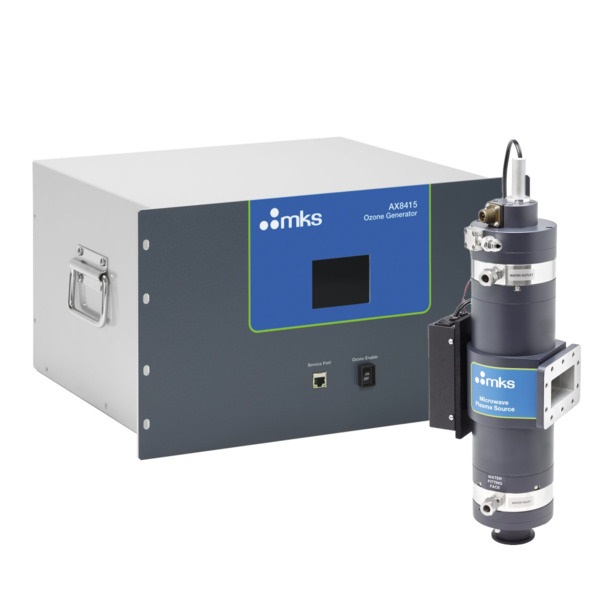
In this category, compact examples include the Giorgio Bormac OZ-10 and OZ-30 ozone generators, which are suited to applications where surface coverage, timer-based operation, and straightforward electrical supply are important. At the other end of the range, systems from MKS address more advanced delivery requirements, including high-flow ozone generation and dissolved gas dosing for ultrapure water environments.
Key solution types in this category
A practical way to evaluate this range is to look at how the reactive gas is used in the process. One group focuses on ozone generation for air or process gas applications. Another focuses on dissolved gas delivery, where gases such as ozone, carbon dioxide, or ammonia are introduced into high-purity liquid systems under controlled conditions.
Examples from the current selection illustrate this difference clearly. The MKS O3CS Compact Ozone System and MKS AX8407 or AX8410 SEMOZON® models are intended for controlled ozone production with defined flow and pressure conditions. By contrast, the MKS DI-CO2, MKS DI-NH3, and LIQUOZON-VariO3 systems support process integration where gas-liquid interaction, wetted materials, and communications interfaces are part of the equipment selection criteria.
What to consider when choosing a reactive gas system
The first selection factor is the process objective. If the goal is room or area treatment, buyers usually compare ozone output, airflow, coverage, duty cycle, and ease of operation. If the goal is process integration, attention shifts toward concentration control, outlet pressure, feed gas requirements, liquid-contact materials, and compatibility with the rest of the installation.
A second factor is the operating environment. Some systems are built for relatively simple indoor use, while others are intended for highly controlled industrial settings and may include support for remote operation, analog or digital communication, and compliance-oriented design. It is also important to review utilities such as power supply, cooling water, gas purity, and exhaust requirements before selecting a model.
For facilities that need to connect treatment equipment with condition monitoring, it can also be useful to review air quality sensors as part of a broader environmental control strategy.
Materials, interfaces, and process compatibility
For advanced users, specification details are less about headline numbers and more about whether the system fits the process safely and reliably. In dissolved gas and ultrapure water applications, material selection matters because wetted parts must withstand chemical exposure while preserving process cleanliness. That is why systems in this category may use engineered materials such as PFA, PTFE, PVDF, quartz glass, or stainless steel in specific parts of the flow path.
Control architecture also matters. Many integrated systems support interfaces such as binary I/O, RS232, RS485, analog 4-20 mA, or USB for connection to supervisory controls and plant automation. These features are especially relevant where reactive gas delivery must be coordinated with other steps in a manufacturing or treatment sequence.
Representative products in the range
For compact ozone generation, the Giorgio Bormac OZ-10 and OZ-30 provide a more accessible format for users who need timer-equipped operation and practical deployment in enclosed spaces. Their rated working conditions and room coverage profiles make them easier to assess for smaller-scale treatment tasks.
For higher-demand installations, the MKS portfolio offers a wider process spectrum. The O3CS Compact Ozone System serves users who need a smaller ozone platform with remote operation capability, while the AX8555, AX8580, and AX8585 SEMOZON® families are oriented toward larger delivery requirements and advanced process applications. For liquid-phase treatment, LIQUOZON-VariO3 and the DI-series systems extend the category into ozonated water and dissolved chemical delivery use cases.
How this category fits into a broader environmental and process setup
Reactive gas equipment is rarely chosen in isolation. In real installations, it often sits alongside ventilation, sensing, alarm, and validation tools. A facility may pair ozone generation with measurement devices, or integrate dissolved gas delivery into a process skid that includes flow control, automation, and safety interlocks.
Where aerosol behavior or dispersion testing is relevant to air treatment studies, users may also explore an aerosol generator for complementary work. The best configuration depends on whether the priority is environmental treatment, production process control, or a combination of both.
Choosing with confidence
The strength of this category lies in its mix of simpler ozone devices and more specialized reactive gas platforms. That gives buyers a clearer path whether they are looking for a standalone unit for localized use or a system engineered for integration into a controlled industrial process.
When comparing options, focus on the intended application, required flow and concentration range, installation conditions, and control needs rather than product names alone. A well-matched reactive gas solution will be easier to deploy, safer to manage, and more aligned with long-term process performance.
Get exclusive volume discounts, bulk pricing updates, and new product alerts delivered directly to your inbox.
By subscribing, you agree to our Terms of Service and Privacy Policy.
Direct access to our certified experts

