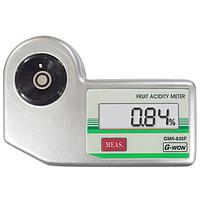
Oil and Axid meter
Oil quality, acid concentration, and related liquid properties often need to be checked quickly in production, maintenance, food processing, and laboratory workflows. In these situations, the right instrument helps teams make faster decisions on process control, product quality, and equipment condition without relying only on delayed off-site analysis.
This category brings together Oil and Axid meter solutions used for checking acid value, oil condition, concentration, refractive index, and specific gravity in different liquid applications. The available range covers practical tools for on-site screening as well as digital instruments for more repeatable measurements in industrial and quality-control environments.

Where these instruments are commonly used
In B2B settings, oil and acidity measurement is rarely a one-size-fits-all task. Food manufacturers may need to monitor frying oil degradation, maintenance teams may check battery acid condition, and production lines may verify the concentration of cutting oils, coolants, or process liquids. Each use case calls for a different measuring principle and a different level of portability, speed, and chemical compatibility.
That is why this category includes both strip-based screening tools and digital handheld devices. For buyers who also use disposable consumables in routine liquid checks, related options such as test paper can be a useful complement to instrument-based measurement.
Typical measurement methods in this category
The products shown here mainly support a few practical approaches. Test strips are useful for rapid pass/fail style checks and simple trend monitoring. Refractometer-based devices are used to evaluate concentration or refractive behavior of oils, coolants, acids, and related liquids from just a small sample volume. In some cases, digital hydrometers are more suitable when the target parameter is specific gravity rather than refractive index.
For example, the Advantec AV-CHECK test strips are intended for thermal degradation screening, while the ATAGO AOM-03 Oil TESPER™ focuses on checking AV in edible oils. Where more numerical readout is needed, instruments such as the ATAGO DOM-24 frying oil monitor or the ATAGO DH-10C and DH-10F digital hydrometers provide a more instrumented approach to process monitoring.
Examples of instruments for oil and acid-related testing
Several devices in this category illustrate the range of real-world applications. The ATAGO portfolio is especially relevant here, with handheld instruments designed for oil concentration, edible oil quality, sulfuric acid concentration, and battery acid specific gravity. This makes the category useful not only for one industry, but for buyers working across food, maintenance, chemical handling, and general industrial operations.
A practical example is the ATAGO PAL-102S Cutting Oil Refractometer, which is suited to checking dilution or concentration of cutting oil, hydraulic oil-related fluids, and cleaning liquids on the factory floor. For food applications, the ATAGO DOM-24 measures both TPM and AV, helping users monitor frying oil condition during routine quality checks. For battery-related service tasks, the ATAGO DH-10C and DH-10F support sulfuric acid specific gravity measurement while reducing direct contact with corrosive liquid.
Other specialized options also appear in the range. The EXTECH RF41 Portable Battery Coolant/Glycol Refractometer combines coolant and battery-acid related checks in one handheld format, while the ATAGO QR-HSO is designed for sulfuric acid measurement in applications where suction-type sampling is beneficial. These examples show how instrument selection depends less on the product label and more on the liquid, parameter, and working environment involved.
How to choose the right device
The first step is to define what exactly needs to be measured. Some users need acid value in edible oil, others need total polar materials, and others need concentration, refractive index, or specific gravity. Choosing the wrong measurement principle can produce readings that are difficult to interpret, even if the instrument itself is functioning correctly.
Next, consider the sample condition and operating environment. Portable instruments are often preferred for production floors, kitchens, workshops, and field service because they can deliver quick readings with only a few drops of sample. Features such as water resistance, simple cleaning, and automatic temperature compensation may also matter when measurements are taken frequently or under changing ambient conditions.
It is also useful to think about whether screening is enough or if you need a digital numeric result for documentation. A strip-based product may be ideal for quick routine checks, while a digital meter is generally better for trend analysis, repeatability, and process records. In workflows where liquid chemistry is broader than oil alone, adjacent categories such as other reagents may also be relevant for supporting test procedures.
Applications across food, maintenance, and process control
In food processing, oil monitoring helps maintain product consistency and supports timely oil replacement decisions. Instruments that check AV or TPM are commonly used where frying oil condition directly affects product quality, taste, appearance, and operating cost. The ATAGO AOM-03 and DOM-24 are clear examples of tools aimed at this type of quality control task.
In maintenance and utilities, battery acid and coolant checks are a different but equally important use case. Specific gravity measurement supports condition assessment in battery service, while glycol and coolant checks help maintain thermal systems. The EXTECH RF41 and ATAGO digital hydrometers fit this kind of workflow well because they focus on measurable parameters that technicians can act on quickly.
In manufacturing, concentration control of cutting oils and process liquids can affect machining quality, tool life, cleanliness, and corrosion behavior. Instruments such as the ATAGO PAL-102S help operators verify concentration on site without a complex setup. For buyers comparing broader liquid analysis options, specialized categories like ion measurement electrodes may be useful when the testing requirement extends beyond oil-related parameters.
Why portable measurement matters in daily operations
Portable testing is valuable because many oil and acid checks need to happen at the point of use, not only in a central lab. A quick result at the fryer, beside a battery bank, or near a machining line can reduce downtime and help operators respond before quality drifts too far from the target range.
Small sample volume is another practical advantage. Many handheld refractometers and hydrometers in this category work with only a few drops or a small liquid draw, making routine checks easier and reducing operator exposure to aggressive liquids. This is particularly relevant for sulfuric acid and other corrosive samples where safe handling remains a priority.
FAQ
What is the difference between an oil test strip and a digital oil meter?
Test strips are typically used for fast screening or simple visual checks, while digital meters provide numerical readings that are easier to document and compare over time.
Can one instrument measure every type of oil or acid?
No. Selection depends on the target liquid and the parameter to be measured, such as AV, TPM, concentration, refractive index, or specific gravity.
Are these devices only for laboratory use?
Not necessarily. Many models in this category are designed for handheld, on-site use in factories, food production areas, workshops, and maintenance environments.
Choosing the right oil and acid measurement device starts with understanding the liquid, the parameter that matters, and how the result will be used in daily work. This category is built to support that selection process, from simple disposable checks to more advanced handheld instruments for repeatable quality and process monitoring.
Get exclusive volume discounts, bulk pricing updates, and new product alerts delivered directly to your inbox.
By subscribing, you agree to our Terms of Service and Privacy Policy.
Direct access to our certified experts