Sugar meter
Consistent sugar concentration matters in many production and testing workflows, from beverage formulation and fruit processing to honey evaluation and brewing. A sugar meter helps teams check dissolved solids quickly, supporting product consistency, process control, and day-to-day quality decisions without relying on guesswork.
On this page, the category focuses mainly on refractometer-based instruments used to measure Brix and related scales in liquid samples. Depending on the application, users may prefer a simple optical unit for routine checks or a compact digital model for faster reading, easier interpretation, and better repeatability across operators.
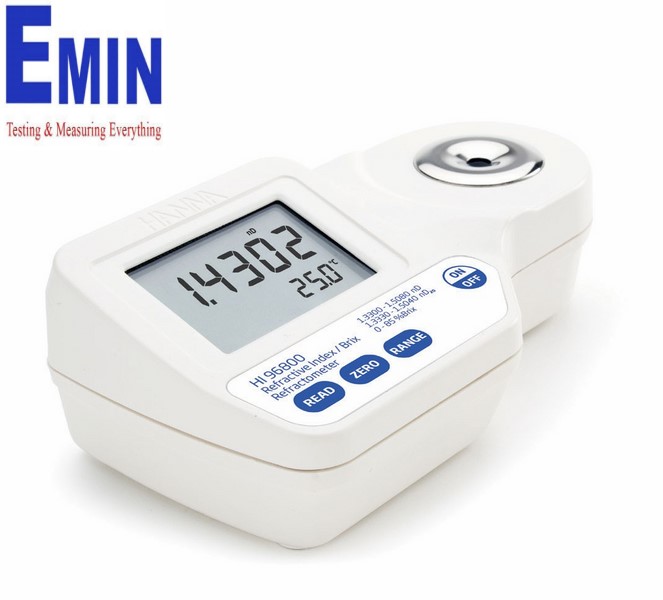
Where sugar meters are commonly used
In industrial and commercial settings, sugar meters are widely used wherever the concentration of dissolved sugars affects taste, stability, or process control. Typical examples include fruit juice, soft drinks, sauces, soups, coffee products, jams, marmalade, honey, and other food or beverage samples that require a reliable concentration check.
They are also useful in more specialized workflows. Brewing may use Plato-based measurement for sweet wort, while confectionery and pastry applications may benefit from instruments that support Brix together with other sugar-related scales. In broader liquid testing work, sugar concentration is often reviewed alongside tools such as test paper or application-specific refractometers, depending on what needs to be controlled in the sample.
How a sugar meter works in practice
Most products in this category rely on the principle of light refraction. When light passes through a liquid, the angle changes according to the concentration of dissolved substances. In sugar testing, that change is typically displayed as Brix, which is commonly used as a practical indicator of sugar concentration in many food and beverage applications.
For routine use, the process is straightforward: place a small amount of sample on the prism or sensor surface, allow the instrument to compensate for temperature if supported, and read the result. This makes sugar meters suitable for incoming raw material checks, in-process verification, and final product inspection with only a few drops of sample in many cases.
Mechanical and digital refractometers
Handheld optical refractometers remain a practical option when simplicity, portability, and low dependency on power are priorities. Models such as the ATAGO MASTER-Pα Hand Held Refractometer and EXTECH RF11 0 to 10% Portable Sucrose Brix Refractometer with ATC illustrate the kind of compact tools often chosen for spot checks, field use, or routine production-floor measurement.
Digital units are often preferred when operators need quicker reading, reduced interpretation error, and easier handling across multiple users. Examples in this category include the ATAGO PAL-1 Refractometer, ATAGO PALALPHA Digital Hand-held, and ATAGO PAL-2 Refractometer for higher concentration samples. If your process uses different liquid matrices or requires manufacturer-specific options, it may also be useful to review available instruments from ATAGO and EXTECH.
Choosing the right measurement range
One of the most important selection criteria is the measurement range. Low to medium Brix applications such as juices, beverages, soups, sauces, and diluted process liquids may fit instruments in the 0 to 33% or 0 to 53% range. In this group, the ATAGO MASTER-Pα Hand Held Refractometer (0.0 to 33.0% Brix), ATAGO MASTER-53Pα Hand Held Refractometer, and ATAGO PAL-1 Refractometer are relevant examples.
High-concentration products need a different approach. Honey, jam, jelly, concentrated juice, and confectionery mixtures may require wider or higher ranges, such as the ATAGO PAL-2 Refractometer for 45.0 to 93.0% Brix, the ATAGO MASTER-500 Hand Held Refractometer for wide-range checks, or the ATAGO PAL-Pâtissier Pâtissier Refractometer for sweet-making applications. Selecting a range that matches the actual process helps avoid poor resolution at the low end or out-of-range readings at the high end.
Application-specific models in this category
Not every process is best served by a general-purpose Brix meter. Some operations benefit from application-focused instruments that simplify the reading scale for the operator. For honey testing, the ATAGO PAL-22S Honey Humidity Meter is designed for moisture-related checks in honey, which can be more relevant than a general Brix reading in that workflow.
For breweries, the ATAGO PAL-Plato Plato Refractometer supports Plato measurement for sweet wort. Wine-related production can also require different scales, as seen with the ATAGO PAL-86S Wine Refractometer, which combines Oe (GER) and Brix. In comparison, general-purpose models remain suitable when one instrument must cover many liquid samples across food production, receiving inspection, or R&D screening.
Features that matter in daily operation
In real working environments, usability features can be just as important as the scale itself. Automatic temperature compensation is valuable when sample temperature varies during production or when testing is done outside controlled lab conditions. Water resistance, including IP65-rated designs mentioned in several products here, can also make cleaning easier when handling sticky or viscous samples.
Another practical point is body material. Within the ATAGO MASTER series, some versions are metal while others are plastic, and the plastic body is positioned for salty or acidic samples in certain cases. That kind of detail can influence long-term durability and ease of use. If your testing workflow expands beyond sugar concentration alone, related liquid analysis tools such as urine refractometers or specialized electrodes may be more suitable for other parameters.
How to select a sugar meter for your process
Start with the sample type and concentration range. Clear, low-viscosity liquids are usually easy to handle with standard Brix refractometers, while dense, sticky, or high-sugar samples may need a wider range and easier washdown capability. Next, consider whether operators need simple field checks or fast digital readings that improve consistency between shifts or locations.
It is also worth thinking about sample temperature, cleaning frequency, and how often the instrument will be moved. A compact waterproof digital model can be a good fit for production and receiving areas, while a straightforward optical refractometer may be enough for occasional spot checks. For users comparing brands, this category includes recognized names such as Anton Paar, Cole parmer, ATAGO, Bellingham, EXTECH, HANNA, KERN, KRUSS, MILWAUKEE, and PCE.
Final considerations
A well-matched sugar meter supports faster quality checks, better batch consistency, and more confident process adjustments. The best choice usually depends less on marketing labels and more on your actual sample type, concentration range, preferred scale, and operating conditions.
Whether you need a compact optical refractometer for routine Brix checks or a digital model for faster, more repeatable measurement, this category brings together practical options for food, beverage, honey, brewing, and related liquid testing workflows. Reviewing range, scale, temperature handling, and cleaning needs first will make selection much more efficient.
Get exclusive volume discounts, bulk pricing updates, and new product alerts delivered directly to your inbox.
By subscribing, you agree to our Terms of Service and Privacy Policy.
Direct access to our certified experts