
Strain Gauges
Accurate strain measurement starts with the right sensing element. In testing, structural analysis, product development, and industrial monitoring, a well-matched strain gauge helps convert tiny deformation in a component into a usable electrical signal for analysis, control, or validation.
This category brings together strain gauges for different measurement patterns, mounting needs, and resistance options. Whether the application involves single-axis stress evaluation, multi-directional strain analysis, or diaphragm-based measurement points, selecting the proper gauge geometry and connection style has a direct impact on signal quality, installation stability, and long-term reliability.
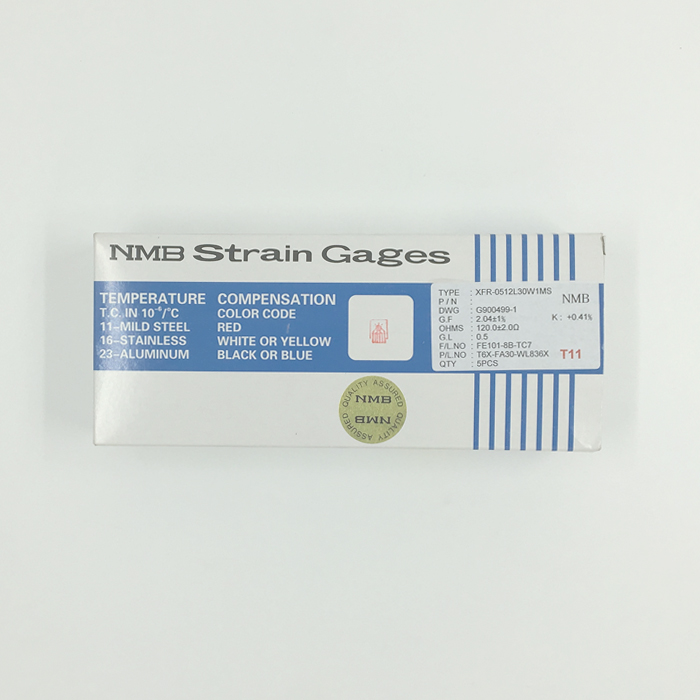
Understanding the role of strain gauges in measurement systems
A strain gauge is a sensor element bonded to the surface of a test piece or machine component. When the material stretches or compresses, the electrical resistance of the gauge changes slightly, allowing strain to be measured through a suitable circuit and instrumentation chain.
In practical use, the gauge itself is only one part of the system. Signal conditioning, data conversion, and display also matter, which is why strain gauges are often used together with strain meters or other measurement electronics. Choosing the gauge pattern correctly at the start makes the rest of the setup much easier to optimize.
Common strain gauge types in this category
This selection includes both uniaxial and triaxial patterns. Uniaxial gauges are suited to applications where the main strain direction is already known, such as simple beam testing, localized stress checks, or routine measurement on mechanical parts. They are often preferred when installation space is limited and the measurement objective is straightforward.
Triaxial gauges are useful when strain direction may vary or when principal strain analysis is required. Models such as the NMB Technologies XFR-0512L30W1MS, NMB Technologies FR-1A-12L50W05MS, and KYOWA KFGS-1-120-D17-11N30C2 use a 0°/45°/90° arrangement, which helps engineers evaluate more complex stress states on components, prototypes, and structural elements.
This category also includes diaphragm-oriented options from OMEGA, such as the SGK-L6B-K1000U-PC23-E and SGK-L6B-K1000U-PC11-E. These are relevant when the application requires a linear diaphragm strain gauge format, solder pad connections, and higher nominal resistance.
How to choose the right gauge for your application
The first point to confirm is the measurement direction. If the expected strain path is clear, a uniaxial gauge can be the most efficient choice. Examples in this category include KYOWA KFG-1-120-C1-11L3M2R, KYOWA KFEL-2-120-C1L1M2R, and KYOWA KFL-1-120-C1-11R2M2R, each suited to different mounting areas and gauge lengths.
The second point is physical fit. Base size and gauge length should match the available bonding surface and the size of the strain field being measured. Very small areas may call for compact designs like the NMB Technologies YFR-0512L50W3MS, while larger measurement zones may be better served by longer-grid models such as KYOWA KFWB-5-120-C1-11L1M2R or KYOWA KFWB-5-350-C1-11L1M2R.
Resistance is another important parameter. This category includes both 120 Ω and 350 Ω products, as well as 1000 Ω diaphragm types from OMEGA. Resistance selection can affect bridge configuration, leadwire influence, heat generation, and compatibility with the rest of the instrumentation chain, especially when cable length or thermal conditions are part of the design concern.
Installation and wiring considerations
Even a high-quality gauge can deliver poor results if installation practice is inconsistent. Surface preparation, adhesive selection, alignment, and leadwire handling all influence repeatability. For that reason, buyers often evaluate not only the gauge pattern and size, but also cable style, lead length, and connection format before finalizing the part number.
Several products here are supplied with 2-wire cables, while some options such as the KYOWA KFGS-1-120-C1-11L3M3R use a 3-wire cable configuration. In many measurement setups, the wiring method affects compensation strategy and ease of integration. If the gauge will be connected into a broader signal chain, it may also be useful to review related peripheral devices for support components used around force and strain measurement systems.
Representative manufacturers in this range
KYOWA is well represented in this category with uniaxial and triaxial options covering compact formats, longer gauge lengths, and different resistance values. This makes the brand relevant for users who need flexibility across laboratory testing, industrial validation, and structural measurement tasks.
NMB Technologies contributes compact triaxial models designed for multi-directional strain analysis where small mounting areas and rosette-style layouts are important. OMEGA expands the selection with linear diaphragm strain gauges, which can be useful when the measurement point, material, or electrical preference differs from standard foil gauge selection.
Together, these manufacturers provide a practical spread of sensor formats rather than a one-size-fits-all range. That variety is valuable because strain measurement requirements often depend on specimen geometry, expected stress distribution, mounting constraints, and the intended readout method.
Where strain gauges are commonly used
Strain gauges are used across product testing, materials evaluation, structural monitoring, machine development, and transducer design. Engineers may install them on beams, brackets, housings, fixtures, rotating parts, or diaphragm structures to understand how loads are transferred and where deformation occurs under real operating conditions.
They are also widely used as core sensing elements inside force-related devices. In applications where the measured signal needs to be transmitted or processed for control systems, users may pair gauges and bridge-based sensors with a load cell transmitter or other conditioning electronics. This broader ecosystem is often important in industrial automation, test benches, and OEM integration.
Choosing a category approach instead of a single part search
For many buyers, the challenge is not simply finding a gauge, but narrowing down the right combination of pattern, size, resistance, lead arrangement, and application fit. A category-level view makes it easier to compare options side by side, especially when deciding between uniaxial and triaxial layouts or between compact and larger-format designs.
If you already know your required gauge length, resistance, or cable style, the listed products provide a strong starting point. If the application is still being defined, reviewing available strain gauge formats first can reduce the risk of selecting a part that fits electrically but not mechanically, or vice versa.
Final considerations
The best strain gauge choice depends on how and where the measurement will be made. Pattern orientation, available bonding area, resistance value, lead configuration, and downstream instrumentation all need to work together for stable results.
This Strain Gauges category is intended to support that selection process with options from KYOWA, NMB Technologies, and OMEGA across common industrial and laboratory use cases. By comparing the sensor layout and installation characteristics before purchase, users can build a more reliable force and strain measurement setup from the start.
Get exclusive volume discounts, bulk pricing updates, and new product alerts delivered directly to your inbox.
By subscribing, you agree to our Terms of Service and Privacy Policy.
Direct access to our certified experts

