Depth gauge
Accurate depth measurement is essential when checking slots, grooves, blind holes, step heights, and tread wear in machining, maintenance, and quality control. On this page, the Depth gauge category brings together instruments designed to measure recesses and internal depths with better consistency than improvised methods or general-purpose rulers.
Depending on the task, buyers may need a simple mechanical tool for routine inspection or a digital instrument for faster reading and finer resolution. This category is especially relevant for workshops, toolrooms, automotive service environments, and inspection teams that need repeatable results across different depth ranges and workpiece sizes.
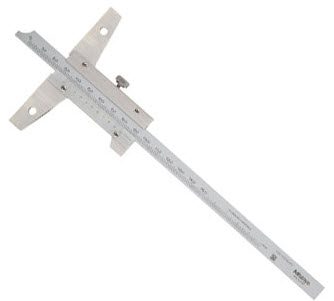
Where depth gauges are used in practice
A depth gauge is commonly selected when surface reference and measurement depth must be established from the same operation. Typical applications include checking the depth of drilled holes, milled pockets, narrow channels, shoulders, and recessed features on mechanical parts. In maintenance settings, depth measurement is also useful for wear assessment and service checks.
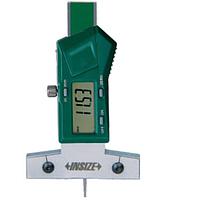
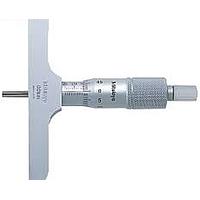
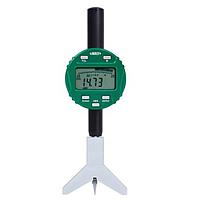
Some instruments in this category are suited to highly precise dimensional inspection, while others are intended for quick functional verification. For example, the TOPTUL JEBM0125 Digital Tire Tread Depth Gauge is aimed at tire tread checking, while larger micrometer-based tools are more appropriate for workshop metrology and part inspection.
Common instrument types in this category
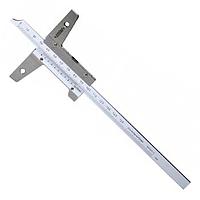
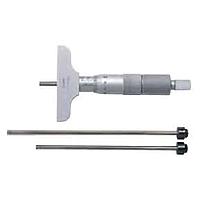
The category generally covers both digital depth gauges and more traditional mechanical designs. Digital models are often preferred when operators need direct LCD readout, unit switching between mm and inch, and faster reading with less risk of misinterpreting the scale. Mechanical or micrometer-based designs remain relevant where users prefer straightforward construction and long-term familiarity.
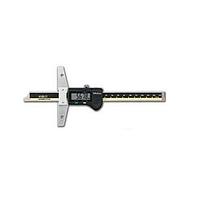
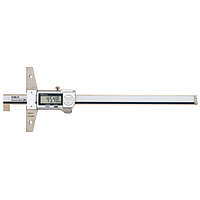
Another important group is the depth measuring caliper. Compared with a dedicated micrometer depth gauge, this format can be helpful when greater measuring reach or hook-based access is needed. If your work also involves external or step dimensions, related tools such as callipers may be useful alongside a dedicated depth instrument.
What to consider before choosing a depth gauge
The first selection point is measuring range. Short-range instruments are suitable for shallow features and routine inspection, while deeper bores or larger recessed sections may require 100 mm, 150 mm, 200 mm, or even 300 mm capacity depending on the application. Choosing too much range can reduce convenience, while too little range limits usability.
The second point is resolution and expected accuracy. In this category, some digital depth micrometers offer fine 0.001 mm resolution, which is valuable for inspection work where small variation matters. For faster operational checks, a practical digital gauge with easier readout may be more appropriate than a metrology-oriented instrument with tighter tolerances.
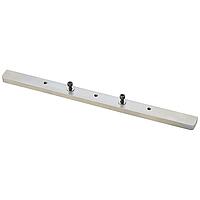
Base size and contact style also affect performance. A stable base helps the instrument sit squarely on the reference surface, which is important for repeatable readings. In some cases, the shape of the measuring rod or hook determines whether the instrument can reach the target feature cleanly.
Examples from leading manufacturers
Well-known brands in this range include MITUTOYO, MOORE & WRIGHT, Mahr, Niigata Seiki, and TECLOCK. Brand choice often depends on the required measuring style, user preference, and whether the tool will be used for production checks, incoming inspection, or maintenance work.
A representative digital caliper-style option is the MITUTOYO 571-265-20, an IP67 waterproof electronic depth measuring caliper with inch/metric operation and data output support. For users focused on micrometer-style depth measurement, the MOORE & WRIGHT MW305 series covers multiple capacities from 0-25 mm up to 0-300 mm, allowing buyers to match the tool more closely to the expected workpiece geometry.
Where the task is more application-specific, compact tools like the TOPTUL JEBM0125 can be a practical choice. It is designed for tire tread depth measurement, with digital display and mm/inch switching, making it suitable for service environments that need quick readings rather than general machining inspection.
Digital versus mechanical depth measurement
Digital instruments are often chosen for speed, readability, and convenience. Features such as clear LCD display, automatic power-off, inch/metric conversion, and in some cases data output can improve daily workflow, especially when many checks are performed in sequence or results must be documented.
Mechanical depth gauges and depth micrometers still have strong value in many facilities. They can be preferred where users want a familiar measuring feel, minimal battery dependence, and direct control over spindle movement. For some inspection routines, this tactile feedback is an advantage rather than a limitation.
The best choice depends less on technology preference and more on the measurement environment. If the tool is used on the shop floor with frequent operator changes, digital readout may reduce reading errors. If the process emphasizes stable manual measurement habits, a mechanical model may fit better.
How depth gauges fit into a broader inspection workflow
Depth measurement is rarely isolated from the rest of dimensional control. Many workshops combine depth gauges with dial indicators for displacement checks, alignment verification, or comparative measurement tasks. This combination helps cover both direct dimensional inspection and movement-based setup control.
In applications where wall thickness or sheet thickness must also be checked, a thickness meter may complement the depth instrument. Selecting tools as part of an inspection set rather than as stand-alone items often leads to better process consistency and fewer measurement gaps.
Practical buying guidance for B2B users
For production and QA teams, it helps to define the measurement task before comparing product pages. Ask whether the target feature is shallow or deep, whether readings need to be recorded, whether mm/inch conversion is necessary, and whether the measuring environment includes coolant, dust, or frequent handling. These questions usually narrow the selection faster than comparing brand names alone.
It is also worth considering standardization across the team. Using similar depth measuring instruments across departments can reduce training time and improve consistency in reading methods. Where inspection procedures are formalized, digital models with stable repeatability and simple operation often support smoother day-to-day use.
Choosing the right option for your application
This category covers depth measurement needs ranging from compact service tools to higher-precision workshop instruments. Whether you are checking tread depth, inspecting machined pockets, or measuring internal recesses on production parts, the right depth gauge should match the real measuring range, reading method, and working conditions of your process.
Review the available models with attention to capacity, resolution, measuring format, and operating environment. A well-chosen instrument supports more reliable inspection, easier operator use, and better confidence in dimensional results across routine B2B applications.
Get exclusive volume discounts, bulk pricing updates, and new product alerts delivered directly to your inbox.
By subscribing, you agree to our Terms of Service and Privacy Policy.
Direct access to our certified experts