Industrial Pump
Fluid handling affects far more than simple transfer from one point to another. In industrial environments, pump selection influences process stability, operating safety, maintenance intervals, and the consistency of production or fieldwork. A well-matched Industrial Pump supports reliable flow, while an unsuitable choice can lead to premature wear, unstable pressure, or unnecessary downtime.
This category brings together pump solutions used across industrial systems, utility applications, and technical sampling tasks. The range shown here is especially relevant for users comparing compact transfer pumps, submersible configurations, and peristaltic sampling sets for demanding work in manufacturing, water-related operations, and environmental monitoring.
Where industrial pumps are used
Industrial pumps appear in many operating scenarios, but the duty requirements can vary significantly. Some applications focus on continuous liquid transfer in process lines, while others require temporary pumping, field sampling, well purging, or mobile use where portability matters as much as performance.
In broader fluid-handling systems, users may also compare this category with solutions such as chemical process pumps when media compatibility and corrosion resistance become a primary concern. For installations that need coordinated start/stop logic, protection, and monitoring, a matching pump control panel can also be an important part of the overall system.
Different pump types for different duties
Not every pump is designed for the same operating principle. Some are intended for straightforward transfer of relatively clean liquids, while others are selected for controlled low-flow sampling or for lifting water from depth. Understanding the duty first usually leads to a better product decision than focusing only on motor power or price.
Peristaltic pumps are often chosen when controlled sampling is required and when the fluid should remain isolated within tubing. Submersible pumps are typically preferred for pumping from wells or deeper locations where lift capability matters. Compact transfer pumps, including drill-driven models, can be useful for light-duty or portable tasks where convenience and quick deployment are more important than continuous heavy operation.
Representative products in this category
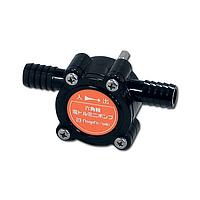
Several products in this range illustrate how varied industrial pumping needs can be. The Niigata Seiki RDP-01 MINI PUMP (Ø16mm) is a compact mini pump that operates using a portable drill, making it suitable for simple transfer jobs where mobility and ease of use are key considerations. Its small form factor makes it very different from pumps intended for long-duration industrial duty.
For field sampling and groundwater-related work, Eijkelkamp offers several more application-specific options. The 12.35 series peristaltic pump sets combine a 12 VDC advanced peristaltic pump with accessories such as a compact flow-through cell and measurement instruments, with variants that include or exclude battery and charger. The Eijkelkamp 12.27 MP 1 submersible pump series is designed for tasks such as purging and sampling monitoring wells, with versions supplied without tube or with LDPE or PTFE tubing in multiple lengths.
How to choose the right industrial pump
The first step is to define the liquid and the job. Ask whether the medium is clean water, a process liquid, or a sample that needs controlled handling. Then review the required flow, lift or discharge height, installation environment, portability needs, and whether the pump will run occasionally or for extended periods.
Material compatibility is especially important when the fluid or sampling environment may affect tubing, seals, or wetted components. Tube length and tube material can matter in well sampling setups, which is why product variants with LDPE or PTFE tubing are relevant. If the application is more construction-oriented and focused on dewatering or temporary site use, users may also want to review related construction pump solutions for comparison.
Power supply is another practical consideration. A 12 VDC peristaltic set supports mobile field use, while a higher-power submersible unit may be more appropriate for deeper pumping duty. In all cases, the best approach is to match the pump type to the process objective rather than assuming one configuration will fit every task.
Why tubing, accessories, and package configuration matter
In technical B2B purchasing, the pump itself is only part of the decision. Package configuration can directly affect deployment time and field readiness. For example, a peristaltic pump set that includes battery, charger, flow-through cell, and measurement meter can reduce setup complexity for teams performing site sampling or water-quality checks.
The same logic applies to submersible systems. Choosing a version with the correct tube material and length can simplify installation and help align the equipment with the intended sampling depth or fluid compatibility needs. These details may seem secondary during initial comparison, but they often determine whether the equipment integrates smoothly into actual operating procedures.
Operation and maintenance considerations
Stable pump performance depends not only on the initial selection but also on routine inspection and maintenance. Operators typically monitor flow consistency, vibration, noise, temperature, and power conditions to identify wear before it affects production or field schedules. Even compact or portable pumps benefit from regular checks of connectors, tubing, and seals.
For sampling-oriented equipment, maintenance also includes keeping the flow path clean and replacing worn tubing or consumable parts when needed. For submersible units, attention to operating depth, cable and tube condition, and protection against dry running or overload helps preserve service life. A realistic maintenance plan is often just as important as the initial specification.
Common questions about industrial pump selection
Which pump type is suitable for monitoring well sampling?
Peristaltic and submersible options are both used, but the choice depends on sampling depth, flow requirement, and handling method. The Eijkelkamp peristaltic pump sets and MP 1 submersible pump models in this category reflect those different use cases.
Does a compact mini pump fit heavy industrial duty?
Usually not. A compact unit such as the Niigata Seiki RDP-01 is more suitable for light-duty or portable transfer tasks, while continuous or deeper pumping applications generally require a more specialized industrial configuration.
Why are there versions with different tubing materials?
Tubing material affects compatibility, handling, and application suitability. LDPE and PTFE options are typically selected based on the operating environment and the nature of the fluid or sample being handled.
Choosing with the full application in mind
A good pump decision comes from balancing pumping principle, installation conditions, fluid characteristics, and the accessories needed to make the system practical in day-to-day use. This category is built to support that comparison, whether the priority is compact transfer, controlled sampling, or submersible well pumping.
By reviewing the intended duty carefully and comparing package configuration alongside core pump performance, buyers can narrow the selection more effectively and choose equipment that fits real operating requirements instead of only headline specifications.
Get exclusive volume discounts, bulk pricing updates, and new product alerts delivered directly to your inbox.
By subscribing, you agree to our Terms of Service and Privacy Policy.
Direct access to our certified experts