
Oscilloscope Calibrator
Accurate scope verification is essential wherever waveform shape, timing, and amplitude must be trusted in maintenance, calibration labs, electronics production, and test environments. Choosing the right Oscilloscope Calibrator helps technicians check instrument performance with repeatable reference signals across a defined frequency range, supporting more reliable measurements and better traceability in day-to-day work.
This category focuses on oscilloscope calibration equipment designed for professional use, especially where multiple channels, broad signal coverage, and stable output are important. It is relevant for organizations maintaining bench oscilloscopes, validating test setups, or supporting service workflows that depend on dependable scope performance.
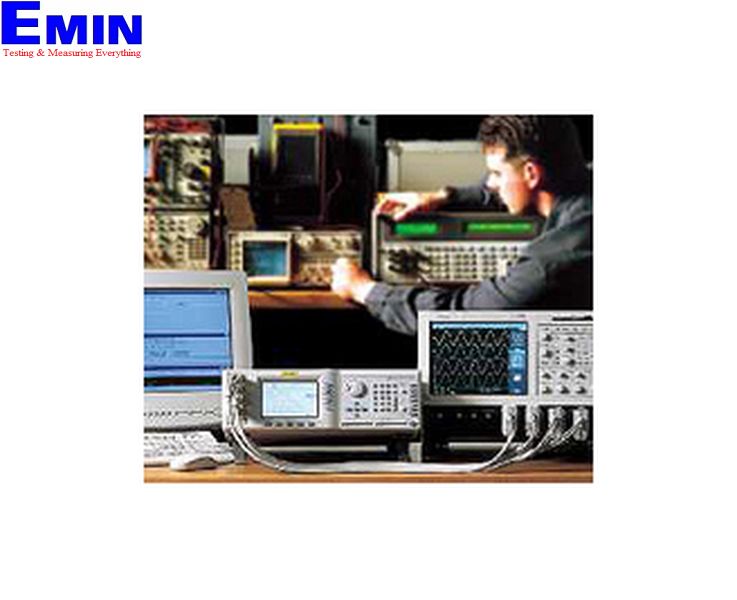
Where oscilloscope calibrators fit in a calibration workflow
An oscilloscope must display electrical signals accurately if it is going to be used for troubleshooting, validation, or production testing. A dedicated calibrator provides known reference outputs so users can evaluate how the scope responds to signal frequency, channel input, and waveform reproduction under controlled conditions.
Compared with more general-purpose calibration tools, this type of equipment is aimed at the specific needs of oscilloscope verification. In a broader calibration environment, it often complements tools such as multifunction calibrators, which are commonly used for electrical instruments with wider but less specialized coverage.
Typical requirements when selecting an oscilloscope calibrator
The first point to review is the frequency range needed for the oscilloscopes in your lab or service program. Low-frequency capability is important for general verification tasks, while higher-frequency output becomes critical when working with faster scopes or applications involving more demanding signal analysis.
Another practical factor is channel configuration. A calibrator with output on multiple channels can simplify routine verification, improve consistency across test points, and support more efficient work when several scope inputs need to be checked in one setup. Buyers should also consider how the unit fits into existing procedures, documentation requirements, and the level of calibration detail expected by their organization.
Representative models in this category
This category includes selected models from Fluke (Calibration), a recognized name in professional calibration workflows. The available examples illustrate how different frequency ranges can support different oscilloscope classes and verification needs without changing the overall purpose of the instrument.
The Fluke 9500B/3200 Oscilloscope Calibrator offers output from 0.1 Hz to 3.2 MHz on 5 channels, making it suitable for lower-frequency scope calibration tasks and general laboratory support. For broader signal coverage, the Fluke 9500B/600 extends from 0.1 Hz to 600 MHz, while the Fluke 9500B/1100 reaches 0.1 Hz to 1100 MHz, both also providing output on 5 channels for more advanced oscilloscope verification programs.
How frequency coverage affects application fit
Frequency capability has a direct impact on which oscilloscopes and test scenarios a calibrator can support. A lower-range unit may be entirely appropriate for service benches, educational laboratories, or facilities that mainly work with standard electronic circuits. In contrast, environments dealing with faster signals or higher-bandwidth scopes generally need broader coverage to verify instrument response more effectively.
This is why model selection should be based on actual scope inventory and calibration scope rather than on headline range alone. A unit with very wide coverage may offer flexibility for future needs, while a more targeted range can still be the right choice when the application is clearly defined and cost-to-use efficiency matters.
Practical use cases in labs, service, and production
In a calibration laboratory, an oscilloscope calibrator is typically used to generate controlled reference signals for periodic verification and documentation. In repair and maintenance settings, it helps technicians quickly determine whether a scope is responding correctly before deeper fault analysis begins. In manufacturing or electronics test stations, it can support quality routines where measurement confidence needs to be maintained across multiple instruments.
These use cases often sit alongside other calibration disciplines. For example, facilities with mixed instrumentation may also operate pressure calibrator systems or temperature calibrators as part of a broader metrology setup, even though the oscilloscope calibrator serves a much more specialized electrical test role.
What to compare before purchasing
When comparing options in this category, start with the oscilloscope bandwidths you need to support and the level of verification required by your procedures. Then review channel count, output stability expectations, and how easily the calibrator can be integrated into bench workflows, scheduled calibration plans, and service documentation practices.
It is also useful to think about scalability. If your organization expects to add higher-performance oscilloscopes later, choosing a model with broader frequency capability may reduce the need to replace equipment too soon. On the other hand, if current requirements are stable, a model aligned to the present application can offer a more practical fit.
Choosing the right category for your calibration needs
Not every calibration task requires a dedicated oscilloscope solution, but when scope accuracy is a priority, specialized equipment makes the process more consistent and relevant to the instrument being tested. This category is intended for users who need dependable reference signals for oscilloscope verification rather than a general electrical calibration platform.
By comparing required frequency range, channel needs, and the types of oscilloscopes in service, buyers can narrow the selection more effectively. If your work depends on trustworthy waveform measurement, a suitable oscilloscope calibrator can become an important part of a stable, well-structured calibration workflow.
Get exclusive volume discounts, bulk pricing updates, and new product alerts delivered directly to your inbox.
By subscribing, you agree to our Terms of Service and Privacy Policy.
Direct access to our certified experts

