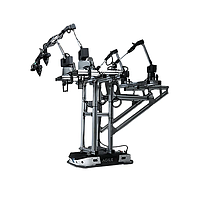
Humanoid Robots
Human-centered automation is becoming more relevant in environments where machines need to move, interact, and work in spaces originally designed for people. In that context, Humanoid Robots stand out as a category built around mobility, manipulation, and communication patterns that fit real-world human environments rather than requiring a fully redesigned workspace.
For B2B buyers, engineers, educators, and solution planners, this category is useful when evaluating robots intended for service interaction, research, demonstration, training, or advanced automation projects. The value of a humanoid platform is not only in its appearance, but in how it combines sensing, actuation, balance, motion control, and task-oriented behavior into a more adaptable robotic system.
Where humanoid robots fit in modern robotics
A humanoid robot is generally designed with a body structure that resembles key aspects of the human form, such as a head, torso, arms, or legs. This structure can support interaction in spaces built for people, including walking paths, doorways, workstations, counters, and public-facing service areas. In practical terms, that makes the category relevant for organizations exploring robots that need to communicate clearly, gesture naturally, or navigate shared environments.
Compared with highly specialized robotic systems, humanoid platforms often serve broader goals such as research, public engagement, assisted interaction, and flexible task experimentation. They are especially relevant when the project requires a combination of human-machine interaction, mobility, and coordinated movement rather than a single fixed function.
Typical application scenarios
Search intent around this category often comes from teams looking for robots that can do more than repeat a simple industrial motion. Humanoid platforms may be considered for reception and customer-facing interaction, educational labs, robotics research, AI behavior testing, demonstrations, and experimental service workflows. Their form factor can also make them useful in studies involving social interaction, collaborative assistance, and multimodal communication.
In commercial and public settings, some buyers evaluate humanoid systems alongside other service-oriented platforms depending on the task. For example, if the focus is item transport rather than expressive interaction, delivery robots may be the better fit. If the goal is front-desk guidance or user support, organizations may also compare this category with assistant robots to align robot design with the intended user experience.
Core capabilities buyers usually evaluate
When reviewing humanoid robots, the most important considerations usually go beyond appearance. Buyers typically focus on motion performance, stability, perception, communication interfaces, and software flexibility. A capable platform should support coordinated movement and responsive interaction while fitting the technical requirements of the intended environment.
Key evaluation areas often include sensor integration, degree of movement freedom, control architecture, battery operation, onboard computing, and compatibility with development tools. In research and advanced prototyping, software openness and integration options can be just as important as the robot’s mechanical design, especially when teams need to test custom behaviors, AI models, or task-specific workflows.
How humanoid robots differ from other robot categories
Not every robotics project benefits from a human-like platform. In many cases, a specialized robot will be more efficient, easier to deploy, and simpler to maintain. Humanoid robots become more relevant when the use case depends on interaction style, anthropomorphic communication, or movement through spaces tailored to human reach and motion.
For example, facilities focused on maintenance and autonomous floor care may find more direct value in cleaning robots. Organizations working in field surveys, hazardous environments, or remote investigation may instead prioritize exploration robots. The humanoid category is most compelling when the robot’s body design itself supports the operational objective.
Selection factors for technical and procurement teams
A practical buying decision starts with defining the real task, not the visual concept. Some projects need a robot for public engagement and interaction, while others need a platform for locomotion research, manipulation experiments, or AI integration. Clarifying whether the robot will be used for demonstration, education, R&D, or service deployment helps narrow down the most relevant specifications and feature priorities.
Procurement teams should also assess deployment conditions such as indoor versus controlled lab use, operator skill level, required safety procedures, maintenance expectations, and available software resources. In many B2B settings, the right choice depends on balancing technical ambition with implementation practicality, especially when the robot is part of a wider automation or research ecosystem.
Integration, usability, and long-term planning
Humanoid robots are rarely standalone purchases in serious technical environments. They are typically part of a broader system that may include software development, simulation, data collection, AI testing, operator training, and user interaction design. This means buyers should think beyond initial hardware selection and consider how the platform will be programmed, monitored, updated, and evaluated over time.
Long-term usability also matters. A robot intended for repeated demonstrations or ongoing research should support reliable operation, manageable servicing, and a clear workflow for updates or application changes. Teams that approach the category from a systems perspective usually make better decisions than those focusing only on the visual appeal of a humanoid platform.
Who this category is most relevant for
This category is especially useful for universities, robotics labs, innovation centers, solution developers, and organizations exploring interactive automation. It can also be relevant for public-facing venues, advanced education providers, and businesses testing new customer engagement or service models where robotic presence and interaction style matter.
For these users, humanoid robots are not simply novelty systems. They can serve as platforms for experimentation, communication, applied research, and next-generation automation concepts. The right product choice depends on the required balance between movement, interaction, programmability, and operational simplicity.
Choosing the right direction for your robotics project
Selecting from the Humanoid Robots category works best when the project truly benefits from a robot designed around human-oriented movement and interaction. If your priority is research, service communication, or advanced experimentation in human spaces, this category offers a strong starting point for evaluating suitable platforms.
Before making a final selection, it is worth comparing the real operating goal, environment, and integration needs against adjacent robot types. That approach helps ensure the chosen platform supports practical deployment, not just conceptual interest, and leads to a robotics solution that fits the application more effectively.
Get exclusive volume discounts, bulk pricing updates, and new product alerts delivered directly to your inbox.
By subscribing, you agree to our Terms of Service and Privacy Policy.
Direct access to our certified experts