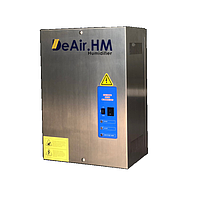
Humidifier
Stable indoor humidity is often a hidden requirement behind product quality, process consistency, and equipment reliability. In production rooms, storage areas, laboratories, and technical facilities, air that is too dry or too humid can affect materials, increase electrostatic risk, and make environmental control harder to maintain. This is why Humidifier systems are widely used as part of practical humidity management in industrial and commercial environments.

Within this category, users can find humidification equipment designed for different output levels, installation needs, and operating scales. The focus is not only on adding moisture to the air, but on supporting more stable working conditions where humidity directly influences process performance, storage quality, or the protection of sensitive equipment.
Why humidity control matters in technical environments
Humidity affects far more than comfort. In electronics assembly and data-related spaces, excessively dry air can increase the chance of electrostatic discharge, which may damage sensitive components or create unstable operating conditions. In warehousing, paper handling, wood processing, and museum-type preservation spaces, poor humidity control can contribute to cracking, deformation, or long-term material degradation.
Industries such as pharmaceuticals and food processing also depend on controlled ambient conditions to help maintain product integrity. Powders, tablets, packaging materials, and hygroscopic ingredients can all respond to air moisture changes, so humidification is often part of a broader environmental control strategy rather than a standalone accessory.
How industrial humidifiers are typically selected
Choosing the right system usually starts with required humidification capacity, room size, air exchange rate, and whether the unit will operate independently or as part of HVAC integration. A smaller room with localized demand may only need a compact unit, while central air handling or larger production zones often require significantly higher output.
Power supply and installation conditions also matter. In this category, several models operate on 380V three-phase power, making them relevant for industrial sites where continuous-duty performance is expected. Control power requirements, tank size, and overall dimensions can further influence where and how a unit is installed.
Where monitoring is part of the application, it may also be useful to combine humidification with measurement tools such as multifunction moisture meters or dedicated soil moisture meters when the controlled process involves materials, substrates, or storage conditions that need verification beyond ambient air control.
Representative humidifier models in this category
The range includes compact to high-capacity solutions from DeAir, covering applications from small technical rooms to larger industrial spaces. Lower-capacity models such as the DeAir DeAir.HM-6S and DeAir DeAir.HM-8S are suited to installations where moderate output is sufficient and space is limited. These units offer a practical starting point for localized humidity support.
For medium-scale demand, models such as the DeAir DeAir.HM-15S, DeAir DeAir.HM-30S, and DeAir DeAir.HM-45S provide a broader operating range. They are relevant where humidity must be maintained more consistently across production rooms, equipment zones, or controlled storage areas. As output requirements increase, the DeAir DeAir.HM-65S, DeAir DeAir.HM-90S, and DeAir DeAir.HM-130S support larger-volume humidification and more demanding continuous operation.
This category also includes the DEVATEC ELMC20 Machine wet (20l/h), which expands the available selection for users comparing different humidification approaches and capacities. Rather than focusing only on one output point, the category helps buyers evaluate equipment according to installation scale and environmental objectives.
Typical application areas for humidifier systems
In electronics-related environments, the main goal is often to reduce static build-up by keeping air conditions within an appropriate humidity range. Here, a stable humidification source can support assembly quality and reduce the likelihood of process disruption caused by very dry air. Medium-capacity options are commonly considered for production rooms and technical workspaces where balanced environmental control is important.
In pharmaceutical and clean manufacturing settings, humidifiers may be used to help maintain process stability over long operating periods. Warehouses storing paper, wood-based materials, or moisture-sensitive goods can also benefit from consistent humidification, especially where seasonal dryness causes dimensional change or surface damage. For larger infrastructure environments, higher-capacity units may be integrated with ventilation or air handling systems to serve the full airflow of a space.
Capacity range and practical comparison points
One useful aspect of this category is its broad capacity range. Available DeAir models extend from 6 kg/h and 8 kg/h through 15 kg/h, 30 kg/h, 45 kg/h, 65 kg/h, and 90 kg/h up to 130 kg/h. This makes it easier to shortlist equipment based on actual humidification demand rather than trying to oversize or undersize a single model for every application.
When comparing units, buyers typically look beyond nominal output. Tank arrangement, electrical load, physical footprint, and integration requirements can all shape the final choice. A compact model may be easier to place near a controlled area, while larger systems may be more suitable for centralized operation where steady high-volume moisture supply is needed.
For sites that also verify humidity-related conditions in stored goods or agricultural materials, complementary tools such as moisture meters for agriculture can support a broader quality-control workflow. This is especially relevant when ambient humidity and product moisture need to be assessed together.
What to consider before ordering
Before selecting a humidifier, it is helpful to define the target environment clearly: room volume, ventilation rate, operating hours, and whether humidity must be maintained continuously or only during certain production periods. The answer often determines whether a compact standalone unit is enough or whether a larger industrial model is more appropriate.
It is also worth checking available electrical infrastructure, installation space, and service access. In many industrial settings, humidification performance must be considered together with maintenance practicality and control compatibility. A model that fits the process technically but is difficult to install or maintain may not be the best operational choice over time.
Finding the right humidifier for your process
This humidifier category is intended for users who need more than a simple room comfort device. It brings together industrial-capacity options for applications where humidity stability supports product quality, material protection, or safer operating conditions. From compact DeAir units to higher-output systems and the DEVATEC ELMC20, the selection covers a range of practical industrial needs.
If your process depends on controlled air moisture, the right choice usually comes from matching capacity, electrical requirements, and installation method to the real operating environment. Reviewing the available models in this category is a solid starting point for selecting a system that aligns with your space, workflow, and humidity control target.
Get exclusive volume discounts, bulk pricing updates, and new product alerts delivered directly to your inbox.
By subscribing, you agree to our Terms of Service and Privacy Policy.
Direct access to our certified experts