
Safety Controllers
Protecting people and keeping machines productive often depend on how reliably a control system reacts to hazardous events. In automated lines, packaging systems, robotic cells, and material handling equipment, Safety Controllers help coordinate emergency stops, guard doors, light curtains, safety switches, and other protective devices in a structured and scalable way.
For engineering, maintenance, and purchasing teams, this category is relevant when a standard control approach is not enough for machine safety logic. It covers controller platforms and related modules used to build safety functions, expand I/O, and connect safety systems to industrial networks while supporting practical integration into modern automation environments.
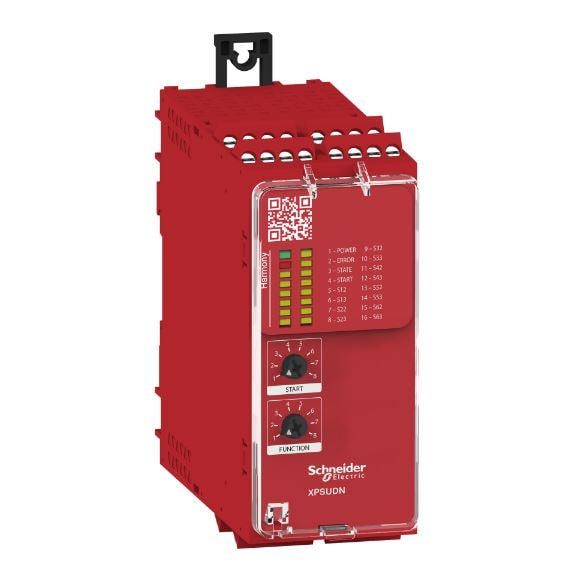
Where safety controllers fit in industrial automation
A safety controller is typically used when multiple protective devices and stop functions must be monitored and processed together. Instead of wiring every safety device into isolated relay logic, users can centralize safety-related decisions, simplify diagnostics, and adapt the system more easily as the machine evolves.
This makes safety controllers especially useful for machines with several zones, mixed input types, or communication requirements to higher-level control systems. If your project also involves broader control architecture, it can be helpful to compare these solutions with programmable controllers used for standard automation tasks, since safety and standard control often need to work side by side.
Typical module types in this category
This category includes more than just one standalone controller. A practical safety control platform is usually built around a main module, then expanded with additional I/O or communication modules depending on the machine design and the required safety logic.
Examples from the available range illustrate that structure clearly. Main modules such as SICK FLX3-CPUC200 Safety Controllers Flexi Compact and SICK FX3-CPU320002 Safety Controllers Flexi Soft provide the central processing function. Expansion modules such as SICK FLX3-XTDO100 or SICK FLX3-XTDI100 add safe inputs and outputs, while gateway modules such as SICK FLX0-GPNT100, SICK FLX0-GETC100, and SICK FX0-GMOD00000 support communication with industrial networks like PROFINET, EtherCAT®, CANopen, or Modbus TCP.
Common applications and system roles
In real machines, safety controllers are often used to combine signals from emergency stop circuits, interlock switches, enabling devices, and presence-sensing equipment into a defined response. That response may include safe stopping, controlled restart logic, zone muting, or status exchange with the main automation system.
They are also useful when machine builders need a cleaner path for system expansion. A modular design can make it easier to add extra safe inputs, increase the number of controlled outputs, or introduce fieldbus connectivity without redesigning the entire safety architecture from scratch. This flexibility is one reason such controllers are widely considered in complex machine safety projects.
How to evaluate the right configuration
Selecting the right solution usually starts with the logic requirements rather than with brand or form factor alone. Buyers and engineers typically review the number of safe inputs and outputs needed, whether non-safe I/O is also required, how much future expansion should be reserved, and which communication interface is expected by the machine or plant network.
It is also worth checking physical and environmental fit. The products listed in this category show common industrial characteristics such as 24 V DC supply, compact module widths, front or plug-in terminal connections, and IP20 enclosure ratings for cabinet installation. For installations where communication to other control layers matters, the gateway choice can be as important as the CPU itself.
Flexi Compact and Flexi Soft examples from SICK
SICK is one of the manufacturers represented in this category, and the listed products show two distinct modular families: Flexi Compact and Flexi Soft. Flexi Compact examples include main modules like FLX3-CPUC100 and FLX3-CPUC200, as well as matching I/O and gateway modules. These are relevant when a compact modular safety system with safe I/O expansion and network integration is needed.
Flexi Soft examples in the current range include FX3-CPU320002 as a main module, FX3-XTDS84002 and FX0-STIO68002 as expansion modules, and communication options such as FX0-GETC00000 or FX0-GMOD00000. From a selection perspective, these examples highlight a practical ecosystem approach: start with the processing module, then choose the I/O density and protocol support that best match the machine architecture.
Communication, diagnostics, and integration considerations
In many projects, safety performance is only one part of the purchasing decision. Integration effort also matters. Modules with USB, TCP/IP, TFT display configuration, or fieldbus connectivity can reduce setup time, support commissioning, and simplify troubleshooting during maintenance.
Protocol choice should align with the surrounding control system and plant standards. Depending on the machine, users may need PROFINET for integration with PLC-based environments, EtherCAT® for fast automation networks, or Modbus TCP for broader interoperability. Where the project includes process-oriented loops rather than machine safety, related categories such as PID Controllers serve a different control purpose and should be evaluated separately.
What buyers often compare across brands
This category brings together solutions associated with recognized industrial automation suppliers such as Banner Engineering, Omron Automation and Safety, PHOENIX CONTACT, SCHNEIDER, SIEMENS, Weidmuller, IDEC, Littelfuse, Carlo Gavazzi, and SICK. In practice, buyers often compare not only hardware specifications, but also configuration workflow, module availability, network compatibility, panel space, and long-term maintainability.
For B2B purchasing, another important factor is whether the controller family supports the broader safety concept of the machine. That includes the expected number of devices, expansion path, and serviceability over time. If your application spans several control functions in the same machine, it may also be useful to review categories such as power controller products or level controller solutions where those functions are part of the same overall system design.
Choosing with a long-term system view
The most suitable safety controller is rarely the one with the longest feature list on paper. A better fit usually comes from matching the controller platform to the real machine layout, the required I/O structure, the communication method, and the expected maintenance workflow. A modular family can be especially valuable when the machine may later need additional zones, revised guarding, or network expansion.
This category is designed to support that selection process with controller CPUs, I/O extensions, and gateway modules in one place. By reviewing the available safety control options in the context of your machine architecture, it becomes easier to build a system that is practical to integrate, straightforward to maintain, and aligned with industrial automation requirements.
Get exclusive volume discounts, bulk pricing updates, and new product alerts delivered directly to your inbox.
By subscribing, you agree to our Terms of Service and Privacy Policy.
Direct access to our certified experts