
Centerless grinding machine
Precision cylindrical parts often depend on a grinding process that can hold tight roundness and surface finish without slowing production. In many machining lines, a centerless grinding machine is chosen for exactly that reason: it supports continuous, accurate grinding of shafts, rollers, pins, and other round components without clamping the workpiece between centers.
This category focuses on equipment used for high-throughput and stable external grinding in industrial manufacturing. It is especially relevant for users comparing machine capacity, achievable accuracy, workpiece diameter range, and the overall fit between machine configuration and production requirements.
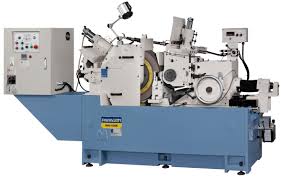
How centerless grinding works in practical production
Unlike conventional cylindrical grinding, the workpiece in a centerless grinding process is supported on a work rest blade and positioned between a grinding wheel and a regulating wheel. The grinding wheel removes material, while the regulating wheel controls rotation and feed, helping maintain stable geometry throughout the cycle.
This setup is widely used where manufacturers need consistent roundness, repeatability, and efficient handling of cylindrical parts. Because the workpiece does not need to be centered or chucked in the traditional way, setup time can be reduced and continuous processing becomes easier to achieve in medium- to high-volume production.
Why manufacturers choose centerless grinding machines
Centerless grinding is often selected when production demands both precision and throughput. It is well suited to parts that require controlled roundness, cylindricity, and surface roughness, especially when the same component must be processed repeatedly with minimal variation from one piece to the next.
Another advantage is process stability. With the right machine specification, users can balance wheel size, power, workpiece diameter range, and feed method to match their application. In lines where thermal control also matters, supporting equipment such as an industrial chiller may be considered as part of the wider machine environment.
Representative machine options in this category
This category includes equipment from manufacturers such as SMAC and WMT CNC, each relevant to different production scenarios. SMAC models in the current range are particularly aligned with centerless grinding applications, while WMT CNC appears in the broader machining context through honing equipment often used in adjacent finishing workflows.
Among the representative examples, the SMAC 3G6020 Centerless Grinder is intended for smaller diameter work, while the SMAC 3G6040 Centerless Grinder is also positioned for tapered roller applications with fine roundness and surface finish targets. For larger workpiece ranges, models such as the SMAC G11150, SMAC G10300, and SMAC GT10400 show how machine selection changes as diameter capacity, wheel dimensions, and installed power increase.
Some versions are also tailored to specific process priorities. For example, the SMAC G11200/2 Centerless Grinder is noted with a wide grinding wheel configuration, which may be relevant in applications where contact width and process behavior are part of the selection criteria.
What to evaluate before choosing a machine
The first step is to define the actual workpiece diameter range and the quality target. A machine intended for small rollers or slender cylindrical components will not be selected the same way as one used for larger through-feed grinding jobs. Capacity should be checked together with accuracy expectations rather than in isolation.
Users should also review grinding wheel size, total installed power, machine mass, and the intended grinding method. Heavier, higher-power equipment may be better suited to demanding production environments, while smaller machines may be more practical for compact parts and narrower processing windows.
In addition, it is important to consider whether the application is primarily through-feed or tied to a more specialized part geometry. The required level of process control, operator involvement, and integration with upstream or downstream equipment can have a direct impact on the most appropriate machine choice.
Typical applications and production context
Centerless grinding machines are commonly used for cylindrical components where dimensional repeatability matters over long runs. Depending on the machine and setup, this may include rollers, shafts, bearing-related components, and other round parts used in automotive, mechanical, and precision manufacturing environments.
Several SMAC models listed here are specifically marked for tapered roller work, which indicates a clear fit for precision rolling-element production. In broader factory settings, centerless grinding may sit alongside other finishing and process-support equipment, including compressed air treatment equipment when air quality and pneumatic system reliability are part of the production infrastructure.
Reading specifications in a more useful way
When comparing models, it helps to interpret specifications based on production goals rather than simply looking for the biggest machine. Diameter range indicates the physical scope of parts the machine can handle, but achievable roundness, cylindricity, and roughness are what determine whether that machine is suitable for the final quality requirement.
Wheel dimensions and total power also influence grinding behavior, stock removal capability, and the type of production load the machine can sustain. Machine weight can be a useful indirect signal of rigidity, especially in heavier-duty installations, although it should always be considered together with the intended application and the full process design.
If a production line includes other precision finishing operations, it may also be useful to compare centerless grinding with adjacent technologies rather than treating all post-machining processes as interchangeable. That broader view helps avoid overspecifying or underspecifying the grinding stage.
How this category fits into a wider machining workflow
Centerless grinding is often one stage within a larger manufacturing sequence. Parts may be turned, heat treated, ground, inspected, and then sent to assembly or further finishing depending on the end product. In some sectors, it operates alongside internal finishing processes such as honing, especially when both external and internal geometries must meet controlled surface and dimensional targets.
For buyers comparing process routes, this category is useful not only as a list of machines but also as a starting point for matching equipment capability to part geometry, output volume, and quality expectations. That approach usually leads to a better shortlist than choosing only by power rating or nominal capacity.
Conclusion
A well-matched centerless grinding machine can improve consistency, reduce handling complexity, and support efficient production of cylindrical parts across a wide range of industrial applications. The right choice depends on more than diameter capacity alone; it should reflect the required finish, process stability, machine configuration, and the realities of the production line.
By comparing representative models carefully and viewing the machine as part of a complete manufacturing workflow, buyers can identify equipment that fits both current output needs and long-term process control goals.
Get exclusive volume discounts, bulk pricing updates, and new product alerts delivered directly to your inbox.
By subscribing, you agree to our Terms of Service and Privacy Policy.
Direct access to our certified experts


