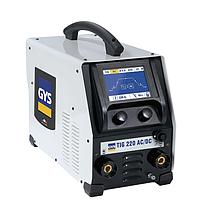
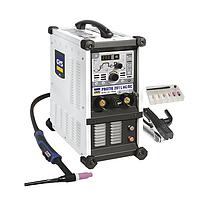
Multi-function welding machine
In fabrication shops, maintenance departments, and industrial production lines, one machine often needs to cover more than a single welding process. That is where a multi-function welding machine becomes especially practical: it helps operators switch between MIG/MAG, MMA, and TIG workflows without building a separate setup for every task.
For B2B buyers, this category is relevant when flexibility, floor-space efficiency, and process control matter as much as output power. It is commonly considered for mixed-material work, repair operations, general metal fabrication, and production environments where welding parameters need to be adjusted quickly for changing jobs.
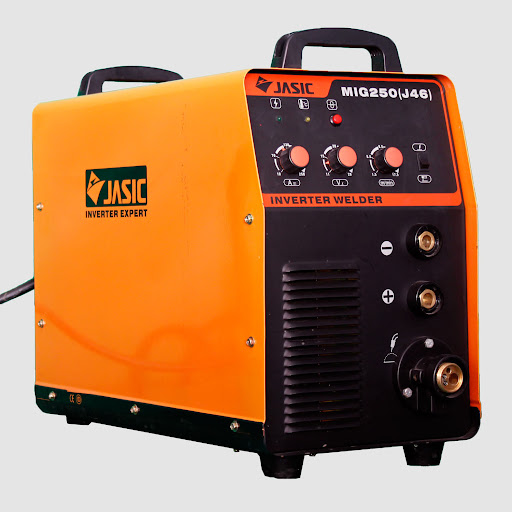
Why multi-process welding equipment matters in industrial applications
A multi-function platform brings several welding methods into one system, reducing the need to purchase, move, and maintain separate machines for each process. In practice, this can simplify workshop organization and make it easier to support varied tasks such as steel fabrication, stainless work, aluminum welding, and field repair.
Compared with a process-specific unit, the main advantage is operational range. A single machine may support MIG/MAG for productivity, MMA for robust general-purpose welding, and TIG for jobs that demand more controlled arc behavior and cleaner finishes. This versatility is useful for subcontractors, OEM workshops, metal structure manufacturers, and industrial maintenance teams.
What to look for when selecting a multi-function welding machine
The right choice depends on more than output current alone. Buyers usually need to match the machine to available power supply, expected duty cycle, material types, welding processes, and the working environment. In this category, many systems are designed for 3-phase industrial power and higher current ranges suited to demanding production tasks.
It is also worth reviewing whether the setup includes a separate wire feeder, cooling unit, trolley, connection cables, and the appropriate torch configuration. These details influence usability on the shop floor, especially for longer welding runs, mobile workstations, or setups that need to handle both steel and aluminum efficiently.
- Process coverage: MIG/MAG, MMA, TIG, and whether pulsed modes are supported
- Power and current range: suitability for heavy fabrication or mixed-duty work
- Cooling and handling: air-cooled or water-cooled torch packages, trolley or pallet movement
- Wire feeding system: single or dual wire feeder arrangements for productivity and material changes
- Control features: digital interface, synergic programs, stored jobs, and traceability support
Typical configuration options in this category
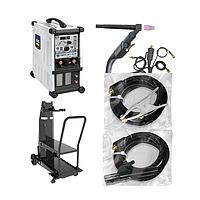
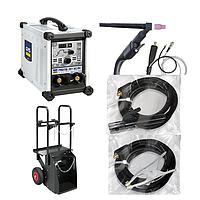
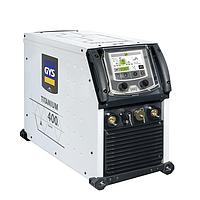
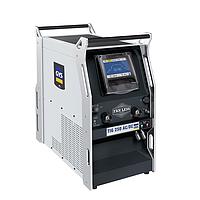
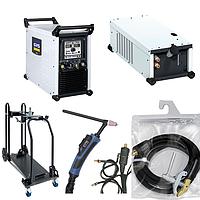
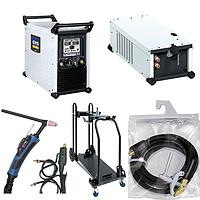
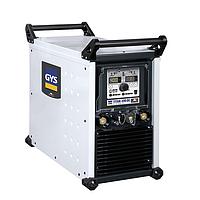
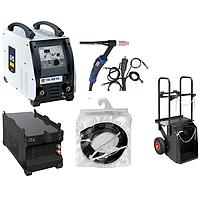
The products featured here show how multi-process welding systems can be configured for different operating needs rather than being limited to one standard format. Within the GYS range, there are packages based on NEOPULSE 400 G and NEOPULSE 500 G platforms, with versions intended for steel or aluminum work and different accessory combinations.
Some sets are supplied with a single wire feeder, while others include dual wire feeder arrangements that can be useful in production lines where reducing changeover time matters. There are also packages with cooling units, pallet trolleys, or standard trolleys, making them more suitable for fixed stations, larger assemblies, or more mobile workshop layouts.
Examples from the GYS range
GYS is the main manufacturer represented in this category, and the listed systems highlight a clear focus on industrial multi-process welding. For example, the GYS NEOPULSE 400G A1 STEEL PACK and GYS NEOPULSE 400G W2 ALU PACK illustrate how the same core platform can be adapted for steel or aluminum-oriented work, depending on the torch and package setup.
At a higher output level, the GYS PACK NEOPULSE 500 G W3 and GYS PACK NEOPULSE 500 G W4 are built for heavier-duty applications and broader process flexibility. These packages combine MIG/MAG, MMA, and TIG capability with digital control functions, separate wire feeding, and industrial accessories that support more demanding fabrication workflows.
Across these examples, the value is not just the amperage rating. Features such as synergic adjustment logic, pulsed welding capability, stored job management, and production-oriented traceability functions can be important for users who need repeatable results over multiple workpieces and welding procedures.
How to match the machine to your materials and workflow
When welding primarily carbon steel structures, an air-cooled or water-cooled steel package may be enough, depending on current demand and working duration. If aluminum is part of the workflow, selecting a package designed around the correct feeder and torch arrangement can make setup more stable and reduce friction during operation.
For workshops that regularly alternate between materials or production runs, dual-feeder systems can be attractive because they help reduce interruptions tied to wire changes. Where weld quality consistency matters, digital pulsed MIG/MAG and synergic curve support can also help operators reach usable settings faster, especially in mixed production environments.
If your operation requires broader process coverage but lower complexity at the workstation level, it may also be useful to compare this category with a dedicated plasma cutter for cutting tasks or explore other spot welding machine solutions for sheet-metal joining applications.
Digital control, repeatability, and production support
Modern multi-function welding systems increasingly serve not only as power sources, but as part of a more controlled production process. Digital parameter setting, memory functions, and weld data handling help reduce variability between operators and shifts. In industrial environments, that can support better repeatability and easier process standardization.
Several featured GYS packages also point toward applications where traceability, energy calculation, and saved welding jobs are relevant. These functions are especially useful in contract manufacturing and structured fabrication processes where parameter consistency, documentation, and quick setup recovery are important.
When a multi-function welding machine is the better investment
This category is often the better fit when one team must cover diverse welding requirements without managing several standalone machines. It can be particularly suitable for fabrication contractors, industrial maintenance departments, machinery builders, and workshops that handle different alloys, thickness ranges, or repair scenarios.
However, the best option depends on how often each process is used. If your workflow is centered on one highly specialized process, a dedicated machine may still be worth considering. For buyers who need one platform to handle broad day-to-day welding demands, a multi-process welding solution offers a more flexible path.
Choosing the right package for your operation
Within this category, the differences between packages are meaningful: 400 A versus 500 A platforms, steel versus aluminum torch setups, single versus dual wire feeders, and trolley versus pallet configurations all affect suitability in real production use. Reviewing the included accessories is just as important as comparing the core power source.
If your team needs a welding system that can adapt across processes while supporting industrial-level output and control, this range is a strong starting point. Focus on the actual materials you weld, the way operators move around the job, and whether your process benefits more from portability, cooling capacity, or faster wire changeover.
With the right configuration, a multi-function welding machine can simplify equipment planning, support a wider range of work, and provide a more scalable welding setup for growing industrial operations.
Get exclusive volume discounts, bulk pricing updates, and new product alerts delivered directly to your inbox.
By subscribing, you agree to our Terms of Service and Privacy Policy.
Direct access to our certified experts