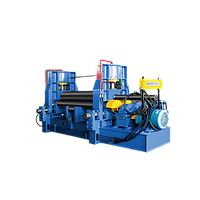
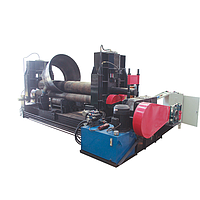
Winding machine
In metal fabrication, the ability to bend thick plate into precise cylindrical or curved forms has a direct impact on downstream welding, assembly, and structural quality. This is where Winding machine solutions play an important role, especially for workshops handling tanks, pressure vessels, piping sections, shipbuilding parts, and heavy steel structures.
On this page, buyers can explore rolling equipment used to form sheet metal and plate into round, curved, or conical profiles depending on machine design and production requirements. The category is especially relevant for businesses that need consistent forming accuracy, higher productivity, and repeatable results in medium to heavy-duty plate rolling applications.
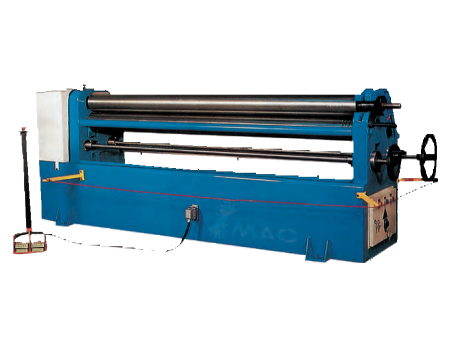
Where these machines are used in industrial production
Plate winding and rolling equipment is commonly found in fabrication environments where flat metal sheets must be transformed into shells, cylinders, arcs, and other curved components. Typical applications include storage tanks, process vessels, boiler sections, structural steel fabrication, pipeline components, and large-diameter rolled parts for energy and infrastructure projects.
Because many of these parts require controlled geometry before welding, the machine is not just a forming tool but a key step in the overall manufacturing flow. In many workshops, it works alongside cutting, handling, cooling, and finishing equipment; for example, an industrial chiller may support broader factory utility needs around hydraulic and production systems.
How a winding machine supports plate forming accuracy
The core function of this equipment is to apply controlled force through rollers so that a sheet or plate gradually takes on the required radius. Depending on the machine architecture, operators can perform initial positioning, rolling, and in many cases pre-bending to reduce flat ends and improve the final roundness of the part.
For industrial users, the main advantages are process consistency and better control over repeat jobs. This matters when producing shells that must fit accurately during welding or when handling thicker materials that are difficult to form manually. In CNC hydraulic configurations, positioning and pressure control also help reduce setup variation across batches.
Common machine types and selection logic
One practical way to compare this category is by looking at the number of rollers, drive method, and control style. In real purchasing scenarios, companies often focus first on the material thickness, plate width, and whether the job requires frequent repetition, because these factors influence machine size, power, and the need for CNC automation.
Among heavy fabrication solutions, four-roll hydraulic machines are often preferred when users want efficient loading, stable plate clamping, and more controlled pre-bending. CNC-based models can be a good fit for workshops that process multiple part sizes or need more repeatable forming parameters from one production run to the next.
It is also useful to consider the surrounding production setup. Facilities with compressed-air-based automation or auxiliary systems may review related equipment such as compressed air treatment equipment to maintain reliable plant operation beyond the forming station itself.
Representative models in this category
This category includes a range of hydraulic four-roller machines from Rbqlty, covering different forming capacities for plate thickness and working width. For example, the Rbqlty W12CNC-25x2500 and W12CNC-30x2500 models are positioned for lighter heavy-duty work where a 2500 mm width suits the production profile, while the W12CNC-30x3000 extends the working width to 3000 mm for larger shells and rolled sections.
For more demanding fabrication, models such as the Rbqlty W12CXC-50x2500, W12CXC-60X2500, W12CNC-70x3000, W12CNC-80x3000, W12CNC-90x3000, and W12CNC-100x3000 illustrate a progression toward thicker plate handling and higher installed power. Across these examples, buyers can see a clear scaling pattern in roller diameter, motor power, and supported rolling thickness, which helps when shortlisting equipment for specific workloads.
Instead of choosing only by the largest nominal capacity, it is usually better to match the machine to the material range used most often in production. A model that closely fits daily work can deliver better utilization, simpler operation, and lower long-term operating burden than an oversized machine selected only for occasional peak jobs.
What to evaluate before choosing a machine
The first checkpoint is actual plate specification: material type, yield strength, sheet thickness, and working width. Even when example models list capacity against a specific yield level, real-world suitability still depends on the material being processed and whether the application involves full rolling, pre-bending, or special shapes.
The second consideration is production workflow. If the workshop frequently changes between part sizes, a CNC hydraulic machine may provide a more efficient setup process. If the main goal is consistent cylinder production for tanks or vessels, attention should also be given to roller geometry, rolling speed, and handling method for loading and unloading heavy sheets.
Power and installation conditions matter as well. Larger machines in this category move into high-power industrial territory, so users should review floor layout, electrical infrastructure, material handling access, and operator safety procedures before purchase.
Why pre-bending capacity matters
When manufacturing cylinders or shells, the unbent flat ends of a plate can create additional fit-up work later. That is why pre-bending capacity is a meaningful specification in this category. Better pre-bending performance can reduce the need for secondary correction, improve roundness, and make welding preparation more efficient.
In practice, this becomes important for pressure-related components, large tanks, and structural rolled parts where dimensional consistency affects the next fabrication step. For buyers comparing models, pre-bending capability should be evaluated alongside maximum rolling thickness rather than treated as a secondary detail.
Applications across fabrication sectors
The machines in this category are relevant to a wide range of industrial sectors. Fabricators may use them for storage tanks, pressure vessel shells, duct and pipe sections, marine structures, heavy equipment covers, and curved architectural or structural steel components. Their value is highest where repeated curved forming must remain accurate across multiple batches.
Some production environments may combine plate rolling with packaging or finishing lines in a broader factory ecosystem, where other machinery categories such as heat shrinking machines serve completely different downstream tasks. While these systems are not substitutes, understanding the wider production context helps procurement teams plan equipment investments more effectively.
Final considerations for B2B buyers
Choosing the right winding machine is less about finding a generic machine type and more about matching forming capacity to the real production mix. Thickness range, plate width, pre-bending needs, automation level, and installation conditions should all be reviewed together before narrowing down a model.
For businesses working with rolled plate components, this category offers a useful starting point to compare heavy-duty hydraulic four-roll options and assess which configuration fits the intended fabrication workflow. A careful shortlist based on daily production requirements will usually lead to better process stability, more efficient forming, and smoother integration into the full metalworking line.
Get exclusive volume discounts, bulk pricing updates, and new product alerts delivered directly to your inbox.
By subscribing, you agree to our Terms of Service and Privacy Policy.
Direct access to our certified experts