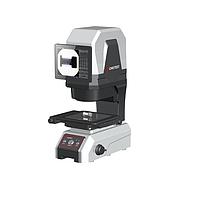
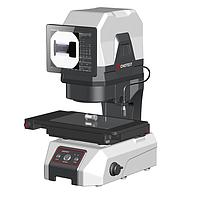
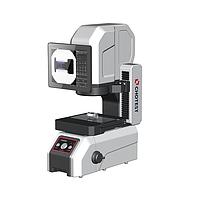
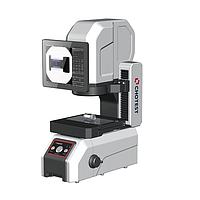
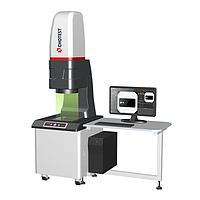
Flash Measuring Machine
High-throughput dimensional inspection often becomes a bottleneck when parts need to be checked quickly without sacrificing measurement confidence. In these situations, a Flash Measuring Machine is a practical solution for manufacturers, quality teams, and technical buyers who need fast non-contact measurement for small to medium components, profiles, and precision parts.
Compared with slower manual methods, this type of optical measuring system captures dimensional data in a single shot or with very limited operator intervention. That makes it especially relevant for repetitive inspection, incoming quality control, and production environments where speed, consistency, and ease of use matter as much as raw accuracy.
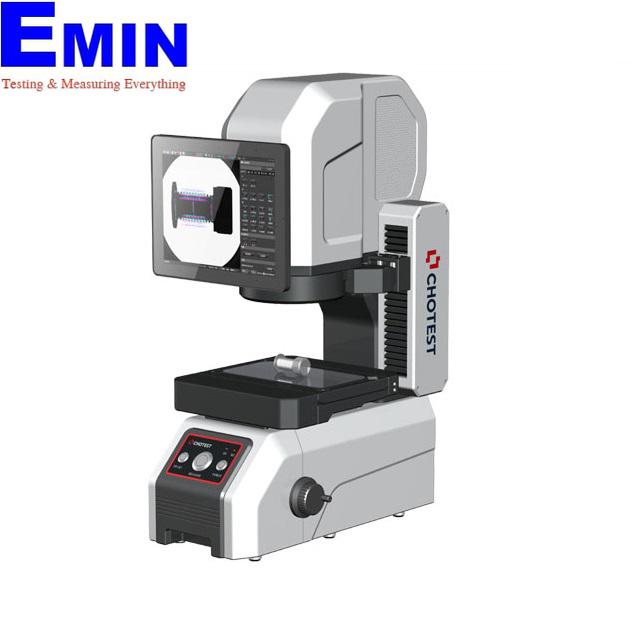
Where flash measuring machines fit in modern inspection workflows
A flash measuring machine is designed for non-contact optical measurement, using an imaging system to evaluate dimensions, positions, and geometric features of a part. Instead of relying only on touch probes or fully manual comparison, users can inspect multiple features rapidly, which helps reduce inspection time and improve repeatability between operators.
This makes the category relevant for workshops producing stamped parts, machined components, electronic parts, connectors, springs, and other items that require fast dimensional verification. In many production settings, these systems complement rather than replace traditional tools such as callipers for basic checks or more specialized systems like a roundness measuring machine when the inspection task calls for dedicated form analysis.
Why many users choose optical flash measurement
The main benefit of this category is speed. By combining imaging, software-based edge detection, and a controlled measuring setup, a flash system can evaluate parts far faster than many conventional manual methods, especially when the same part family is inspected repeatedly.
Another advantage is reduced dependency on operator technique. For B2B users managing quality across multiple shifts, this can help standardize inspection routines and improve traceability. It is also useful when delicate, lightweight, or easily deformed parts should not be measured by contact methods. For routine comparative checks, some facilities may still use tools such as dial indicators, but optical systems are often preferred when speed and multi-feature measurement are priorities.
Typical selection criteria for this category
Choosing the right system usually starts with the size and type of parts being measured. Field of view, working distance, and depth of field all influence whether a machine is better suited to compact precision parts, longer components, or larger flat workpieces. Loading capacity is also important when fixtures or heavier parts will be placed on the stage.
Accuracy and resolution should be evaluated against the actual tolerance of the part, not only the headline specification. In practice, buyers should also think about workflow factors such as inspection frequency, operator skill level, required throughput, and whether the machine will be used for first-article inspection, incoming inspection, or in-process quality control.
Example Chotest systems in this range
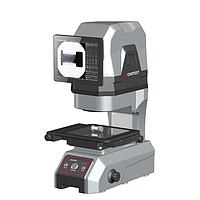
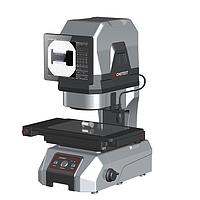
This category includes several models from Chotest, covering different inspection sizes and performance levels. For compact applications, the Chotest VX3030D Flash Measuring Machine and VX3100D Flash Measuring Machine are relevant options where smaller fields of view and light workpieces are involved. These systems are suitable for parts that need fine measurement resolution in a relatively compact benchtop format.
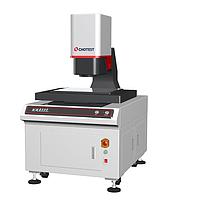
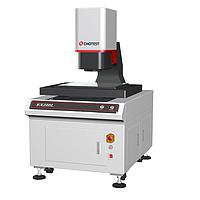
For users needing a larger measuring area, models such as the Chotest VX3200D and VX3300D extend the usable field of view while still supporting fast optical inspection. At the larger end of the category, the Chotest VX3500 and VX8500 address wider-area measurement tasks and higher loading capacity requirements, while the VX4230S and VX8300 provide additional options for applications that require a particular balance of measuring area and accuracy.
How to match machine size to part characteristics
Smaller benchtop systems are often a good fit for precision components with limited dimensions, especially when the goal is to inspect many pieces quickly in a lab or near-line quality station. In these cases, a compact machine can simplify handling and reduce footprint while still delivering high-resolution optical measurement.
Larger systems become more relevant when the workpiece size increases, when multiple parts are inspected together, or when the fixture itself occupies significant stage space. A buyer comparing models should think beyond nominal part dimensions and include handling clearance, fixturing, production rhythm, and future part variations. This usually leads to a more durable purchasing decision than selecting only by current part size.
When a flash measuring machine is the better choice
This category is especially useful when the same dimensional checks are repeated frequently and time savings quickly accumulate. It is also a strong choice when users want a cleaner digital workflow, visual measurement support, and more standardized operation than purely manual gauges can offer.
That said, not every inspection task belongs here. For basic thickness verification, a dedicated thickness meter may be more straightforward. For very simple shop-floor dimensional checks, manual instruments can still be the practical option. The strength of a flash measuring machine is in fast, repeatable, image-based inspection across multiple features in a single measuring process.
What technical buyers should review before purchasing
Before selecting a model, it is worth confirming the actual part mix, tolerance range, and expected daily inspection volume. A system that looks suitable on paper may be undersized if future product changes require a larger field of view or a heavier fixture. Likewise, a very large machine may be unnecessary for small repetitive parts and take up more floor space than needed.
It is also helpful to compare camera type, measuring area, loading capacity, and expected accuracy in relation to the application. In this category, some Chotest models use 5M CMOS imaging, others 12M or 20M CMOS, and the available field of view varies significantly. Reviewing these factors together gives a more realistic picture of system fit than looking at a single specification alone.
Choosing with application needs in mind
A well-matched flash measuring machine can improve inspection efficiency, reduce manual effort, and support more consistent dimensional control across production and quality processes. The most suitable option depends on part size, required accuracy, throughput expectations, and how the system will be used day to day.
For buyers comparing optical inspection equipment, this category offers a useful range of Chotest solutions from compact benchtop models to larger systems for broader measuring tasks. Reviewing the intended workflow first, then matching it to measuring area, resolution, and capacity, is usually the most reliable way to narrow down the right model.
Get exclusive volume discounts, bulk pricing updates, and new product alerts delivered directly to your inbox.
By subscribing, you agree to our Terms of Service and Privacy Policy.
Direct access to our certified experts