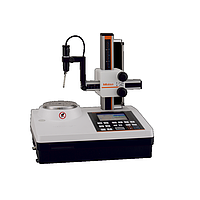
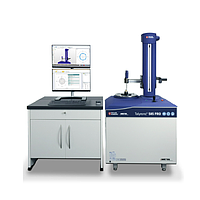
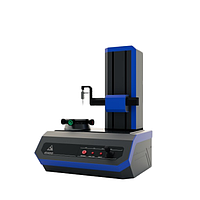
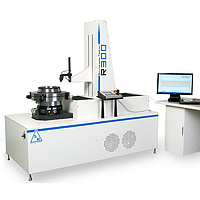
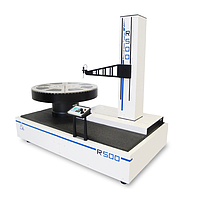
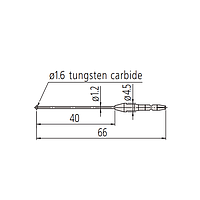
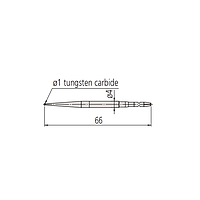
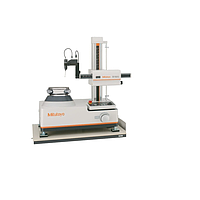
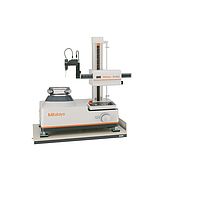
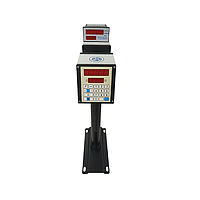
Roundness measuring machine
When dimensional tolerances become extremely tight, it is no longer enough to check only diameter or basic profile. Manufacturers working with bearings, shafts, raceways, precision automotive parts, and other cylindrical components often need a clearer view of roundness, cylindricity, and form accuracy to control process capability and reduce functional defects.
Roundness measuring machines are designed for this task. They help quality teams evaluate how closely a part matches its intended circular geometry, while also supporting deeper analysis of straightness, contour, and related surface form characteristics depending on the system configuration.
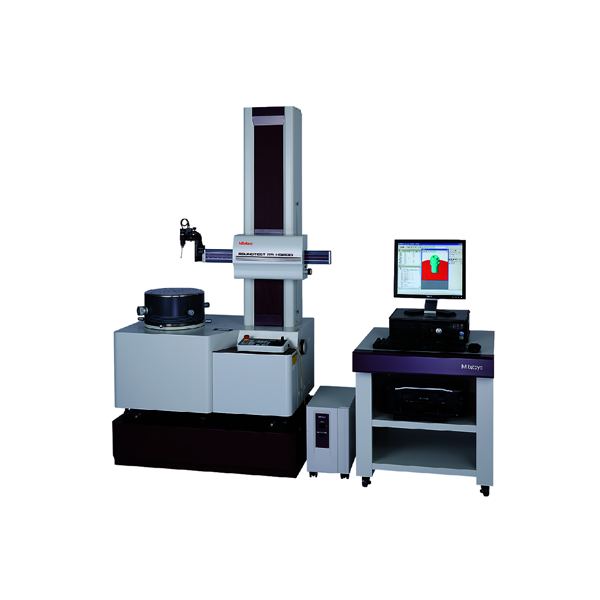
Where roundness measurement matters
Roundness inspection is especially important in applications where rotational accuracy, sealing performance, noise, wear, or fit between mating parts must be controlled. Even small deviations can affect bearing life, spindle performance, vibration behavior, and assembly consistency in high-precision production environments.
Compared with general-purpose tools such as dial indicators or callipers, a dedicated roundness system provides a far more detailed picture of circular form. This is valuable in metrology labs as well as in production lines where repeatability, traceability, and process feedback are critical.
What a roundness measuring machine typically evaluates
The main purpose of this equipment is to measure the deviation of a circular feature from a true circle. In practice, many systems also support analysis of cylindricity, straightness, contour, and harmonic characteristics, helping users understand whether an issue comes from machining, fixturing, spindle behavior, or part handling.
Modern systems often combine a precision spindle, sensitive gauge mechanism, software-based evaluation, and automated positioning functions. This makes them suitable for both single-part inspection and higher-throughput routines where the same measurement sequence must be repeated consistently over many parts.
Selection factors for different inspection tasks
Choosing the right machine depends on the type of components being measured, required accuracy, throughput expectations, and the level of automation needed. For some users, the priority is ultra-fine radial accuracy; for others, it is the ability to handle larger diameters, taller parts, or multi-part inspection in a production setting.
It is also useful to consider gauge range, measurement resolution, software capability, centering and leveling functions, and whether the machine will be used mainly for laboratory analysis or near-line process control. If your inspection workflow also includes complementary checks such as wall or coating verification, a thickness meter may be part of the broader quality system.
Representative systems in this category
Within this category, Taylor Hobson is a notable manufacturer for advanced roundness and cylindrical geometry measurement. Different platforms are suited to different operational needs, from compact automated measurement to ultra-high-precision and large-part inspection.
For example, the Taylor Hobson 131 and 131C Automated Roundness & Cylindricity Measuring Equipment are aligned with users looking for automated form measurement with precision air bearing spindle performance and standards-based software evaluation. For faster inspection in demanding production environments, the Taylor Hobson 150 PRO and 170 Raceway are positioned toward high-speed workflows and repetitive measurement tasks.
Where larger or heavier components must be evaluated, models such as the Taylor Hobson 1700 PRO, 585 XL PRO, and 565 XL PRO provide a more suitable platform for extended vertical travel and larger diameter capability. For applications that require very fine resolution and advanced automation, systems such as the 595 UHPR PRO, 595H PRO, 595 PRO, 585 PRO, and 565 PRO illustrate the range available for ultra-precise, multi-part, and traceable measurement routines.
Automation, throughput, and repeatability
Many buyers are no longer looking only for a measurement result; they also need a system that fits real manufacturing constraints. In this context, features such as automated center and level functions, gauge calibration, programmable measurement routines, and touchscreen or PC-based software can significantly reduce operator dependency and improve consistency between shifts.
This becomes particularly relevant in high-volume sectors where several parts must be checked every minute or where delicate components need stable handling. A more automated roundness machine can help standardize inspection procedures, shorten setup time, and support repeatable quality control without relying entirely on manual alignment skills.
Accuracy and machine capability in practical terms
In precision form measurement, performance is often discussed in nanometer and sub-micron terms. The listed systems in this category show how machine capability can vary depending on application needs, with some models emphasizing very high spindle accuracy, others offering broad gauge range, and others balancing precision with throughput and production-ready robustness.
For buyers, the key is to match specification level to the actual tolerance strategy of the component. An ultra-high-precision platform may be justified for bearing elements, raceways, and demanding reference parts, while a different configuration may be more appropriate when part size, handling, or inspection volume is the primary constraint. If you are reviewing broader metrology options, this roundness measuring machine category can be considered alongside other precision instruments used for dimensional verification.
How to evaluate the right system for your process
A practical selection process usually starts with a few simple questions: What part geometry needs to be measured? What tolerance band must be verified? How many parts need to be inspected per shift? Will the machine be used in a metrology room, near the line, or as part of a more automated quality workflow?
It is also worth defining whether your team needs only roundness data or a wider capability that includes cylindricity, straightness, contour, and advanced analysis packages. Looking at these requirements early makes it easier to choose between a compact automated solution, a high-speed production-focused platform, or a large-capacity system for heavier and more complex components.
Conclusion
A well-matched roundness measuring system helps manufacturers move beyond simple dimensional checks and gain more reliable insight into functional form quality. Whether the priority is ultra-high precision, faster throughput, or measurement of large cylindrical parts, the right platform can improve process understanding, support traceable inspection, and reduce variation where circular geometry truly matters.
For teams comparing equipment in this category, it is worth focusing on real application needs rather than only headline specifications. Accuracy, automation level, part size range, and software workflow should all be considered together to select a machine that fits both current inspection tasks and future production demands.
Get exclusive volume discounts, bulk pricing updates, and new product alerts delivered directly to your inbox.
By subscribing, you agree to our Terms of Service and Privacy Policy.
Direct access to our certified experts